Constellation Software Mark Leonard

Cracks in the Constellation: Why the Market is Rethinking a Long-Shining Star Serial Acquirer

Investing

For two decades, Constellation Software (TSX: CSU) has been the closest thing public markets had to a perpetual compounding machine.

Under the stewardship of Mark Leonard — a reclusive former venture capitalist turned operator — the company executed one of the most disciplined and successful vertical market software (VMS) serial acquisition engines in modern history.

From a modest Canadian software consolidator, CSU evolved into a sprawling network of over 1,500 downstream companies, each operating in niche verticals with high switching costs and mission-critical workflows.

The formula was like clockwork:

  • Acquire small VMS companies at low multiples
  • Decentralize operations and preserve entrepreneurial autonomy
  • Harvest predictable free cash flow
  • Deploy capital into the next acquisition
  • Continually repeat…

This wasn’t just M&A — it was a well oiled capital allocation engine in hyper drive.

But in 2025 – 2026, something started to change…

The tone from long-time investors wasn’t what it used to be. Quietly at first, then more openly; the market was beginning to question whether the flywheel at Constellation Software could still spin as effortlessly as it once did for the past 20 years.


The Bear Case: Why Conviction Is Cracking

1. End of the Mark Leonard Era

Leonard’s transition away from day-to-day leadership — and more importantly, from the board — represents a structural break.

This is not a typical CEO succession story.

Leonard wasn’t just setting strategy; he defined the culture, underwriting discipline, and capital allocation philosophy. His letters became required reading across the investment community, often compared to those of Warren Buffett.

Now, the wizard is gone.

As highlighted in the latest ROE Newsletter by Jason Donville, President DKAM – a long time investor in CSU who recently exited his position entirely in 2025 between $3,250 – $3,760 – the concern isn’t just about Leonard’s abrupt exit but compounded by the fact that Constellation Software is becoming increasingly more challenging to model. And the very real threat of AI disruption is not helping the outlook.


2. The Flywheel Is Losing Torque

Donville goes on to write in his newsletter that historically, CSU thrived on a powerful structural advantage:

  • Acquire VMS businesses at ~0.8x revenue
  • CSU trades at 4–6x revenue (a handsome multiple)
  • Reinvest internally generated cash at similar spreads

This created embedded multiple arbitrage, supercharging returns.

But that engine is evolving.

The Shift: Minority Investments

CSU has increasingly allocated capital into minority stakes in public and private companies.

The Problem:

  • No operational control
  • No guaranteed access to cash flows
  • No ability to redeploy capital internally

In other words, less flywheel, more portfolio-investing.

This is a fundamental shift from operator to allocator.

And markets are rational to question whether the same premium multiple applies.


3. The AI Conundrum: A Portfolio Too Big to Valuate

Finally, Donville laments that boasting over 1,500 businesses across dozens of industries; CSU has become too vast and complex to model at the edge.

That was once a strength.

Now it’s a risk.

AI introduces asymmetric disruption:

  • Some VMS businesses may become significantly more valuable (data + workflow ownership)
  • Others may be quietly obsoleted by AI-native challengers

The issue isn’t direction — it’s uncertainty.

If even 10–20% of the portfolio faces structural erosion, the compounding math changes materially.

And unlike a focused SaaS company, CSU cannot easily communicate this exposure.

It’s a black box at scale.


The Bull Case: Why the Compounding Machine May Still Work

1. Decentralization Was the Point All Along

Bulls argue the market is over-indexing on Leonard.

Constellation is not a centralized empire — it’s a federation of capital allocators.

Its six major operating groups (including Topicus, Lumine, Harris, Jonas, etc.) already function semi-independently.

Over decades, CSU has effectively trained hundreds of operators to think like disciplined investors

The argument:
Leonard didn’t just build a company — he built a system.


2. The New CEO – Mark Miller – is an Insider

With Mark Miller stepping into the CEO role, the market is now recalibrating around a different kind of leader.

Miller is not an outsider parachuted in to “professionalize” the business. He is a Constellation insider, having spent years inside the organization, most notably as a senior executive within operating groups like Volaris.

In many ways, he represents the purest continuation of the CSU playbook — a capital allocator trained inside the system rather than a strategist imposing a new one.

What Bulls Like

  • Cultural continuity: Miller is steeped in CSU’s disciplined capital allocation and decentralized philosophy
  • Operator DNA: Unlike traditional CEOs, he has direct experience overseeing acquisitions at the ground level
  • No reinvention risk: There’s no indication he intends to “fix” what isn’t broken

What Bears Question

  • Is he Leonard — or just Leonard-adjacent?
  • Will underwriting discipline hold at scale without the founder’s final say?
  • Does he have the authority to say “no” as often as Leonard did?

The real issue isn’t competence — it’s comparative mythology.

Leonard became larger than the company itself.

Miller inherits not just the role, but the expectation of near-perfect capital allocation.

That’s an almost impossible benchmark.


3. Vertical Market Software Still Wins

The core thesis behind VMS remains intact:

  • High switching costs
  • Deep workflow integration
  • Low relative cost to customers
  • Often mission-critical

Examples include software for:

  • Municipal governments
  • Healthcare providers
  • Utilities
  • Education systems
  • Dealerships

These are not easily replaced.

Even in an AI-driven world, incumbents often win because:

  • They own the data
  • They control the workflow
  • They have distribution

Firms like Morningstar have long argued that VMS companies may benefit from AI via upselling and automation.


4. Downturn = Opportunity

Constellation has historically thrived in fragmented, inefficient markets.

If AI or macro tightening creates distress among smaller software vendors, CSU could:

  • Acquire at lower multiples than historical norms
  • Re-accelerate organic and inorganic growth
  • Reassert its dominance

In this framing, today’s uncertainty is tomorrow’s hunting ground.


The New Reality: A Valuation Reset

The real shift isn’t operational — it’s psychological.

For years, CSU enjoyed:

  • Premium multiples
  • Near-unquestioned trust
  • “Buy at any price” status among quality investors

That era may be ending.

The market is now asking:

  • What is the sustainable reinvestment rate?
  • How repeatable is the acquisition model at scale?
  • What is the true AI exposure?
  • Who replaces Leonard as the philosophical anchor?

This is not a collapse.

It’s a repricing of certainty.

For another long-time investor in Constellation Software, though, the current climate of uncertainty isn’t changing his course: “I have been personally adding to CSU and TOI (for clients we are holding)”, says Jason Del Vicario, Portfolio Manager at Hillside Wealth, a division of iA Private Wealth.

In a conversation over email, Jason Del Vicario elaborated:

”The true moat at Constellation Software lies in their deep customer relationships and a culture of governance and incentives that is globally second to none. While some may view recent moves into public equities like SABR as a departure, CSU (through Topicus) has a proven track record of finding value where others don’t. They are built to excel at deploying capital effectively, potentially even beyond the VMS space in the long term. We remain long-term believers. Rather than taking a ‘victory lap’ on short-term price movements, the real test of a thesis is where the price sits in five to ten years. For those of us focused on high-quality businesses and perfect incentive alignment, we’re happy to step in when others decide to exit.”


For investors reassessing Constellation Software, which companies are you looking to deploy capital into going forward? For investors buying more or holding, what’s the rationale?


Regards,
Robin Speziale

Disclosure: own CSU

The TFSA Millionaires Club: How a Handful of Canadians Turned $100,000 into Millions — Tax Free — By Betting Big On These Stocks

Investing

As I write this issue of the newsletter, I’m high up in the air and on my way to Las Vegas. Probably the worst destination to attempt any sort of wealth creation — but the sunny 30+ degree weather and escape from Toronto is drawing me in 🙂 I’m sure most of you know by now that I much prefer the proven long term way to build wealth: The stock market. And I’m not alone…

There are nearly 20 million Tax-Free Savings Accounts open in Canada as of March 2026.

Naturally, most are ordinary:

  • Holding cash
  • A few ETFs
  • Bank stocks (that I call “Canada’s Magnificent 6”)

In fact:

  • ~95% of TFSAs are under $100,000
  • Only a tiny fraction exceed $200,000
  • Just a few hundred have crossed $1 million
  • Fewer than 30 Canadians have built TFSAs worth over $5 million

It’s those $1 million plus TFSAs that are the focus of The Globe and Mail’s “TFSA Trouncers”, a recurring series that uncovers a parallel universe where ambitious and bold DIY investors reveal how they parlayed up to ~$100K of lifetime TFSA contributions into seven-figure portfolios (note: the profiled investors must submit their brokerage statements to The G&M to verify their balances).

Let’s be honest: $1M+ TFSAs are not typical outcomes. They are statistical outliers.

But the stories behind these TFSA Trouncers interestingly all follow a similar script.

Read on to learn how these extraordinary investors turned $100,000 into millions — tax free.


1. The Shopify Engineer — ~$2M–$3M TFSA (20x–40x Return)

Core holding:

  • Shopify

An engineer made one of the most consequential retail investing decisions and more than 20x’d his TFSA: he went all-in—early—on into Shopify.

And then:

  • Ignored volatility
  • Avoided trimming
  • Let it run

As Shopify compounded, his TFSA:

  • Crossed $1M
  • Then climbed toward $2M–$3M

At a time when 95% of Canadians hadn’t even reached $100K, one stock alone – Shopify – created generational wealth.


2. The U.S. Tech Visionary — ~$1.5M–$2.5M TFSA (15x–30x Return)

Core holdings:

  • Tesla
  • NVIDIA

This investor bet on the most disruptive and innovative U.S. leaders.

The payoff:

  • Tesla’s explosive run
  • NVIDIA’s AI-driven surge

Result:

  • A multi-million-dollar TFSA

In a country where only a few hundred accounts exceed $1M, this portfolio got there by concentrating in only two stocks.


3. The Elite Serial Compounder — ~$1M–$1.5M TFSA (10x–20x Return)

Core holding:

  • Constellation Software

No moonshot.

No hype.

Just:

  • Elite capital allocation
  • Serial acquisition engine
  • Long-term compounding
  • Believed in the magic of Mark Leonard

This investor quietly crossed $1M+ placing them in the top fraction of 1% of all TFSA holders in Canada.


4. The Canadian Tech Stack Builder — ~$800K–$1.5M TFSA (8x–15x Return)

Core holdings:

  • Lightspeed Commerce
  • Kinaxis
  • Enghouse Systems

This portfolio combined:

  • Multiple Canadian tech growth names
  • Occasional exposure to Shopify (for that added oomph)

Outcome:

  • High six figures to low seven figures Canadian tech concentration (imagine that; no exposure to the Mag 7!)

Still an outlier — given that the vast majority of accounts never approach even half that size.


5. The Oil Cycle Insider — ~$700K–$1.2M TFSA (5x–10x Return)

Core holdings:

  • Suncor Energy
  • Cenovus Energy
  • Canadian Natural Resources

This investor understood oil cycles.

Buying when oil was out of favor, then riding recovery:

  • Doubles
  • Triples
  • 5-baggers

Outcome:

  • Approaching or exceeding $1M

Again, placing them in elite TFSA territory — shared by only a few hundred Canadians nationwide.


6. The Junior Mining Jackpot — ~$1M+ TFSA (10x–50x Spike)

Core holdings:

  • Undisclosed junior miners

Outsized TFSA gain typically driven by one major discovery.

One breakout. One life-changing position.

Multiple investors fit this category:

  • Took small speculative bets
  • Hit exponential upside in 1-2 junior miners
  • Benefitted not just from new discoveries but commodity prices for precious metals (Gold, Silver, etc.) surging to the moon

Often:

  • A single junior mining stock turned tens of thousands into hundreds of thousands — or more

In a system where millions of accounts stagnate, this is pure asymmetry – and what’s still possible in Canadian junior mining.


7. The High-Volatility MicroCap Investor — ~$500K–$1M TFSA

Core exposure:

  • Microcaps
  • Crypto-adjacent equities

This approach:

  • Created massive swings
  • Occasionally massive gains

But also highlights something critical: for every successful high-risk TFSA, there are many that don’t survive — and those blow-ups are rarely ever talked about.


8. The Late Bloomer (Retiree) — ~$1M+ TFSA (10x–20x Return)

Core holdings:

  • Shopify
  • NVIDIA

Instead of de-risking later in life, this retiree:

  • Leaned into growth – with a cross border mix of technology superstar stocks

Outcome:

  • million-dollar TFSA

Highlighting a striking contrast in a country where most retirees:

  • Hold conservative, balanced portfolios – with bonds or GICs outweighing stocks almost always
  • And never approach these outcomes

9. The Massage Therapist — ~$700K–$1M TFSA (10x–20x Return)

Core holdings:

  • Shopify
  • Tesla

No formal education in finance.

No network on Bay Street.

Just:

  • Conviction
  • Patience
  • Discipline

Her TFSA climbed toward seven figures — placing her among the top 1% of all Canadian investors.


What we can observe through these nine case studies of $1M+ TFSAs is that each of the “TFSA Trouncers” profiled in the Globe & Mail followed a very similar playbook for outsized returns:

1. Typically one big bet drove the asymmetric outcome within the tech, junior mining, oil & gas, and micro-cap space

  • Tesla, NVIDIA, and Shopify were the most common stocks

2. Concentration — not diversification — created wealth in a relatively short period of time

  • Position size really, really matters

3. Holding — not trading — captured the gains


4. Canada and the US both presented opportunities to invest in market-beating companies (Go Canada!)


When the TFSA was first launched on January 1, 2009, it wasn’t designed to create millionaires.

And statistically — it doesn’t.

But for a tiny minority:

  • One stock
  • One decision
  • One act of patience

Was enough to separate them from millions of other Canadians.

In a country where most TFSAs quietly compound — or sit idle — a few became something entirely different:

Tax-free engines of asymmetric wealth.

Whether you call these extraordinary stories “gambling” or not is up to your interpretation. For me, they’re nothing short of inspiring. That being said, I’m off to play the slot machines in Vegas — hope I get lucky!

Regards,
Robin Speziale

Disclosure: own SHOP, CSU, NVDA, TSLA

Pesorama JOi Dollar Plus $PESO.v

The Early Innings of a Potential Value Retail Compounder: Pesorama’s Store Growth is Accelerating, Revenue is Compounding, and Margins are Moving in the Right Direction

Investing

A $65M Canadian company is quietly building what could become the Dollarama of Mexico…

And almost no one is paying attention.

When most investors look at Pesorama they see:

– A small-cap TSX Venture stock
– A company still reporting net losses
– A retailer in an unfamiliar market

And they move on.

But that’s not where the real story is.

Pesorama is attempting to build a scaled discount retail chain in Mexico — a market with ~130 million people and an estimated 13,700 potential dollar-store locations (est. total addressable market).

Today, Pesorama operates 35 JOi Dollar Plus stores (see all of their listings on Google Maps here)

That’s less than 0.3% market penetration.

Is Pesorama in the early innings of becoming a potential retail compounder? The stock was up +180% (~3x) in 2025, and is up +36% YTD 2026. Let’s explore…

1. Store Growth: The Foundation of Everything

The entire thesis starts here.

Retail winners scale locations first, then optimize everything else.

Pesorama store count trajectory:

Year Stores
2019 1 (founding year)
2020 ~10
2021 18
2022 21
2023 22
2024 25
2025 31
2026E ~40-45 (35 as of Mar '26)

What this shows:

  • Store acceleration is happening now, not later
  • The jump from now → 50 stores is where scale starts to matter
  • Nearing the phase where retail models can typically inflect

2. Revenue Growth: Proof of Demand

Growth isn’t theoretical — it’s already showing up.

Revenue (CAD)
2023 $14.5M
2024 $20.5M (+41%)
2025 $23.5M (+14%)
2026E ~$25-$30M+

Sales increased 14% in 2025 to ~$23.45M, continuing strong momentum.

What matters alongside the revenue growth rate:

👉 Growth is paired with margin expansion
👉 Same-store sales are still positive (~5–6%)
👉 Ticket sizes are increasing (~15–20%)

That combination is what separates early-stage retailers doing something right versus “story stocks.”


3. Margin Expansion: The Hidden Engine

Gross margins are continually improving.

Gross Margin
2023 ~40–41%
2024 ~42.4%
2025 ~44.5%
2026E ~46%+

Margins increased from ~42.4% to 44.5% in 2025, with further expansion estimated to exceed ~46%+ in 2026.


Why this matters:

This is textbook retail scaling:

  • Higher volumes → better procurement
  • Better procurement → higher margins
  • Higher margins → more capital to reinvest in growth

This is the aspirational flywheel.


4. Unit Economics: The Early Tell

Zoom in further.

Per-store performance:

Metric Value
--------------------------------------
Revenue/store ~$750K–$1M
Store-level profit ~$100K+
Same-store sales +5–6%
Ticket growth +15–20%

Total store profits increased +60% in 2025


Interpretation:

Each store is not just:

→ A growth unit
→ But a cash-generating asset

That’s what eventually enables scale without constant dilution (in theory). That said; Pesorama is still funding store growth via debt/share issuance.


5. Valuation vs Peers: Where It Gets Interesting

Let’s compare.

Company EV / Sales Growth Profile
----------------------------------------------------
Pesorama ~3x Early / high growth
Dollar General ~1x Mature / competitive
Dollarama ~8x Premium / scaled

Dollarama operates at ~45% gross margins and premium valuation.


What this implies:

Pesorama is currently priced:

  • Too high to be “distressed retail”
  • Too low to be “proven compounder”

That middle ground is where mispricing can happen.


6. The Flywheel (Visualized)

This is the entire thesis in one aspirational diagram:

New Stores Open
Higher Sales Volume
Better Procurement
Higher Margins
More Cash Flow
Fund More Stores
(REPEAT)

The key question:

👉 Has the flywheel started?

Based on the data, it appears to be just beginning – but needs to prove-out with an inflection point in scale.


7. What Would This Look Like at Scale?

Let’s project directionally (all estimates, not actuals):

Scenario Stores Revenue(E) Outcome
----------------------------------------------------------------
Today ~35 ~$25M+ Early stage
Near-term 50+ ~$50M Scale emerging
Mid-term 100+ ~$100M+ Institutional interest
Long-term 300+ ~$300M+ Category player
...

This is not a prediction.

Rather, it’s a framework for thinking about upside.


8. Final Takeaway

If you zoom out:

  • Store growth is accelerating
  • Revenue is compounding
  • Margins are expanding
  • Unit economics are proving out

And yet:

  • Market cap: ~$65M
  • Coverage: minimal
  • Institutional ownership: low

The Big Idea

Most investors wait for this:

✔ Profitability
✔ Scale
✔ Institutional validation

But by then, the biggest gains are mostly gone…

The greatest opportunity is usually when there’s broad uncertainty.


Closing Thoughts

Pesorama is not a guaranteed winner. The risks are real.

But it is:

• Early
• Executing
• Underfollowed
• Showing real signals beneath the surface

Disclosure: $PESO.v (own)

Watch a recent interview (2026) with Pesorama’s Founder & CEO:

How a $100,000 Bet Turned Into $19 Billion And Why Concentration (Not Diversification) Creates Fortunes

Investing

On TD’s Inside Investing show, I was asked a simple question:

Can you get rich investing in index funds / ETFs?

My answer was blunt: No.

– Can you compound your money? Absolutely.
– Can you outperform most people? Sure.
– Can you get rich (rich)? Very unlikely.

Here’s why:

Index funds are designed for diversification.
But outsized wealth is built through concentration.

If you study the world’s wealthiest investors and entrepreneurs, a clear, obvious pattern emerges:

– They didn’t own everything
– They owned meaningful stakes in one or a few exceptional businesses for the long run

Case in point:

David Cheriton—a Canadian, born and raised in Vancouver, educated at the University of Waterloo, and later a Stanford computer science professor—made one of the greatest investments of all time.

In 1998, two PhD students knocked on his door: Larry Page and Sergey Brin.

They pitched him a search engine: Google.
Cheriton didn’t buy an ETF.

He didn’t “diversify.”

He wrote Page and Brin a $100,000 cheque.

And today?

Cheriton’s stake in Alphabet (Google) is now worth over $19 Billion USD.

That’s what a bold concentrated bet can do.

Jeff Bezos and Elon Musk didn’t spread capital evenly across the S&P 500.

They built and held large, concentrated positions through 80%+ drawdowns in businesses they deeply believed in and grew from the ground up.

That’s how wealth is created.

You won’t find people on the Forbes list who got there by steadily buying index funds alone. No way. That strategy is about preservation and compounding—not asymmetric outcomes.

If your goal is to build real wealth:
– You need to own stocks
– You need conviction
– And you need concentration

In many cases, that means looking where others aren’t — micro-cap and small-cap companies—where you can actually build meaningful stakes (1–5% in each company) and benefit from true upside.

That’s exactly how I approach investing in the public markets today.

I’ve been building positions in businesses that I believe can scale significantly. One example is Pesorama.

Pesorama operates JOi dollar stores in Mexico—targeting underserved communities with a value-focused retail model; think Dollarama. But what’s compelling isn’t just the stores—it’s the ambition behind the rollout and the long-term vision to build a much larger retail footprint across Mexico.

It’s early. It’s not without risk.
But that’s the point.

Wealth is built in the early innings—through concentration, not diversification.

Index funds are a great tool.
Just not the one that typically makes people rich.

There’s many more examples of small-cap opportunities, some of which I profile on my Capital Compounders Show (YouTube).

Disclosure: $PESO.v (own)

Watch the TD Inside Investing Episode Now ⤵️

How I find winning stocks in an overvalued market (live show)

Investing

I had an incredible time recently being featured on the TD WebBroker Inside Investing Show — a live broadcast that reaches investors across Canada. 🍁

Our conversation was on “How I find winning stocks in an overvalued market”, unpacking timeless growth investing principles that anyone can apply, capping off with a live Q&A session with viewers sending in their questions.

Thank you to Producer Rob Moysey and Host Hiren Amin for having me on the show!

Here are 8 key takeaways from our conversation:

📈 Capital Compounders: I highlighted companies that are free cash flow generative, operated by intelligent capital allocators — achieving high ROE

💎 In Canada, some of the best gems are small and mid-cap stocks — the research process can be exhausting but exceptionally rewarding

📊 Valuation still matters — but context matters more. Outstanding companies can justify higher multiples

💰 Earnings power > narratives. I focus on durable, repeatable cash flow and sustainable competitive advantages

🧠 Avoid prediction traps. You don’t need to forecast the economy or geopolitics — you need discipline and a repeatable framework

⏳ Patience is a strategy. Sometimes the best move is waiting for your big pitch; and outperformance = time in the market, not timing the market

🔴 Beware the red flags: deflective or over-promising management, continually dilutive share issuance, and an asymmetrical debt burden

🛡️ Risk management isn’t optional. Your portfolio’s position sizing and conviction levels should always align

Watch the episode now ⤵️

Dollarama Fast Tracks Entry into Mexico for This Year — 2025 (Could This Little-known Dollar Store Be A Takeover Target?)

Investing

DOLLARAMA 💚S MEXICO

🔎 Buried deep inside Dollarama’s Q4 earnings released April 3rd, 2025 was the company’s announcement that $DOL’s majority-owned Latin American banner, Dollarcity, will now open its “first stores” [plural!] in Mexico in the summer of 2025 [yep — this year], faster than initially planned [i.e, 2026] “as a result of accelerated planning efforts.”

This underscores Dollarama’s recent, and aggressive international push to seemingly become the World’s Dollar Store. Case in point; Dollarama’s acquisition of Australian store chain “The Reject Shop” just a couple of weeks ago.

Here’s what’s interesting; Pesorama $PESO.v – a fellow Canadian company – has been opening their “Joi Dollar Plus” stores across Mexico City since 2018/19; its founder Rahim Bhaloo understood the massive untapped opportunity in Mexico early on, years before behemoth Dollarama.

In a story featured in the Financial Post, Rahim, a Toronto-native and lifelong entrepreneur, said that he struggled for hours to find a gift bag for a birthday party that his daughter was to attend in Mexico City (where Rahim + family had moved to). And from that struggle hatched the idea to open dollar stores, which look and feel a lot like Dollarama stores, throughout Mexico City (have a look for yourself by searching “Joi Dollar Plus” in Google Maps)

Notably, Dollarama’s original governance terms with Dollarcity did not include Mexico – can you believe that? 😁 It was only recently in Fiscal Year 2025 that Dollarcity and Dollarama agreed on updated governance terms as part of the ‘Dollarcity Transaction’, which provide for, among other things, “the future expansion of the business into Mexico”.

Fast forward to today; Mr. Bhaloo opened the 25th Joi Dollar Plus store in Dec 2024, and the company plans further expansion throughout Mexico City, with a sprawling 23,000,000 population — the 7th largest mega-city in the world!

This all begs the question; could Pesorama $PESO.v be a takeover target for Dollarama in the future? Regardless, Dollarama’s now aggressive push into Mexico most likely validates the business case that it’s a crucial, and largely untapped market — but can multiple store chains co-exist?… time will tell.

(Ownership Disclosure: $PESO.v – yes)

Bob Dhillon

Canada’s Outsider CEO Bob Dhillon: The Radically Rational Blueprint for Mainstreet Equity’s $MEQ Outstanding Success

Investing

If I were to write the Canadian edition of “The Outsiders”, Bob Dhillon, Founder of Mainstreet Equity Corp. would easily be one of the unconventional CEOs I would feature…

🤔 Why? Well, Mainstreet Equity $MEQ might be one of Canada’s best kept secrets….

✅ 18K+ suites across Western Canada
✅ Owner-operated, with long term focus
✅ Publicly traded since 2000 w/ low hype
✅ Underfollowed by most investors
✅ Growth without share dilution
✅ 18% cash flow growth annually
✅ 13 quarters of double-digit growth
✅ High insider ownership (~50%)
✅ Strategically not structured as a REIT
✅ Benefits from Alberta’s cont. population boom

📈 What about stock performance? In a 20-year (2000 – 2020) stock performance comparison, Mainstreet Equity $MEQ.TO outperformed Amazon, Berkshire Hathaway, and Royal Bank of Canada. Wow!! 🤯

💜 As for philanthropy, Bob’s very giving… in 2018 he made a $10 million donation to the University of Lethbridge – the largest donation in the university’s history. The money is being used by the newly named Dhillon School of Business.

Learn more about Mr. Dhillon and Mainstreet Equity Corp in my conversation with $MEQ investor Jordan Zinberg, video is below ⤵️ Enjoy!! 🍿

(P.S. if you haven’t heard the lightbulb 💡 story, you’re in for a treat; it’s one of the many reasons that set Bob Dhillon apart…)

Ownership Disclosure: $MEQ – Yes

Best Kept Secret on the TSX: Pinetree Capital $PNP & CEO Damien Leonard — Mark Leonard’s Son

Investing

You’re in for a treat. My friend from across the pond – Alex – has a real knack for deep dives on underfollowed companies. Follow him on X here: Simeon Research.

Alex is a full-time investor, investing for the long term in quality companies within tech, healthcare, and insurance.

And he loves Canada. 3 holdings from his portfolio are $CSU, $TVK, and $VHI …

Large Caps: $CSU.TO – 30% $GOOG – 14% $AMZN – 14% $BRO – 9% $ASML – 5%

Mid Caps: $KNSL – 5% $MEDP – 5%

Small Caps: $NXSN.TA – 5% $TVK.TO – 5% $VHI.TO – 4% $HIMS – 4%

I asked Alex to perform a deep dive into a little-known company traded on the Toronto Stock Exchange: Pinetree Capital ($PNP). I don’t see much talk about Pinetree anywhere, and that’s more surprising when you find out who it’s helmed by… none other than Mark Leonard’s son – Damien Leonard. (Mark being the Founder & CEO of Constellation Software)

Here’s a recent photo of Damien Leonard below (the glorious beard is genetic by the way, and I believe its growth is correlated with gains in the share price of $PNP).

But time will tell…

Profile photo of Damien Leonard

Photo of Damien Leonard, CEO Pinetree Capital

Pinetree Capital Deep Dive:

Pinetree Capital (PNP.TO): A Unique Approach to Venture Capital
Written by: Simeon Research

Basic Data:

– Market Cap – $107 Mil
– Share Price – $11.5
– P/E – 5.72
– Revenue CAGR 3yr – 57%
– Gross Margin – 100%

Overview

Pinetree Capital operates as both a venture capital and private equity firm, specializing in a diverse range of investments, from early-stage ventures to mature companies. The firm focuses on micro and small-cap companies, believing they offer more attractive risk-to-reward opportunities.

It’s important to note that before 2016, the company operated as a resource management firm until it was acquired and transformed into an investment vehicle. Now, it invests in companies across the software, finance, and healthcare sectors. These industries provide excellent opportunities for vertical applications and niche-focused enterprises.

It’s important to note that software is absolutely essential for companies to operate effectively in today’s world, but I will discuss that further in the next chapter.

Investment Criteria

As a company that invests in others, the philosophy guiding its investment decisions is closely tied to its success.

Their principles go as follows:

A) They stick to their area of competence meaning they only work for companies they understand and have insight on
B) They only have 8-12 investments.
C) No controlling stakes, they trust the management they picked to deliver over a long period of time.
D) Long term oriented
E) Buy at a discount relative to the intrinsic value of a company!
F) The primary focus is of course equity, and occasionally debt and convertible securities.
G) While they avoid intervening with the companies / management, if the situation arises, they will provide strategic counseling.
H) Equity Positions fluctuate between 7-12% of the total assets owed although they state this may at times exceed 20%.
I) Mission Critical Software and Services

I can clearly see here parallels between Pinetree and Constellation software which makes total sense given that the President of Pinetree is Damien Leonard the son of the GOAT of compounding; Mark Leonard (Constellation Software), I really like this direction but we have a lot more to cover.

Down the Rabbit Hole

If you recall the company before 2016 was a resource management company but the changes that happened after that really interested us.

CEO Richard Patricio was replaced by Peter Tolnai an activist investor who bought a 31% stake in the company through the open market. All previous board members and staff were replaced.

The next move was a share consolidation of 100:1 bringing the shares outstanding to 4.5 million.

After this in 2017, Tolnai stepped down from being the CEO of Pinetree, and here where Damien Leonard was bumped up to the CEO position while previously holding a COO position at the company.

It is worth mentioning that even though Tolnai stepped down he reduced his stake to just 7.8% to L6 Holdings (which is run by the children of Mark Leonard, the name L6 is actually L from Leonard and 6 is the number of Leonards involved!). After some research, I found that L6 owns around 1,000,000 shares of CSU, so the ties of Pinetree with the Leonard family are closer than actually meets the eye.

To strengthen this argument even further we can see in 2023 in the case of Quorum Information Technologies; L6 & Pinetree both invested. A total 25.5% stake (11% Pinetree and L6 14.5%).

We have even seen Pinetree buying a 2.6% stake in a company like Sygnity which is considered the CSU of Poland that has a very similar approach to investing. The ties and inspiration from Constellation Software are surely there and play an important role in Pinetree’s success.

Moat

It is essential for every business to have a unique approach or competitive edge that sets it apart and enables it to grow beyond expectations.

In the case of Pinetree, I can identify several key areas that could be considered an advantage.

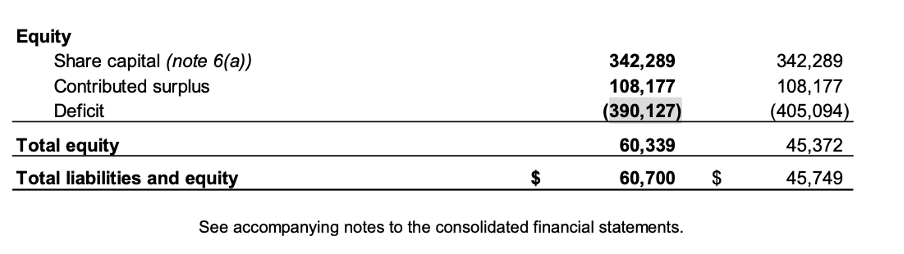
First, we need to discuss the legacy investments situation, as they are the cornerstone of Pinetree’s strategy. Pinetree reports losses amounting to 390 million CAD, which are listed under the Deficit section of the equity balance sheet.

From Q3 2024

I can hear you thinking how this could help them in any way. This deficit is very cleverly used to offset any capital gains from sales of legacy investments.

So if for example they own shares in company A and those shares are sold for a 10 million profit they will pay 0 tax and the deficit is reduced by 10 million so it will be 380 million.

The only exception is actual income but since they only operate as a holding company it’s a free way to have 0 capital gain tax until the deficit runs out.

I also consider an advantage the fact that they are not limited in any way in their investments they can invest in whatever fits their criteria. Most funds are limited by the size of the equities they can invest in; geolocation, liquidity, industry, etc., the fact that they are not gives them a slight edge over competitors.

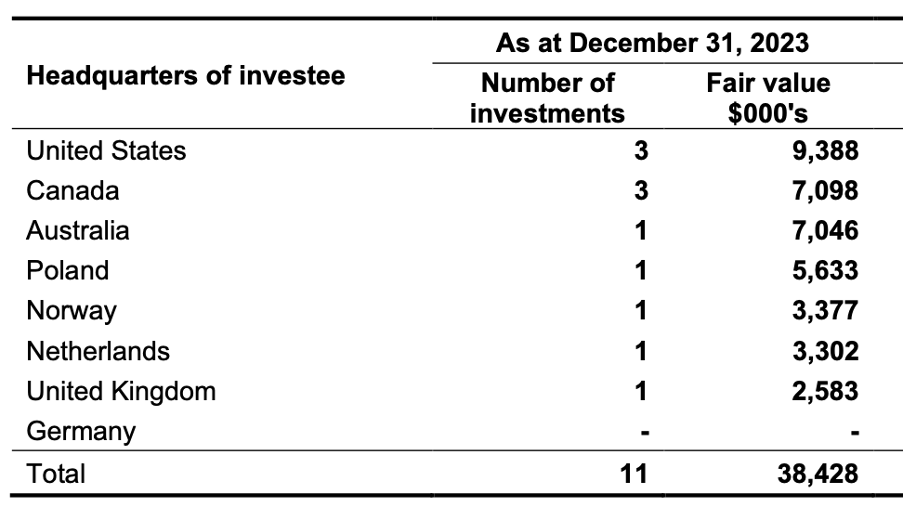
I would call this a risk-agnostic approach! We can see they have investments in the US, Canada, Australia, Poland, Norway, Netherlands, UK, and Germany where most funds are focused exclusively on the United States. However, we will analyze their stock portfolio in the next section.

It is also important that they take an approach of being more concentrated thus focusing more on quality companies with a niche twist towards companies with vertical software solutions.

I would also consider the area of expertise as a key element of their potential success. Vertical software is something I am very familiar with being a $CSU shareholder for a long time. Vertical software not only is less crowded than the broad software market, meaning you can hunt deals more easily and acquire companies at lower multiples, but you can also build expertise. As Pinetree completes deals they can develop great expertise in specific verticals inside the software market helping identify better opportunities.

I can actually write a separate article on why vertical software is one of the best areas to hunt for acquisitions. They have higher retention of clients because the software is essential to run their business thus; very strong retention, pricing power, and very long customer lifetime value. This way there’s more predictable FCF as the revenue is recurring! The retention is reinforced even further by the fact that most vertical software is tailored for the specific needs of each client, this also makes them able to command higher prices and profit margins! Not only that but also vertical software companies are very aware of specific regulations (especially in sectors like finance and healthcare) so they have a deeper understanding of the software needed from the clients further strengthening retention and a closer relationship.

I favour that Pinetree has decided to own companies operating in these niche fields within the vertical ecosystem as it can yield them great profits in a long-term timeframe.

The fact that they haven’t ever sold an investment at a loss speaks volumes of their strict criteria and discipline. It is very positive that their interest is aligned with shareholders with insiders owning 43% of the company.

Portfolio

Let’s go through their stock holdings and analyze selected ones.

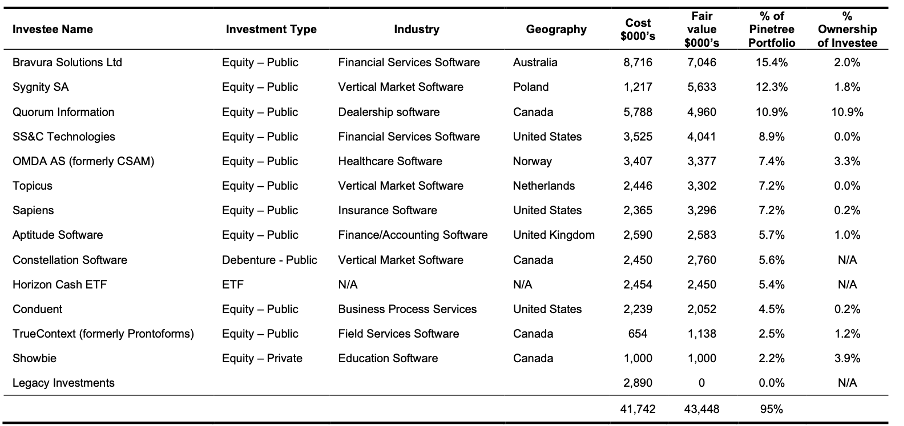
According to their fillings as of December 31, 2023, Pinetree owns 10 public equity positions and 1 private, and in the legacy section, we have 7 investments (carried over) where the company considers their real value to be 0.

Pinetree’s largest current position is Bravura Solutions, a software applications company for the wealth management and funds administration sectors in Australia; operating software to manage wealth, insurance, pensions, accounting, and more! We can clearly see the niche focus we explained earlier in the moat section.

Sygnity, the Constellation software of Poland couldn’t be missing from here of course being 12% of the portfolio. We can clearly see a theme of owning even more companies that own vertical software companies, like: Constellation Software, Sygnity, and Topicus. As stated previously they follow the recipe of Mark Leonard; their philosophy is deeply rooted in his principles. Sygnity makes solutions for Banking, Energy, and Public administration. Specifically, it makes Video and voice solutions, Telemedical platforms, document co-browsing, secure messaging, metering systems, and forecast software. Their operation is very well diversified. When it was acquired, Pinetree helped them cut down nonrecurring businesses and restructure bad debt inherited from previous owners (exactly like they did). Then Sygnity moved towards an m&a growth model to further emphasize long-term growth combined with organic growth.

Another company I was impressed with is SS&C, a company providing operating software for businesses, portfolios, taxes, and assets. It is in their words the largest independent hedge fund and private equity administrator in finance and healthcare (a main focus area of Pinetree).

OMDA is one of their best investments in the healthcare software space with solutions on LIMS (laboratory information systems), medication management, connected imaging analysis, emergency, and of course health analytics. One of the key things regarding this company is a common theme we see throughout our analysis: they are very aware of the regulations and special needs of companies in such a regulation-driven industry. A true vertical software play.

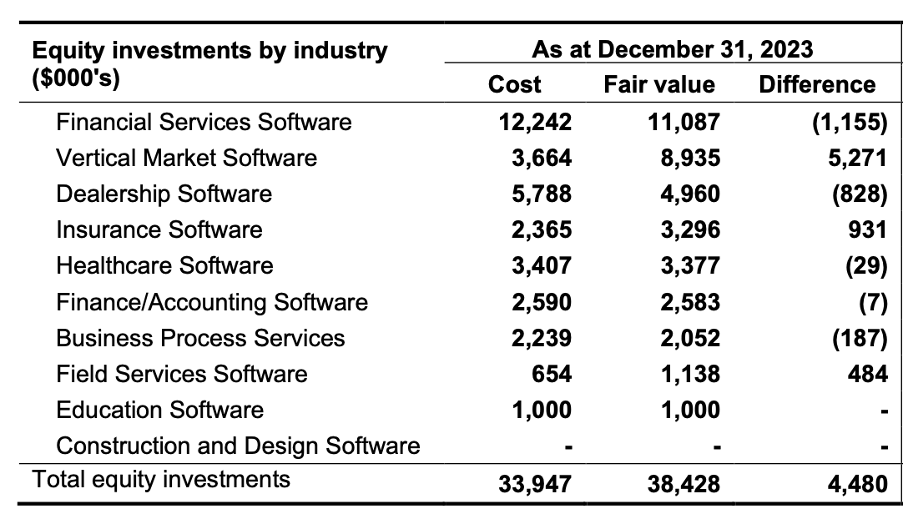
Separated by sector we can see a big focus on financial software and dealership software. They come even before vertical software.

This really intrigued me and I found the reasons why more than half of their portfolio is concentrated there.

The software breakdown goes as follows:

Pinetree Capital Annual Report, 2024

The geographical diversification goes as follows:

Pinetree Capital Annual Report, 2024

Observations

Their stock portfolio, although seems to be concentrated, is indirectly very diversified because a lot of its holdings hold multiple other vertical companies of all sizes across the world of multiple market caps. I can also observe that indeed they stick to their area of niche expertise. They have very smartly positioned themselves towards favorable long-term trends.

Final thoughts

The control leverage Pinetree can achieve due to its ties with Constellation Software, its partners like L6, and other active shareholders is commendable.

Cheers,
Alex
Simeon Research

***

Regards,
Robin Speziale
(Ownership Disclosure: $PNP – Yes)

DISCLAIMER: This content is for informational purposes only, and should not be construed as offering of investment advice or stock recommendations. This content is based on the author’s independent analysis and research and does not guarantee the information’s accuracy or completeness. The information contained in this video is subject to change without notice, and the author assumes no responsibility to update the information contained in this video. All information contained herein this video should be independently verified with the sources and companies mentioned. The author is not responsible for errors or omissions. The author does not purport to tell or suggest which investment securities viewers should buy or sell for themselves. Those viewers seeking direct investment advice should consult a qualified, registered, investment professional. The author is not a professional or financial advisor, and does not provide financial advice. Viewers are advised to conduct their own due diligence prior to considering buying or selling any stock. The author will not be liable for any loss or damage caused by a viewer’s reliance on information obtained in any of this content. It’s important to understand that investing involves risk, including loss of principal. The author is not engaged in any investor relations agreements with any of the publicly traded companies mentioned. The author does not receive compensation of any kind from any publicly traded companies that are mentioned in any of this content. The author has acquired and may trade shares of some of the companies mentioned through open market transactions and for investment purposes only. Refer to the “author’s ownership disclosure” where applicable. There may be affiliate links to Amazon, and other companies in which the author is compensated if any of the affiliate products are purchased from Amazon.ca/.com or any other companies.

How to Invest Like FRANCIS CHOU: Canada’s Value Investor (RARE 2015 INTERVIEW)

Investing

Listen to this EXCLUSIVE & RARE interview from 2015. Francis Chou (founder, Chou Associates) is Canada’s VALUE INVESTOR! An actual early investor (and past colleague) with Francis Chou, a former Bell repairmen, saw his $80,000 grow to $5 million and at the age of 80, will be worth close to $60 million if compounding returns stay consistent. Now, Chou, the deep-value portfolio manager who likes to pay 50 cents on the dollar runs over $1 billion for his loyal investors.

Francis Chou’s Value Investing Lessons:

Relating shopping in India to investing: “It was my job to make sure I was paying the lowest price for the best”

“When you read about great men and women of the past, it is like having a conversation about world affairs in your living It is not only educational but it builds perspective about life and business in general.”

“My first job is to check whether the company in question meets my investment criteria. It could be a good company, a bad company, or it could be a CRAP [cannot realize a profit].”

“I do screens, read a lot, and talk to other talented portfolio managers to see where they are seeing bargains. . . . [And] before you make a purchase, you should look for investors who are negative.”

“Whenever the majority of investors are purchasing securities at prices that implicitly assume that everything is perfect with the world, an economic dislocation or other shock always seems to appear out of the blue. And when that happens, investors learn, once again, that they ignore risk at their own peril”

“We continue to diligently look for undervalued stocks and will buy them only when they meet our price criteria — in other words, when they are priced for imperfection.”

“I’m trying to buy 80 cents for 40 cents. It does not matter whether they are good companies, bad companies, or distressed”

“You’re a businessman . . . you ask, ‘If I were to buy this company, how much would I pay?’”

“Sustainable earning power, business moats, and competitive advantage relate more closely to intrinsic value and therefore are more important than just increases in book value”

How to Invest Like Bill Ackman & Why He Loves Canadian Stocks (RARE 2015 Audio Interview)

Investing

About the Capital Compounders Show: 🚀 From public company CEOs and hedge fund managers to investors and visionary leaders who are building, financing, and investing in the newest high-growth companies, I’ll be bringing you their strategies, stories, and wealth-creation / company building tips that you can apply too!