Portfolio Management

Investing

One can learn modern portfolio theory, and still not be able to invest like the successful investor. Modern portfolio theory is the culmination of ideas that in no way correlate to investing success. Instead of modern portfolio theory, the successful investor practises good old portfolio management.

For instance, the successful investor holds only quality businesses in his portfolio. He does not diversify by industry, sector, or country. And he certainly does not rebalance asset classes. He manages quality businesses in his portfolio, in the form of equity. Bonds, gold, and GIC’s are not quality investments. The successful investor manages his portfolio like he would a holding company. He creates a consolidated report annually, consisting of his portfolio’s average revenue, net income, profit margin, and return on equity. His main focus is on both profit margin and return on equity, for he knows those two metrics determine the core growth of his portfolio.

Annually, the successful investor plots his portfolio’s capital appreciation, or price advance, against the S&P 500. He makes sure to beat the S&P 500’s total return by 5%, but is not devastated if he misses that mark. Also, he averages the dividend yield on his portfolio and calculates the dividend income he receives from his portfolio each year, while noting its annual growth. Annually, the successful investor reinvests his dividends in new holdings or shores up current holdings if valuations are attractive. And, if cash is available that was not deployed throughout the year for stock purchases, the successful investor conducts a stock screen on the S&P 500 and S&P/TSX to filter attractive stocks of quality businesses. If attractive stocks are found, he will purchase those stocks, if not, he will reinvest in current holdings. The successful investor does not succumb to investing in hundreds of businesses. He manages a focused portfolio of about 7 to 30 businesses with clear competitive advantages, and only adds businesses that will maintain his portfolio’s average profit margin and return on equity. Logically then, he does not erode his portfolio’s value.

The successful investor does not check his portfolio daily; for he knows his businesses are running smoothly and are constantly building shareholder value. Quarterly, however, the successful investor checks his portfolio for dividend income earned from the businesses he owns. This makes him happy and proud owner of these successful businesses. Moreover, the successful investor dislikes very much selling his quality businesses. If a quality business generates consistently growing income, why should he sell that business? However, the successful investor does sell a business when its underlying fundamentals deteriorate considerably, pulling down his portfolio’s profit margin and return on equity to historical lows. However, the successful investor is o.k with holding good quality businesses, for he knows his great quality businesses maintain his portfolio’s high returns. If he were to sell every great quality business that turned good quality, he would incur significant brokerage costs. Only quality businesses that are deteriorating significantly are sold.

In all, the successful investor invests in quality businesses with clear competitive advantages, reports on their performance, builds his stake in those quality businesses and invests in new quality businesses annually, watches his dividend income, not stock prices, and in turn, becomes wealthy.

– – –
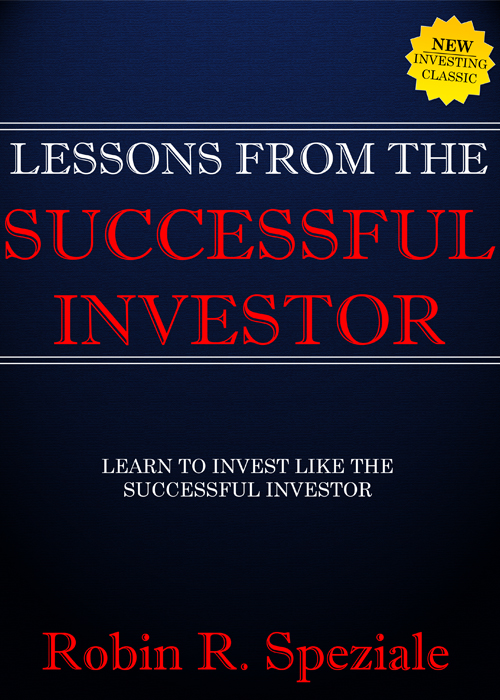
Chapter from my e-book Lessons From The Successful Investor
Available for the Kindle, Kobo, Sony e-reader, iPhone, iPad, and more
>Buy my e-book

Published My e-Book: Lessons From The Successful Investor

Investing

Lessons From The Successful Investor_cover

Cover for Lessons From The Successful Investor


My new e-book, Lessons From The Successful Investor, has been published! I wrote my e-book over the course of 4 months during the summer of 2010. It took 20 drafts, but I finished it! I thought about submitting to literary agents and publishing houses but decided to publish Lessons From The Successful Investor as an e-book. The e-book format is advantageous: low cost, mass coverage, easier to promote, and let’s face it, it’s the future of reading.

Lessons From The Successful Investor is about investing, but more importantly, how to invest successfully.

Here’s the introduction to my e-book:

Lessons From The Successful Investor will show you for the first time how to invest like the successful investor. And although his investing lessons are not revolutionary, they endure the test of time. There exist a few core lessons that underlie successful investing, and while these lessons do not change, the common investor does. For the successful investor, investing is like picking cherries.

As a gift to my readers, I will be giving away my e-book, Lessons From The Successful Investor, free for a limited time. Here are instructions to get my e-book free:

1. Go to http://www.smashwords.com/books/view/23181
2. Click Add to Cart
3. Sign up
4. Input coupon code (BA22P)
5. Download my e-book FREE

– – –
Lessons From The Successful Investor was featured in the Mississauga News.

What is a TFSA? It’s TFSA Season Again

Investing

flaherty-introduces-TFSA

TFSA stands for Tax Free Savings Account.

The TFSA is a tax shelter devised in the 2008 Canadian Federal Budget and introduced January 2, 2009.

Think of the TFSA as a money shelter. Come January 1, 2010, you can sign up for a TFSA account, if you have’nt done so already. The TFSA will let you store $5,000 per year in the shelter.

Can you invest stocks, bonds and mutual funds in the TFSA?

Yes. You can invest in the following investment products with the TFSA.

– Stocks
– Bonds (Canadian Savings Bonds are a popular choice)
– Mutual Funds
– REIT’s
– and more…

The taxman, the government, and the bank cannot touch your TFSA money or investments. No taxes will be deducted. No dividends will be deducted. No withdrawal will be charged.

If you make $10,000 from your first $5,000 TSFA investment, you are taxed $0 and left with the $10,000 gain. Outside the TFSA shelter, that $10,000 you make is taxed and a smaller $8,250* gain is left over.

Just to note, the TFSA contribution limit changes every year subject to inflation.

Read more information about the TFSA

10 Tips For Investing During a Recession

Investing

1- Buy stocks on sale. When a recession hits, investors pull out of the stock market. This leaves you the opportunity to pick up good stocks on sale. I picked up RBC at $30 and Manulife at $12.
2- Ignore the Media. Newspaper companies sell more newspapers with negative headline news. Naturally, the media will pump fear into you. Ignore this fear, and invest in stocks.
3- Remember, the economy will bounce back. Have you ever been super sick and thought you’d never get better? That’s how people think during a recession. The economy will bounce back, study historical trends.
4- Dividends will make you comfortable. Even if the stock market keeps on tanking after you invest, the dividends from stocks will make you happy. RBC sent me a 6% Dividend per quarter during the recession.
5- If you can’t stomache a 40% loss, don’t invest. Near the low point of the stock market crash – March 2009 – my stock losses amounted to 40%. But I sucked it up, and now I’m making money because I kept those stocks.
6- Don’t time the market. Warren Buffet was way off when he invested in GE and Goldman Sachs. But he’s laughing to the the bank now, with capital appreciation and annuity.
7- If you want to time the market…The stock market will reach it’s lowest point once all the unemployment, bankrupty and low earnings in the news are the WORST that can be reported. So when the media shifts focus to news like the Swine flu (as it did in March 2009) times are better for the economy.
8- If you invest, invest big. You’ll be kicking yourself in the butt if you buy 1 share in RBC when one year after the recession the return is 150% and you could have made thousands.
9- Don’t listen to your teacher. Don’t listen to teachers, analysts or politicians. They’re too busy in their ivory tower to know what how the recession is impacting the real world. If you see more people driving new cars and buying Starbucks coffee, chances are the economy is turning around. Invest.
10- Urgency to Invest. Don’t wait until the media starts reporting about good times in the economy. Invest when people are fully depressed about the economy. You know you’re too late to invest when the analysts start slapping buy ratings on every stock on the market.

Stock Market Predictions for 2009 and 2010

Investing

The stock market is a complex machine that takes many factors into account. Among the most significant are psychological factors. With 2009’s low stock price levels, the bulk of mutual funds that experienced mass redemption in 2008 are gaining confidence, figuring this may be the end of turbulence.

This positive attitude is self-fulfilling: Money Managers will begin to deploy hard kept cash reserves and pump up undervalued stocks. A herd mentality will kick in and an onslaught of mutual fund companies will follow suit and inject cash into stocks so they don’t miss the stock market boom in 2010.

However, a factor that could slow stock markets in 2010 is the still looming credit collapse. Credit for so long was the steroid that pumped up companies to disproportionate levels. The era of easy, fast credit is over and thus a new era of internal capital investment will reign.

Because internal capital investment is fueled by income a company generates and its cash flow, investments will be conservatively planned and pursued and thus growth will be slower. 2010 stock market performance will fall in line with future gradual growth of corporations. As Warren Buffet put it: “The party is over”

Good Time To Buy RIM?

Investing

Is it a good time to buy RIM stock? I’d say so. On September 25th, RIM stock took a nasty dive. Why? Investors weren’t happy with earnings forecast moving forward, doubting RIM’s business model. In my opinion, this dive is short term – RIM will bounce back. However, let’s talk long term investing in RIM.
RIM_Stock_Dive

Critics quickly justified RIM’s fall from grace September 25th, pegging the lower earnings forecast to a weakened and questionable business model. Goldman Sachs commented “The failure of RIM’s new products (Javelin and Tour) to drive similar growth in new subscriber adds compared to prior launches makes us doubt RIM’s ability to maintain share in North America,”. Goldman, like RIM’s other critics, are worried about RIM’s consumer business model, citing its consumer line of Blackberry’s as the future to bigger growth and earnings.

I do agree on some level that the consumer line can add more revenue to RIM’s operations. However, one cannot forget RIM’s core business model is the Corporate/ Government sector. And when the ecnomy picks up and the developing world continues building infrastracture and businesses, RIM will supply them. RIM will supply corporations and government in the long run because of security. RIM’s servers are rock solid. I don’t think an iPhone can live up to that same level of security.

Canadian Cell Phone Providers Uncompetitive

Investing

Walk into Bell, Telus and Rogers and the prices just hit you. Why should we pay $699 (no contract) for a Blackberry Storm? Well, I called Bell today and asked that question. The ‘customer care’ rep had no answer.

Hold on, Blackberry’s are made in Canada and we pay more to hold one than our friends to the South? But, don’t blame it on RIM, blame it on our fat, overweight, greedy cell providers… oh and the government – but that’s a different story.

Financial Post has done some recent digging and it can be safely said, the telecom industry in this country is at an appalling state. “Canada’s wireless industry is one of the weakest in the developed world”. And thats not even the kicker. Merrill Lynch ranks current Canadian wireless penetration at 65% – just ahead of Indonesia and Iraq. Just ahead of Indonesia and Iraq? Wow.

So, what this means it that we’re getting screwed. Among developed nations Canada ranks dead last in penetration, meaning that competition is extremely low in this country. And we pay a higher price because of this fact.

So what does this mean for Bell, Telus and Rogers stocks? Well, for now they are riding high but at the same time shaking in their boots. Why? Because a group of new wireless providers are ready to crash their party.

Soon you’ll be seeing ads for Globealive, Shaw, Quebecor selling phones to you. Take a peak at Globealive’s Wind Mobile website – they actually want to treat us as PARTNERS, not lowly, desperate customers.rim-blackberry-bold.

In 2008, Canada held a spectrum auction, meaning the federal Government put wireless space up for sale. So, companies jumped on the opportunity, bid on wireless regions in Canada, some coming out as nation- wide wireless providers and others not.

I have a long term sell on Bell, Telus and Rogers. At the moment they’ll suck as much money out of us until the party ends. Wireless Intelligence indicated that as of the end of Q1 2009, profit margins for Canadian wireless providers were amongst the highest in the developed world – about 44%. Theres no stopping them from selling us $699 Blackberry’s… until the new kids in town arrive. Look forward to healthy competition, lower prices, better phones in the near future.

Analysts will put an axe through Rogers, Telus and Bell, once profit margins on wireless divisions are squeezed due to increased competition. But analysts aside, we – consumers – will determine the fall of these behemoths.

Does Increase in Starbucks Spending Mean the End of Recession?

Investing

starbucks

I have seen more and more people drinking Starbucks. Does this signal the end of the recession?

When the financial crisis hit the U.S. , Starbucks suffered from cut back in consumer spending. In the news, reporters claimed consumers slashed Starbucks coffee from their daily routine in order pay off credit cards, fill up gas, and buy groceries.

So logically, an increase in Starbucks spending should mean that consumers are again confident in the economy and their financial status, thus signalling a broader trend in increased consumer spending i.e. cars, houses that will thrust us out of recession for good.

Invest in Starbucks.

Warren Buffets Investing Lessons from Financial Crisis 2008

Investing

Warren_Buffet

Warren Buffet. Investor extraordinaire and one of the rishest individuals in the world. He is also one of the calmest individuals in the world. The financial crisis 2008 did not sway him like many investors, politicians etc. In fact, Warren Buffet was so confident in the strength of the U.S. and world economy that he plowed money into GE, Goldman Sachs and BYD near the low point of the financial crisis.

I like Warren Buffet’s lesson here. Buy stocks when the market is at a low point. The credo to buy low and sell high is very important to investing. Warren Buffet hits it home when he says: “Be fearful when others are greedy and greedy when others are fearful”. With Buffets logic, when investors are greedy stocks are inflated and when investors are fearful stocks are low.

Another Buffet investing lesson comes from what stocks he invested in during the financial crisis. Is every stock out there a good buy when the stock is low? No. Buffet would be the first to stress a stock is literally a piece of a company. And if you buy a piece of a terrible company, you own a piece of a terrible company. GE, Goldman Sachs and BYD are great companies. Warren Buffet scored by investing in these stocks when prices were depressed.

My Top 10 Investing Tips

Investing

My Top 10 Investing Tips are the result of 6 years of investing. I have made many investing mistakes, but learned a solid set of investment principles in return. Below are my top 10 Investing Tips:

(1) Invest in companies you know
(2) Invest in companies that will grow in the market
(3) Invest in companies that can raise prices and people will still buy
(4) Don’t invest in popular stocks or fads, fads die hard. i.e. Croc’s, Heely’s
(5) Research companies news and financial statements before you invest
(6) Use logic when investing, leave emotion at the door
(7) Keep your portfolio of stocks focused, don’t invest in over 30 stocks
(8) Invest in a stock only if you would you buy the entire company
(9) Invest for the long-term, the tortoise won the race.
(10) Look for companies with worldwide brand presence i.e. Apple, RIM