13 Investing Lessons From Kiki Delaney of Delaney Capital Management

Investing

SubscribeSubscribe Now to My FREE Newsletter (Join 5,000+ Subscribers!)
My full interview with Kiki Delaney of Delaney Capital Management originally appeared in my national bestselling book, Market Masters, which is available at Chapters, Indigo, and Coles as well as Costco and Amazon.ca.

***

I was referred to Kiki Delaney through someone I met after my interview with Gaelen Morphet. “Alex, come meet Robin,” said Gaelen to an employee passing by our interview room at the Empire Life offices. “Alex is one of the brightest stars at the firm.” Alex, a relatively junior employee, glowed at the praise. After all, Gaelen is a senior executive. Alex is around the same age as me and we found that we shared the same perspective on the market. So, we decided to meet some weeks later for coffee at Aroma Café in downtown Toronto.

Alex was excited to hear about this book. After reading my list of Market Masters to him I asked Alex, “Am I missing anyone?” to which he said, “Yeah,” and offered a couple of names. Upon further research there on my smartphone, one individual he had mentioned resonated with me: Kiki Delaney. How had I missed Catherine “Kiki” Delaney? Her firm, Delaney Capital Management, boasts $2 billion in assets under management, with a track record that spans more than 20 years. So, my next email, which I hammered out as soon as my meeting with Alex ended, was a direct request to Kiki: “Would you like to be featured in Market Masters? It would be an honour to have you be a part of the project.” I was delighted, and grateful to her and to Alex, when Kiki said yes.

SubscribeSubscribe Now to My FREE Newsletter (Join 5,000+ Subscribers!)

In the meeting room for our interview, a statue of a defiant bull stood tall over a defensive bear. That statue was especially appropriate since negative news seemed to be hitting the global markets on a daily basis in the first half of 2015 — Greece, China, Oil, the Fed, and so on. I stared at that statue and thought, “Will the bull be too weak to continue to assert its market dominance? Will the bull market finally succumb to the tail risks?” I would soon get reassurance from Kiki that those factors should not matter, that investors must continually find value in the market regardless of whether the bull or the bear reigns supreme.

An important concept that Kiki conveyed is to invest in relative value. For example, while the broader market, industry, or peer group can be overvalued, a particular stock within any of those domains can still be fairly valued or undervalued. Sometimes, the market and stocks within that market are mutually exclusive, in that returns of the market are not always perfectly correlated with all of its constituents. For instance, today, while the broader market can be down, some of your stocks may in fact be up. And that inverse correlation, among other factors, could be because those stocks were relatively cheaper than the broader market at the time, and did not join the market sell-off. Separately, Kiki shares her opinion on which is the more challenging asset class to manage in a portfolio: equity(stocks) or debt (bonds).

Kiki succeeded early on in an industry that was even more maledominated than it is now. As a young adult, she moved to Toronto, where there were more opportunities, not just for women, but in general in the job market. Kiki got her start at Merrill Lynch before moving to Guardian Capital, where she managed equity and fixed-income portfolios. Prior to founding Delaney Capital Management (DCM), Kiki was a partner, executive vice-president, and portfolio manager at Gluskin Sheff + Associates. Interestingly, Martin Braun, whom I also interviewed, filled Kiki’s role as Canadian equity manager at Gluskin Sheff.

With the success of DCM, Kiki became one of the most powerful women on Bay Street. In addition to DCM, Kiki is chancellor of OCAD University, a member of the board of trustees for the Hospital for Sick Children, chair of the investment and pension committee at the Hospital for Sick Children, and a member of the Leadership Council of the Perimeter Institute for Theoretical Physics. And she was appointed a member of the Order of Canada in 2006. The Governor General of Canada wrote this of her: “After a steady rise through major investment houses, she launched her own investment counselling firm, one of the first women in Canada to do so.” Kiki Delaney is a trailblazer.

SubscribeSubscribe Now to My FREE Newsletter (Join 5,000+ Subscribers!)

Kiki Delaney’s 13 Investing Lessons:

1) “Some of the best calls I have made involve avoiding disasters.”

2) “It is easier to pick great companies than to make the macro calls required to manage fixed-income portfolios.”

3) “When we look at a company we compare it to others in the same industry and buy the company that is statistically the cheapest. . . . We want companies that are cheap but also are well managed, have a strong growth profile, have a good product, and where there is the catalyst for change to unlock value.”

4) “If the industry fundamentals are strong and the valuations are appealing, then it makes sense to buy more than one company in the sector.”

5) “We look for catalysts for change . . . a catalyst can be a management change, a new product, an acquisition, or a de-leveraging of the balance sheet.”

6) “The reality is that the Canadian market is two-sided. You have on the one hand resource names, and then on the other hand, you have everything else.”

7) “[On the TSX] there’s also a lot of world-class international companies. Funnily, a lot of them reside in Quebec . . . Quebec companies get positive reinforcement. In many cases, the Caisse de dépôt takes a fairly substantial position in underwriting companies to help them expand through very large acquisitions.”

8) “I think companies should buy their stock back when it is fundamentally cheap. Not every month, or every year. I find it troubling that companies have nothing better to do with their cash.”

9) “[We] invest initially no more than 1% in a small-cap company. If it works, it’s probably really going to work, and it’ll be very beneficial. But if it doesn’t work, it will hurt the portfolio to the extent of its 1% exposure.”

10) “As long as a company continues to represent good value and has decent capital gain potential, we will continue to hold it.”

11) “If you can find a relatively undiscovered theme and marry it with a well-managed and undervalued company, you will probably have a winning combination . . . [for example] companies that make significant and highly accretive acquisitions. This has worked really well in a low-interest environment.”

12) “Declining interest rates are positive. Once interest rates start to go up, they do hit a point where they shut off the economy and that clearly is not good for the stock market.”

13) “You have to read as much as you can. And you have to be as informed as you can be. You don’t want to buy cocktail tips. It doesn’t work.”

SubscribeSubscribe Now to My FREE Newsletter (Join 5,000+ Subscribers!)

MarketMasters

Robin Speziale is the national bestselling author of Market Masters, which is available at Chapters, Indigo, and Coles as well as Costco and Amazon.ca. He lives in Toronto, Ontario. Learn more about Market Masters.

20 Biggest Canadian Family Owned Businesses in the World

Investing

Post - CC

SubscribeSubscribe Now to My FREE Newsletter (Join 5,000+ Subscribers!)

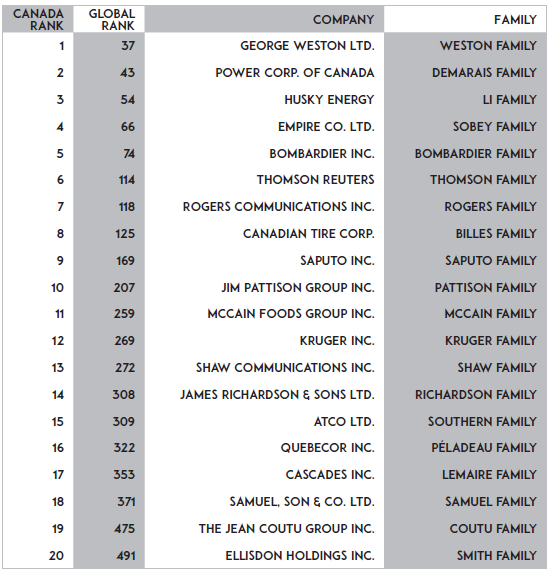
The University of St. Gallen’s Center for Family Business in Switzerland conducts an annual study, the Global Family Business Index, that ranks the world’s five hundred largest family-controlled firms by revenue. The study concluded that “of the world’s five hundred biggest family-owned or -controlled firms, 20 are Canadian.”

Most of these Canadian family owned business are publicly traded on the Toronto Stock Exchange (TSX), meaning that you can invest directly in these companies by purchasing their common stock through a brokerage.

CanadianFamilyOwnedBusinessesStocks.png

Source: Global Family Business Index. Center for Family Business, University of St. Gallen, Switzerland. 2015.

SubscribeSubscribe Now to My FREE Newsletter (Join 5,000+ Subscribers!)

MarketMasters

Robin Speziale is the national bestselling author of Market Masters, which is available at Chapters, Indigo, and Coles as well as Costco and Amazon.ca. He lives in Toronto, Ontario. Learn more about Market Masters.

10 Investing Lessons From Charles Marleau of Palos Management

Investing

become_a_patron_button

Become a Patron Now to Access My Exclusive Content – Top Performers, Portfolio, Watchlist.

My full interview with Charles Marleau of Palos Management originally appeared in my national bestselling book, Market Masters, which is available at Chapters, Indigo, and Coles as well as Costco and Amazon.ca.

***

Charles Marleau was born into the investment world. His father, a prominent capital markets pioneer, groomed him to be a financial whiz kid. When he was 25, Charles started the Palos Management hedge fund with his father. Since its inception in 2001, the Palos Income Fund has beaten the TSX benchmark 11.51% versus 7.69%. In 2014, it was a second-place winner in three categories of the 2014 Canadian Hedge Fund Awards: Best One-Year Return, Best Five-Year Return, and Best Five-Year Sharpe Ratio. The fund’s objective is to deliver trading-enhanced returns, in order to outperform the TSX, but with less risk. It achieves this objective through investing in a core portfolio of select Canadian high-grade and undervalued dividend-paying stocks, preferred stocks, bonds, and convertible bonds. Charles seeks to enhance the returns in his fund by opportunistically engaging in merger arbitrage, pair trades, statistical pair trades, and selling covered calls.

I must have caught Charles in the middle of an important trade, as he hurried our telephone conversation. His advice, therefore, was short but sweet.

Charles Marleau’s 10 Investing Lessons:

1) “What I’m really after is companies that can generate a tremendous amount of cash and grow that cash flow year after year.”

2) “Our ultimate goal has been to always outperform the market with lower volatility — less risk.”

3) “The index is broken up into industries. Our goal on the macro side is to identify which industry in the index will outperform in upcoming years.”

4) “We also make sure that the company can sustainably pay that dividend or distribution. They must have a very strong balance sheet.”

5) “One of the strategies is pair trading . . . we look for companies that have very similar products, and then determine which one we want to own, and which one we’re going to short. We’re removing the market risk or systematic risk.”

6) “At times, a company that we fundamentally like sells off aggressively. We’ll accumulate that company and then short the other company that has weaker fundamentals. The company that we go long on should revert back to its average in the correlation.”

7) “Canadians, as you know, have their wealth in two places: in their houses, and in their RRSP accounts. After that there is really no other disposable cash or investments.”

8) “[For evaluation] we look at how much cash they generate, historical performance, and earning power in the good times and the bad times.”

9) “Exiting a position is probably one of the harder disciplines. We have a good idea of [companies’] historical standard deviation, meaning whether the current price is expensive or cheap compared to the past.”

10) “You should not invest in equity for just three months. You’re investing for the long term to create wealth. People basically look at these stock tickers and make very irrational decisions, rather than looking at the fundamentals and the company’s DNA.”

MarketMasters

Robin Speziale is the national bestselling author of Market Masters, which is available at Chapters, Indigo, and Coles as well as Costco and Amazon.ca. He lives in Toronto, Ontario. Learn more about Market Masters.
19 Investing Lessons From Ryaz Shariff of Primevestfund

Investing

My full interview with Ryaz Shariff of Primevestfund originally appeared in my national bestselling book, Market Masters, which is available at Chapters, Indigo, and Coles as well as Costco and Amazon.ca.

***

Ryaz Shariff journeys through jungles in far-off countries in search of valuable assets. Does that pique your interest? As you’ll learn from our interview, Ryaz is something of an Indiana Jones in the investment world. Some may say that Ryaz is too hands-on in his running of Primevest Capital, but his fund, Primevestfund, has not only survived the prolonged commodities bear market and recent oil price collapse, but has managed
to beat the market since 2005, with a 10% compound annual return.

Being a commodity investor in 2015 is a very lonely proposition. The commodity bear market that started in 2011 has yet to abate, and commodity-era darlings such as Sprott Asset Management have struggled. Ryaz, though, has managed to stay much more versatile. Aside from investing within his core expertise, which is the junior and mid-size mining market, he mandates that his fund remain flexible, which is to say that he adjusts Primevestfund’s investment strategy to reflect the prevailing market conditions. This means taking advantage of non-resource special situations, including large-cap mergers as well as employing short-selling in down markets. Today, over one-third of the fund is in the non-resource sector.

While Ryaz insists that common investors cannot achieve comparable success in the junior and mid-size resource market because they lack “deep domain expertise,” there have always been instances of average-joe stock-pickers who make outsized returns from resource booms. One such example is a family friend of mine, Robert Hirschberg, the owner of a sports apparel company who resides in Toronto. Robert parlayed $20,000 into $15,000,000 by speculating in junior mining stocks throughout the 2002–2007 commodity bull market in Canada. While this anecdotal evidence should bring you some hope, I caution that one should wait until the commodity cycle turns up before investing in this sector or else risk outsized losses. A (grizzly) bear market can be mean. As Ryaz explains
in his most recent fund letter, “As we continue to experience one of the longest resource bear markets in history, we have maintained a disciplined focus on building further expertise within the sector, so when the fund flows return, as is now already becoming evident in small ways, we will be the premier hedge fund in the country to benefit.”

I am not as well-versed in the resource sector as I invest in the nonresource sector of the market. Thankfully, Ryaz was both gracious and accommodating. Our interview was over the telephone, with me in Toronto and Ryaz in Vancouver. Ryaz’s responses were short and to the point.

Ryaz Shariff’s 19 Investing Lessons:

1) “We’d rather invest in exceptional management teams than in ordinary ones. Businesses always have hiccups, but management teams that are exceptional entrepreneurs always figure a way around those issues to create value.”

2) “Most of the names that you find inefficiencies in are ones that the market hasn’t followed or that have been orphaned for some reason.”

3) “Identifying the under-followed small-cap businesses is the first part of the treasure hunt; thereafter, you must figure out what catalysts will drive multiple expansion.”

4) “If management creates value from efficient capital allocation, the asset becomes attractive for larger companies with depleting asset bases to consolidate, at premium values. One of the major challenges of a large company that’s pressured to grow is the replacement of that declining asset base.”

5) “This type of investing [in advanced-stage resource development assets] can be very volatile but there’s no better risk-to-reward relationship if you can get it right.”

6) “We don’t try to forecast commodity prices themselves but rather use long-term consensus estimates to model into these opportunities.”

7) “Commodities are generally the focus in the late stage of economic cycles. When the metals cycle eventually turns, you tend to see multi-fold returns.”

8) “We’re not really looking to forecast when the cycle turns because I don’t believe anyone can. The velocity of money in today’s world is so fast that you can’t really figure out the bottom of cycles, the top of cycles, and the turn of cycles.”

9) “[The ideal energy and production company] has no debt, can maintain their production without going into debt at current low oil prices, and when oil prices move upward, it becomes a go-to name.”

10) “The actual cycle works like this: demand exceeds supply; capital is approved to develop supply; commodity prices increase in value till new supply comes on-line; supply exceeds demand; commodity prices decrease; non-profitable supply comes off-line and then we wait for demand to exceed supply again.”

11) “While demand will be volatile in the short term, the long-term demand will be reasonably sustainable.”

12) “If you can get involved when you see political change occurring within a resource market, then there are usually significant returns to be made.”

13) “The two most important ingredients to look at are the demand/ supply fundamentals and institutional fund flows.”

14) “The resource markets are generally a small market so when institutional funds flow into the sector it can have dramatic effects.”

15) “We always have a hedge in place: the ability to short positions. It’s used to insulate some portion of the systematic risk within the portfolio.”

16) “We’ve had some great wins and they tend to be accentuated by the cyclicality of the sector.”

17) “With resource investments, not only do we want the principal asset undervalued, we also like to see additional ‘blue sky’ in another asset or business line that we get for free.”

18) “Some people argue that those small, single-asset companies are riskier, but I could argue that they’re less risky because we understand those deposits better than a larger company that has 20 different deposits.”

19) “If you look at the history of the Venture Exchange, you’ll see immense upticks and immense downticks. . . . Bear markets tend to have violent moves both up and down.”

MarketMasters

Robin Speziale is the national bestselling author of Market Masters, which is available at Chapters, Indigo, and Coles as well as Costco and Amazon.ca. He lives in Toronto, Ontario. Learn more about Market Masters.

17 Investing Lessons From Martin Ferguson of the New Canada Fund

Investing

SubscribeSubscribe Now to My FREE Newsletter (Join 5,000+ Subscribers!)

My full interview with Martin Ferguson of the New Canada Fund originally appeared in my national bestselling book, Market Masters, which is available at Chapters, Indigo, and Coles as well as Costco and Amazon.ca.

***

Martin Ferguson is the small-cap king of Canada. That said, he’s surprisingly humble about it. Martin’s New Canada Fund has achieved a 13.7% compound annual return over a 10-year period, and an annualized 15-year return of 16.5% compared with the median 10.7% return in the Canadian Small-/Mid-Cap Equity category as tracked by Morningstar. In 2013, the New Canada Fund posted an impressive return net of fees of 49.4%. Assets under Martin’s superb management are above $1 billion.

Surprisingly, though, Martin still didn’t feel worthy of being interviewed. He assumed Jason Donville recommended him to me to be interviewed, but I had known about Martin’s exceptional market performance for years. “I would be pleased to talk to you and answer your questions, if only to determine if I am ‘Master’ material. I value Jason’s opinion on many investment topics but his recommendation [of including me in your book] may be beyond his area of genius,” said Martin.

I responded almost immediately with this list of why I had independently, and irrefutably, included Martin in the Market Masters roster:

• Thirty-three years in the investment industry
• Market-beating returns at Mawer New Canada Fund since its inception
• Best Canadian Small-/Mid-Cap Equity Fund at the 2012 Morningstar Canadian Investment Awards
• Analysts’ Choice Award as the Best Small-Cap Canadian Equity Fund in 2002, 2003, and 2004
• Morningstar Domestic Equity Fund Manager of the Year

Thankfully, Martin finally agreed to be featured in this book. Although his process for picking small-cap stocks is not necessarily unique, it is rigid and scientific and thus not easy to implement on the first go. For example, we discussed the significance of internal cost of capital. Martin primarily employs the return on invested capital or ROIC metric to valuate stocks, and will favour companies where ROIC is greater than their internal cost
of capital. From there he overlays various other models, admittedly more advanced and again increasingly difficult to implement for the beginner investor. The formulas we discussed may seem complex at first. But my recommendation is to work through those formulas with actual stocks (for example, try them with Bell Canada). As the saying goes, practice makes perfect.

During the interview, I asked Martin to compare and contrast his approach to Jason Donville’s preferred ROE (return on equity) valuation method. His reply is food for thought. Finally, you’ll learn that Martin has a golden touch that transforms not only his small-cap stocks into winners, but also his entry-level employees into top performers.

SubscribeSubscribe Now to My FREE Newsletter (Join 5,000+ Subscribers!)

Martin Ferguson’s 17 Investing Lessons:

1) “We focus on companies that can generate a return on invested capital greater than their cost of capital over time. Companies that create cash flow that in turn generate wealth.”

2) “ROIC takes into account the fact that companies can use debt and it also gives an idea of the overall return of the business rather than the equity.”

3) “Cost of capital is determined by the risk of the company. The higher the risk, the higher the cost of capital.”

4) “We have set up our own discounted cash flow models in order to determine intrinsic value. Those models go out 15 years.”

5) “We’re not looking at today’s P/E; we’re looking at its internal rate of return. When you conduct a discounted cash flow analysis on a company, you figure out what cash flows it will generate into the future.”

6) “Management has to allocate capital, grow revenue, control cost, and control risk — four jobs.”

7) “If [management is] not using that cash flow wisely, putting it to low return or inefficient uses, then they can destroy capital so quickly.”

8) “The first thing you must realize is that Canada essentially is a small-cap market. There are very few large-cap companies in Canada.”

9) “I look at companies from $100 million market cap up to about $1.5 billion market cap. And there’s approximately four hundred of those small-cap stocks in the market today.”

10) “Investing is a loser’s game; what we try to do is put probabilities in our favour by sticking to our process, which means valuing companies based on their ability to generate wealth. In this industry there’s no such thing as perfection.”

11) “As a generalization, [commodity companies] are riskier. They are price takers. They sell a commodity. Commodity means undifferentiated product. So, yes, they lack that pricing power.”

12) “A lot of managers won’t invest in a company until they’re a certain size. By the time they grow to a certain size, the run may be done.”

13) “We will work to emphasize those [stocks] that have the best opportunity to provide the highest return on a risk-adjusted basis. [But] as stocks go up in price, and the potential return falls, we actually look at deemphasizing them in our portfolio [and] invest in whatever other sectors look more attractive.”

14) “We hold on average 40 to 60 stocks. To get there, what we consider a full position is a 3% weight. So in other words, in order to create a diversified portfolio, we assume we need about 33 companies.”

15) “We also have what we call ‘confidence weight,’ when we have a higher degree of confidence that any company will do well.”

16) “I believe that there are opportunities in the small-cap area that exceed those in the large-cap area, offset by higher risk.”

17) “If we focus on the companies that have built the business, that are actually generating revenues, that are actually producing cash flows, that are actually generating return, then there’s a lot of opportunity in the small-cap market.”

SubscribeSubscribe Now to My FREE Newsletter (Join 5,000+ Subscribers!)

MarketMasters

Robin Speziale is the national bestselling author of Market Masters, which is available at Chapters, Indigo, and Coles as well as Costco and Amazon.ca. He lives in Toronto, Ontario. Learn more about Market Masters.

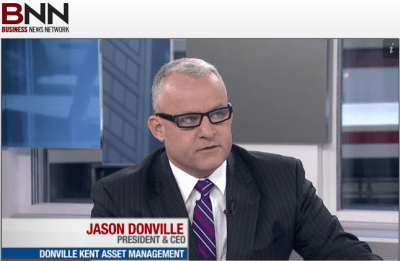
22 Investing Lessons From Jason Donville of Donville Kent Asset Management

Investing

Post - CC

SubscribeSubscribe Now to My FREE Newsletter (Join 5,000+ Subscribers!)

My full interview with Jason Donville of Donville Kent Asset Management can be found here and originally appeared in my national bestselling book, Market Masters, which is available at Chapters, Indigo, and Coles as well as Costco and Amazon.ca.

***

Jason Donville’s 22 Investing Lessons:

1) “You can get the macro thesis right but still not get the stock picks right.”

2) “If I’m adding to a position or subtracting from a position, I don’t want the market to know. Because I don’t want people to front-run me.”

3) “Where the growth of the world is coming from is new product development in knowledge-based industries. Whereas 99% of us already have chesterfields and maybe 1% of us are going to replace our chesterfield.”

4) “Think about the market as a baseball game. Let’s say there’s nine innings in the game. We’re now six years into this bull market. You never know until it’s over, but we’re probably in the seventh or eighth or ninth inning of the baseball game. That’s usually a bad time to own financials.”

5) “The time to buy financials is after the market’s been crushed.”

6) “We base decisions on adjusted ROE as opposed to stated ROE because the stated ROE doesn’t take into account the difference in the dividend policies of all these different companies.”

7) “First we look for companies with ROE greater or equal to 20%. Second, we look for companies in that high-ROE group that are sustainable based on the competitiveness of their products. Third, we assess management’s ability to allocate capital at those companies. Once we validate those three things, we typically find companies that we can invest in.”

SubscribeSubscribe Now to My FREE Newsletter (Join 5,000+ Subscribers!)

8) “Return on equity can be broken down into three pieces through DuPont analysis. You’ve got good ROE and bad ROE. We want to make sure that the ROE is good ROE.”

9) “You can fake good ROE in one year. But to achieve high ROE seven years in a row is tough. . . . So when I see a company that has achieved an ROE of 23, 22, 23, 24, 23, 22, over the past seven years, without even knowing what industry they’re in, I go, ‘Wow! There’s something in place here.’”

10) “If you’re thinking of investing in two companies and you run the numbers over the last seven years on both companies and you put them side by side, the good company will leap off the page at you.”

11) “The great enemy of a high-ROE company is competition.”

12) “Most of the companies we own have people running them that are very good capital allocators. Because if you can keep your ROE over 20% year after year, you almost by definition are a good allocator.”

13) “Our biggest tool for risk mitigation right now though is put options on the TSX. That’s an insurance policy. That won’t protect me from a 30% correction but it should protect me from a 10% correction.”

14) “In Canada, the mid-cap segment is probably the most inefficient part of the market.”

15) “Measuring growth in terms of return on equity and book value per share is a better methodological way than measuring growth in terms of earnings per share.”

16) “If you focus on companies where the net worth of the business is growing at a very steady clip then the share price chart will take care of itself as long as the ROE stays intact.”

17) “If you’re a good stock-picker, concentration works in your favour, and if you’re not, you should own an ETF instead.”

18) “We don’t buy turnarounds. It might be because we don’t have the muscle. We wouldn’t own enough stock to be able to push for a turnaround.”

19) “I continue to look for great companies that are fair price as opposed to cheap stocks.”

20) “If you want to be a great investor, then study the great investors and pick one that fits your style and then master that style.”

21) “Your style of investing has to fit your personality type.”

22) “I’m buying awesome companies and just hoping that they’ll be awesome forever. I get to hang out with the really great CEOs all the time as opposed to having argumentative discussions with mediocre CEOs who aren’t doing a very good job running their companies.”

SubscribeSubscribe Now to My FREE Newsletter (Join 5,000+ Subscribers!)

MarketMasters

Robin Speziale is the national bestselling author of Market Masters, which is available at Chapters, Indigo, and Coles as well as Costco and Amazon.ca. He lives in Toronto, Ontario. Learn more about Market Masters.

19 Investing Lessons From Francis Chou of Chou Associates

Investing

become_a_patron_button

Become a Patron Now to Access My Exclusive Content – Top Performers, Portfolio, Watchlist.

My full interview with Francis Chou of Chou Associates can be found here and originally appeared in my national bestselling book, Market Masters, which is available at Chapters, Indigo, and Coles as well as Costco and Amazon.ca.

***

Francis Chou’s 19 Investing Lessons:

1) Relating shopping in India to investing: “It was my job to make sure I was paying the lowest price for the best quality.”

2) “I contrast the current scenario to the scenario in 1981. Everyone is so bullish but I’m really negative.”

3) “I didn’t know the market was going to take off in six months [in 1981], but I knew you couldn’t get stocks any cheaper than their prices at the time.”

4) “When you read about great men and women of the past, it is like having a conversation about world affairs in your living room. It is not only educational but it builds perspective about life and business in general.”

5) “My first job is to check whether the company in question meets my investment criteria. It could be a good company, a bad company, or it could be a CRAP [cannot realize a profit].”

6) “I do screens, read a lot, and talk to other talented portfolio managers to see where they are seeing bargains. . . . [And] before you make a purchase, you should look for investors who are negative on the stock.”

7) “I just go wherever I can find bargains. For instance, in the years 2000 to 2002, I was basically in distressed bonds. I just go wherever I can find something undervalued.”

8) “Whenever the majority of investors are purchasing securities at prices that implicitly assume that everything is perfect with the world, an economic dislocation or other shock always seems to appear out of the blue. And when that happens, investors learn, once again, that they ignore risk at their peril.”

9) “We continue to diligently look for undervalued stocks and will buy them only when they meet our price criteria — in other words, when they are priced for imperfection.”

10) “Initially I analyze bottom-up and then I go top-down.”

11) “Most investors invest in terms of premium or discount to book value. That is a serious mistake. Let’s say the year was 2006. You examine the loan portfolio [of a bank] and see all the junk there. As a result, you wouldn’t touch a U.S. bank with a barge pole.”

12) “I’m trying to buy 80 cents for 40 cents. It does not matter whether they are good companies, bad companies, or distressed companies.”

13) “The first thing you have to do in this business is to make sure that your valuation is accurate. If your valuation is wrong . . . then you won’t make it in this business.”

14) “You’re a businessman . . . you ask, ‘If I were to buy this company, how much would I pay?’”

15) “I don’t know what will happen two years from now where there could and probably would be newer technology.”

16) “I don’t want to chase businesses where management is making decisions that don’t make economic sense.”

17) “Sustainable earning power, business moats, and competitive advantage relate more closely to intrinsic value and therefore are more important than just increases in book value.”

18) “Investments are most profitable when the selection process is most businesslike. Therefore, you must have the skill level to evaluate a business.”

19) “You have to go against the grain. You have to do your own independent work, your own analysis, and you stand on the merits of your own judgments.”

MarketMasters

Robin Speziale is the national bestselling author of Market Masters, which is available at Chapters, Indigo, and Coles as well as Costco and Amazon.ca. He lives in Toronto, Ontario. Learn more about Market Masters.

17 Investing Lessons From Jeff Stacey of Stacey Muirhead Capital Management

Investing

My full interview with Jeff Stacey of Stacey Muirhead Capital Management originally appeared in my national bestselling book, Market Masters, which is available at Chapters, Indigo, and Coles as well as Costco and Amazon.ca.

***

Jeff Stacey was waiting for me in the Gold Room at the Royal York Hotel, reading the Financial Times and sipping coffee from a white china mug. Nobody else was around him in the classically appointed room that brought to mind images of captains of industry from years past congregating to shape Canada’s economy. It’s hard to fathom now that the Royal York was once downtown Toronto’s tallest building.

It wasn’t officially spring just yet, but the sun was piercing the window onto the table at which Jeff and I would sit and chat. It was so bright that I would later draw the blinds. Jeff was visibly eager to talk to me about his passion: value investing. I was eager, too, as Jeff has been successfuly practising value investing since founding Stacey Muirhead Capital Management in 1994, and is a friend of Prem Watsa, a notable value investor. Days after our interview, he would host the question and answer segment of Prem Watsa’s Fairfax Financial Value Investing Dinner Gala.

Jeff Stacey has learned value investing from both the experiences and writings of super investors such as Benjamin Graham, Warren Buffett, and Sir John Templeton. Over time, he has identified the following enduring value investing principles, which he judiciously applies to all of his long-term investment efforts:

• Think about stocks as part ownership of a business
• Maintain the proper emotional attitude
• Insist on a margin of safety
• Do not diversify excessively
• Invest for the long term

Jeff looks for companies with outstanding business economics that are run by capable and honest managers and that are available at attractive prices. He describes this concept simply as “Great Business, Great People, Great Price.” Jeff also has some great stories on event-driven investments. Specifically, he explained how he profited from Starbucks’ acquisition of Teavana amidst the threat that that deal could have blown up.

Jeff Stacey’s 17 Investing Lessons:

1) “We’re trying to estimate intrinsic value, we’re trying to buy with a margin of safety to that intrinsic value, and we’re trying to be rational and patient in all that we do.”

2) “Event-driven transactions are the pursuit of profits from announced corporate events. So that’s liquidations, mergers, acquisitions, recapitalizations, tender offers, anything where you can say, ‘Okay, if this event happens we’re going to make this amount of money in this amount of time.’”

3) “We will consider bonds that are high-yield because there’s a perception that the companies aren’t going to be able to keep paying, so the analysis is all around why we believe that they’ll be able to keep paying.”

4) “We’re not afraid to let the cash build up when we have more money than good ideas.”

5) “We’re not trying to guess on which company is going to get taken over. It’s a matter of public record.”

6) “Every big merger is widely reported on. From an informational point of view there’s certainly more awareness about mergers than anything else.”

7) “If you knew as a certainty that something could grow 50% a year for a long period of time, of course it’s worth more than seven times earnings.”

8) “The deep-value guys will state, ‘I want to buy something at a discount to book with a dividend yield and a single-digit price earnings multiple.’ You know, that’s probably a great price for a rotten business. But if it’s a better business you can pay more.”

9) “Value depends on the quality of the merchandise. The trick in what we do is to invest in enduring, high-quality businesses that can last for a long period of time.”

10) “We spend a lot of time trying to understand the qualitative competitive advantage that a business has.”

11) “The mistake that the good business buyer will make is he’ll pay too much for something that he or she thought was a really great business that turned out not to be a really great business.”

12) “There could be hidden assets. For example, real estate that is on the books for next to nothing but could be sold to unlock huge value.”

13) “The asset-light management company is generating these recurring service fee revenues from this hotel. That’s a classic example of a business that from a balance sheet point of view doesn’t really have much in the way of assets but it has enormous economic value.”

14) “There is no question that the playing field has been levelled because of the availability and ubiquity of information. However, information is not the same thing as wisdom or knowledge, and so you still have to interpret that information.”

15) “The human condition is subject to cycles of both greed and excess optimism, or fear and excess pessimism.”

16) “You have to get out and you have to travel and you have to see what people are eating, what they are drinking, what they are smoking, what they are wearing, and so on.”

17) “Read the letter to shareholders in the annual report. Is management talking to you like an owner, or does it seem like it’s written by some PR person who really doesn’t know what the business is about?”

MarketMasters

Robin Speziale is the national bestselling author of Market Masters, which is available at Chapters, Indigo, and Coles as well as Costco and Amazon.ca. He lives in Toronto, Ontario. Learn more about Market Masters.
16 Investing Lessons From Gaelen Morphet

Investing

become_a_patron_button

Become a Patron Now to Access My Exclusive Content – Top Performers, Portfolio, Watchlist.

My full interview with Gaelen Morphet originally appeared in my national bestselling book, Market Masters, which is available at Chapters, Indigo, and Coles as well as Costco and Amazon.ca.

***

It was through a story in Canadian Business that I became aware of Gaelen Morphet. The magazine featured one of Gaelen’s largest and most successful holdings: Alimentation Couche-Tard. It’s a stock that she continues to hold today. Alimentation Couche-Tard has been such a high-flying stock that Gaelen’s been forced to sell portions of it over time, taking profits off the table, and reducing its position size in her portfolio.

In her role as chief investment officer at Empire Life Investments, Gaelen oversees a number of funds. The flagship, Elite Equity Fund, has returned 9.8% since its inception. The other funds comprise Empire Life’s “first family of mutual funds.” In total, Gaelen is responsible for approximately $9 billion in assets.

On top of having a knack for picking the right stocks, Gaelen has also been known to make superb calls on the direction of the market. One such call in 2012 turned out to be right on the money, so to speak. In a June 2012 article in the Morningstar Manager Monitor, Gaelen said, “We’re actually in a sweet spot right now. As a value investor, you try and capitalize on the emotionalism of the market to buy names when they’re cheap and sell them when they’re expensive. Almost every stock out there is a value stock right now.” And sure enough, after a broad market decline that started in 2011 and was perpetuated by the Euro Crisis, the TSX finally started to turn up in 2012, and continued to rally all the way into late 2014.

How does Gaelen make such bang-on calls? The answer is that she employs her margin of safety model. Gaelen scans the market on a weekly basis and measures the margin of safety (the difference between intrinsic value and market value) in individual stocks based on Graham and Dodd’s teachings about fundamental value investing. Gaelen then invests in stocks that are below their long-term or intrinsic value. She’s refined Graham and Dodd’s framework and models intrinsic value using a combination of current book value, return on equity, earnings per share for the next two years, projected book value, normalized return on equity, normalized earnings per share, and relative P/E ratio. She uses that information to determine the net present value of a company — in a similar way to the discounted cash flow model. You’ll learn more when you read through our conversation.

Gaelen was relaxed, composed, and open to sharing her stories with me. She removed her thick-rimmed glasses when she wanted to emphasize a point. We met in a large room at Empire Life that could probably have accommodated 20 people.

16 Investing Lessons From Gaelen Morphet:

1) “The markets run on a combination of finance and emotion. [But] investing is largely emotional. In order to get really good at it, you need to understand how you feel when your stock goes down 20% and what your reaction will be.”

2) “I follow the theory that all companies have an intrinsic value, and that stock prices fluctuate around that intrinsic value. I look for companies that build their intrinsic value over time. I . . . compare the intrinsic value to the current stock price and record the difference. I want stocks that are trading below their long-term or intrinsic value.”

3) “If . . . a problem emerges, investors tend to assume the worst and often move to something that isn’t having problems. Value managers often look at this as an opportunity to purchase the stock with the view that the stock will recover when the problem is solved.”

4) “If I know the company really well, I can make a judgment call on whether there’s permanent value destruction.”

5) “Before you know it, everybody’s piling in. That is the way the market works. It is dynamic and relative. It is not black and white.”

6) “You need to stay invested to build wealth over time. If you trade in and out of the market, you’ll miss the best moves. You need to buy high quality companies and let them appreciate in value over time.”

7) “When the market becomes more pessimistic I take advantage of that pessimism and add to my positions. Likewise, when markets become overly optimistic I will pare back.”

8) “I look at return on equity as a measure of profitability. It is important to look at ROE on a historical basis because it indicates how well that company has been run and the return it has delivered over time.”

9) “A longer time period allows you to evaluate the company’s performance over different economic periods, giving you a better indication of how the stock will react, regardless of the macro-economic picture.”

10) “I’m very focused on identifying value traps. Those are stocks that look cheap but are going to stay cheap forever. Some of the reasons a stock may be a value trap is because it has too much debt, doesn’t have good management, or lacks good corporate governance.”

11) “To create a successful portfolio, you need different types of stocks — some that deliver today and some that’ll deliver in the future. The portfolio should be a combination of stocks that are reaching their intrinsic value, trading below their intrinsic value, and some that are going through their intrinsic value.”

12) “My goal is have the portfolio appreciate while always protecting the downside. I do this through diversification and having exposure to many different industries and stocks. And by focusing on stocks that pay dividends.”

13) “If you’re always building wealth with a portfolio that’s less expensive than the market, when the market rolls over, you’ll have that margin of safety that other investors do not have.”

14) “To be a good investor you must go through some very difficult times where you really do question your abilities and your resolve.”

15) “As a value manager, I prefer stocks that have limited downside and plenty of upside.”

16) “When everybody’s playing the same stocks and the expectations are there, it’s difficult for companies to always meet investors’ expectations, and that’s where the volatility comes from. A great deal of investing is about meeting or exceeding expectations.”

MarketMasters

Robin Speziale is the national bestselling author of Market Masters, which is available at Chapters, Indigo, and Coles as well as Costco and Amazon.ca. He lives in Toronto, Ontario. Learn more about Market Masters.

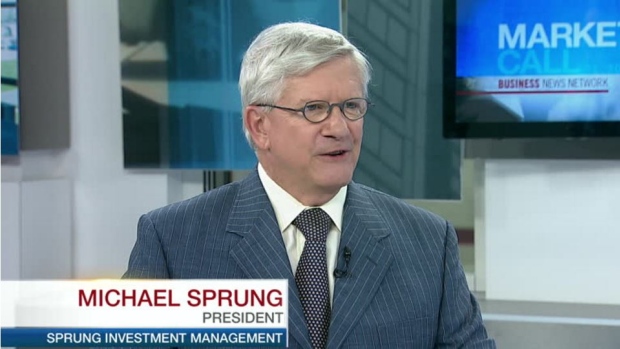
11 Investing Lessons From Michael Sprung of Sprung Asset Management

Investing

My full interview with Michael Sprung of Sprung Asset Management originally appeared in my national bestselling book, Market Masters, which is available at Chapters, Indigo, and Coles as well as Costco and Amazon.ca.

***

Michael Sprung must have been both the shyest and smartest kid in class. You know, the kid who coasted through school with A-pluses without much effort. Well, Michael would go on to study actuarial science, which — based on what it takes to grasp and fulfill the curriculum — is right up there with rocket science as far as I’m concerned. After that he obtained an MBA and then qualified as a CFA. Today, Michael is still relatively shy. He looks exactly how you might expect an actuary to look: white shirt, black slacks, black shoes, and tidy white hair. The thick lenses of his glasses enlarge his eyes. He is soft-spoken. Our interview starts slowly, but Michael opens up as he gets more comfortable with me and the format. The more he talks about investing, the more he comes to life.

Investing happened to be Michael’s calling. He could have very well become a salaried actuary employee at an insurance company, tucked away into a neat little cubicle. Instead, he founded Sprung Asset Management, and as Sprung’s president, Michael’s got lots of interesting stories, insights, and forecasts on investing in the market. Reading the transcript of our interview later, I realized that of all the interviews I had conducted, his transcript was the most cohesive and succinct in its raw form. Michael is a man who thinks clearly and articulately, and who speaks the same way.

Michael Sprung is a student of value investing. Michael’s “school” was his first employer, Confederation Life, where he learned value investing and worked under value managers who would go on to storied careers of their own. “Anyone who went to Confederation Life would consider themselves value investors today,” said Michael during our meeting. Michael and I met in a small, spare meeting room. We pulled our chairs up close and then began with the click of the red button on my recorder.

Michael Sprung’s 11 Investing Lessons:

1) “Our core philosophy is trying to minimize downside risk. . . . Risk is a two-edged sword.”

2) “When you see that retail investors are all rushing in and that people are lining up to buy something, that’s usually a good time to sell out.”

3) “The whole key to value investing is to buy often when stocks are unpopular, when people do not recognize the inherent value in those companies.”

4) “There’s always the question of whether you are too early or too late [investing in a value stock], but as long as we are fairly convinced that a company has the wherewithal and good management to be a survivor, we don’t mind being too early.”

5) “If you buy a stock and all of a sudden it goes down 15% or more, the real question at that point becomes, were you wrong or is this an opportunity to buy more? We try not to look at the short term very much at all. We look at everything with a three- to five-year time horizon or more.”

6) “Around 1999, I made a bet with some portfolio managers that over the next four years Manulife would outperform Nortel, and they thought I was a fool. Nortel was trading at 120 times earnings. Anyway, Manulife outperformed in that period. I won the bet.”

7) “Look for those companies that have deteriorating leverage or margins relative to their competitors — that’s usually a sign that a value trap is going to develop.”

8) “‘A lot of investing is winning the loser’s game.’ You just try to make fewer mistakes than your competitors. And as long as your winners outweigh your losers, you’re doing well.”

9) “In the long term, Efficient Market Theory has some application. Though in the short term there are anomalies within the system where stocks do get mispriced. Hopefully you’re prepared enough to catch those anomalies.”

10) “The worst mistake that I see retail investors make is to become value investors when that’s popular, and then all of a sudden become growth investors when that’s popular. You get whipsawed on making changes between macro-economic sector rotation and micro-economic stock selection.”

11) “Investing success, like any other discipline or profession, is achieved through the rudimentary core knowledge that you need to know. It’s in the application — how you think, your discipline, and whether you can stick with that discipline.”

MarketMasters

Robin Speziale is the national bestselling author of Market Masters, which is available at Chapters, Indigo, and Coles as well as Costco and Amazon.ca. He lives in Toronto, Ontario. Learn more about Market Masters.