How to Generate Real Wealth in the Stock Market

Investing

(Originally written March 2020)

Subscribe Now to My FREE Newsletter (Join 5,000+ Subscribers!)

Generating real wealth is a journey. It’s not short term. You must put in a lot of work, and have the right frame of mind. You also need to make big bets when you feel in your gut that “it’s time”. We are presented with only so many golden opportunities throughout our lives – most consider grasping them – but only a small number of people actually do. 

That’s why so few become rich.

Doomsday-scenario stock market crashes like the one we’re currently going through is what separates the long term wealth generators from the majority of people: fearful, misguided, and short-term thinkers.

Real wealth generators are buying stocks now. 

They’re not selling. 

And they’re certainly not short-term trading.

They’re buying stocks, and building positions in quality companies for the long term.

They’re not worried about making sure if this is the exact bottom. 

They don’t care what you or what anyone else thinks.

Many new Millionaires, and dare I say it – maybe even some new Billionaires – will be born out of this crash. They’re in it for the long run.

Long term (wealth generation)
vs.
Short term (trading/speculation)

Traders are short term. They speculate (usually in their pajamas) on a day-to-day basis. Be wary of listening to anyone, ever, who doesn’t have the vision for long-term wealth creation. Buying, selling – dipping in and out throughout the past couple of weeks – doesn’t build wealth. It just reveals lack of conviction, and a reliance on short-lived dopamine shots.

Don’t let it get to your head. You’re in this for the long run.

Some might quip, “what about Jesse Livermore!”

Jesse Livermore… he made upwards of $100M at the time through short-term speculation. Traders today praise him as some genius. Livermore wasn’t genius. Shortly after making that ~$100 million dollars, Livermore lost it all, and then committed suicide by gunshot to the head. He didn’t think long term, and wasn’t even able to live with himself in the moment.

All that money went *poof* 

Easy come, easy go. 

Instead, let’s think about someone like J. Paul Getty during a time like this.

J. Paul Getty was an oil magnate, and a long term thinker.

In 1957, Fortune magazine named Getty the richest man in the world. By the mid-1970s, at the time of his death (June 6, 1976), it was estimated that Getty had built a personal fortune of up to $6 billion dollars. That was over 40 years ago.

Subscribe Now to My FREE Newsletter (Join 5,000+ Subscribers!)

J. Paul Getty also wrote a book. I recommend it to you all: “How To Be Rich” (1965).

Getty said that his book was not intended to tell people how to get rich, but instead how to be rich.

How to be rich = long term wealth generation

Consider the story of Tide Water Associated Oil Co. 

J. Paul Getty first bought the shares in 1932, in the midst of The Great Depression. The Dow had dropped from a high of 380 in 1929 all the way down to 40 — a fall just shy of 90% in three years. Investors had dumped everything, and most everyone was not buying stocks. Getty first bought shares of Tide Water at just $2.12 per share. Five years later, they traded above $20. Some stocks he owned grew to 100x the value he originally bought them for.

Getty wasn’t trading stocks; in and out, day by day, in a time like this. 

He was investing meaningfully – with purpose – in companies for the long run.

Getty said:

“It is possible to make money — and a great deal of money — in the stock market. But it can’t be done overnight or by haphazard buying and selling. The big profits go to the intelligent, careful and patient investors, not to the reckless and overeager speculator. The seasoned investor buys his stocks when they are priced low, holds them for the long-pull rise and takes in-between dips and slumps in stride.”

Like I said earlier, we’re only presented with so many golden opportunities throughout our lives to continually build (upon) wealth that will last a lifetime (and beyond).

What were you doing during the:

2000 – Tech Bubble

2008 – Financial Crisis

2011 – Euro Crisis

2015 – Oil Crash

Now – Coronavirus Pandemic

Were (are) you buying, selling, or trading during these crashes? They were all incredibly opportune times to invest in stocks for the long run. For example, I’m still holding, and building a position in Starbucks since the financial crisis of 2008 (12 years later). Sure; companies come and go. But are you building real, lastingwealth; adding capital to quality companies that make up the core of your portfolio. If you’re not; that’s just trading.

Getty would capitalize on meaningful opportunities time and time again throughout his life.

For example, when stock markets plunged in 1962, Getty said all around him panicked but there was “little if any reason for alarm and absolutely none for panic”. He said: “As for what I was doing, the answer was simple, I was buying stocks.”

Are you buying stocks now?

It’s important to repeat: Getty bought stocks as a long-term investment, not to make a quick buck when the share prices rose once again. “Get-rich-quick schemes don’t work. If they did, everyone on the face of the earth would be a millionaire,” he said.

Remember: empty vessels make the most noise.

Real, lasting wealth generation is a slow, and boring journey. Quick one-day wins that you can brag to your friends or family about is not real wealth generation. It’s just noise. Nor is selling out of stocks out of baseless fear, or trying to time the exact bottom and thus waiting on the sidelines. Have confidence in yourself, and the future. 

Subscribe Now to My FREE Newsletter (Join 5,000+ Subscribers!)

Real wealth takes time. It takes faith, and it takes conviction; in the world, your country, the market, and the stocks you love. Real wealth generators are in this for the long haul. They invest in quality companies, giving them the capital needed to grow, and in turn, will inevitably reap the rewards over a life-time (and beyond). 

New Interview with Peter Lynch

Investing

Subscribe Now to My FREE Newsletter (Join 5,000+ Subscribers!)

Barron’s recently sat down with Peter Lynch, former Fidelity fund manager, and author of several investment classics, including one of my favourite books ever; One Up On Wall Street

Peter is elusive these days so it’s always nice to hear from him and find out what he thinks about the market today. 

I do recommend picking up a copy of the latest Barron’s issue. Here’s the excerpt of the interview: (oh, and before you read on, look closely in the photo to see the shoes Peter was wearing…) 

***

Peter Lynch: After 50 years of doing this professionally, it reinforces that growth stocks are better than nongrowth stocks. Growth stocks, by definition, are where sales have really grown. People confuse it with earnings going up, but [if you just look at earnings growth] you mix in turnarounds and cyclicals. A company can go from losing money to a 2% margin, to a 12% margin, and earnings are up sixfold—but that’s not a growth company.

Passive management has stomped active.

In terms of attracting assets, yes, though not at Fidelity. Joel [Tillinghast, manager of Fidelity Low-Priced Stock (ticker: FLPSX)] has done it [beaten his benchmarks], Will [Danoff, manager of Fidelity Contrafund (FCNTX)] has done it, Steve Wymer [manager of Fidelity Growth Company (FDGRX)] has done it. We have 10 or 15 funds that have beaten their benchmarks for 10, 15, 20, 25 years now.

What characterizes a great company?

My best stocks have been ones where I didn’t have to worry about the big picture. A company with a better mousetrap, a growth company in a non-growth industry. Stop & Shop and Dunkin’ Donuts are two incredibly successful local companies. The question is, how long is the story? I wish I had been to Arkansas and gone to see Sam Walton of Walmart. Ten years after Walmart went public, it was a 25-year-old company. It was up tenfold. I said, “Ooh, I missed that one.” Then it went up 50-fold. Sherwin Williams earnings are up 20-fold since I managed the stock in Magellan. The professional painter in our little town goes to Sherwin Williams, not to Home Depot. Why didn’t I look at Sherwin Williams? Why didn’t I spend an hour on that? So staggering, dumb, or just lazy. I thought it was the last inning of the ballgame, without doing the research.

You can’t make these conclusions without some basis. Really bad American fast food has done brilliantly overseas. There are 1,400 McDonald’s in France. You want to be in [the stock] in the second inning of the ballgame, and out in the seventh. That could be 30 years. Like the people who were really wrong on McDonald’s. They thought they were near the end, and they forgot about the other seven billion people in the world.

The lists of companies in your books are quaint. They’ve mostly been disrupted.

That’s why you ought to write down, “Why am I owning this?” Cheap is different from a [good] story. There’s a great expression on the Street: It’s always darkest before pitch black. Wait until something’s gotten better. I made a lot of money on Bank of America. I’m not saying it’s a buy today. But Bank of America [during the financial crisis] went from $18 to $7. They had to borrow money wholesale. I knew they couldn’t go under because they were 120% retail funded. They had FDIC [protection]. They went up a lot after that.

How would you update your advice today?

If you cannot find growth companies in innings three through five of the ballgame, look at turnarounds, special situations, back at the cyclicals. There’s a real shortage now of growth companies. That is a red flag, because all the money is flowing into [a few companies]. There’s an end to that game. It will scare me if this trend continues for a couple more years.

Subscribe Now to My FREE Newsletter (Join 5,000+ Subscribers!)

What’s your view of unicorns?

That’s a big difference today—companies stay private a lot longer. The next Google might stay private for an extra 10 years. That makes it more difficult [for individual investors]. The day they come public, a thousand organizations have looked at it, and they’re probably pretty fairly priced. Fidelity can put 5% of funds into these things. The public can’t do that. I’d rather look at something that’s been around for a long time.

Which CEOs do you like?

Satya Nadella really turned around Microsoft [MSFT]. Dan Amos of AFLAC [AFL] is the longest-running CEO in the country after Warren Buffett. And how do you leave out the late Lee Iacocca [former CEO] of Chrysler?

Where are the opportunities now?

I’m looking at industries that are doing badly; that for some reason will get better. Shipping. If you want to buy a ship, it’s a two- or three-year wait. People haven’t ordered ships for a long time, because by the time one comes in, prices may be down again.

Energy services is awful; that could have a major turn in the next year or two. Oil is interesting. Look, longer term, solar, windmills really work. But you need natural gas and oil to bridge to this. Everybody’s assuming the world’s going to not use oil for the next 20 years, or next year. China might sell five million electric vehicles next year, but they might also sell 17 million internal combustion engines. They don’t have old cars to retire. There are no electric airplanes. Near term, liquid natural gas and liquid petroleum gas might replace diesel fuel for trucks. I’m buying companies that I don’t think will go bankrupt. They’ve got to be around the next 18 to 24 months, or I have no interest.

Can we ask which companies?

No. I can’t recommend stocks anymore.

Anything else do you want investors to know?

If you’re going to invest, you have to follow certain rules. If you want to ski, you ought to go to the bunny hill and learn how to stop. It doesn’t make you an Olympic skier, but then in certain cases, you have an edge on the Fidelitys of the world. You might be in the cement industry, and suddenly orders pick up. You can see things better. The one thing I want everybody who is buying individual stocks to get is that they have to understand the story, the five reasons something is going to go right for the company. If you can’t convince an 8-year-old why you own this thing, you probably shouldn’t own it. Don’t invest in a company before you look at the financials. If you made it through fifth grade, you can handle the math.

Source: Barron’s, 2019. Copyright. All Rights Reserved. https://www.barrons.com/articles/peter-lynch-how-to-find-growth-opportunities-in-todays-stock-market-51576877980

Subscribe Now to My FREE Newsletter (Join 5,000+ Subscribers!)

Bill Ackman’s Back

Investing

Subscribe Now to My FREE Newsletter (Join 5,000+ Subscribers!)

(Originally written December 2019)

I interviewed Bill Ackman in 2015  for my book, Market Masters

He was seemingly on top of the world. $20B AUM, gushing performance, star HF manager.

But then Bill had a fall from grace.  Well, it was almost a loud thump.

His long bet on Valeant (-$4B loss) almost took down his fund. 

And his short bet on Herbalife was a both a ‘head-scratcher’ for us, and a lesson in pride for Bill (we can be right, but still wrong).

Investors fled the fund.

His wife left him.

He moved out of his lavish Manhattan skyscraper to smaller digs.

And then he went away… next to no interviews, or sightings of Bill.

But behind closed doors, he was tinkering away, re-building his battered fund. 

Bill started a position in Chipotle (see photo above where Bill”s seen standing in line at a local Chipotle restaurant in NYC). But people scoffed, “doesn’t Chipotle just give you diarrhea?”.  Then a new stake in Starbucks.”How unoriginal” we thought. “I don’t pay a money manager to buy Starbucks”. And then a position in… Berkshire?

However, this year, something out-of-the-ordinary happened. We started hearing that Bill’s fund was up. Quarter after quarter…trouncing the market. “How can this be… I thought Bill was done”.  The first quarter of 2019 could have been a fluke (as all stocks in the S&P 500 seemingly experienced a sharp rebound), but this was consistent. Something was going on.

Subscribe Now to My FREE Newsletter (Join 5,000+ Subscribers!)

Indeed, 2019 was the year that Bill Ackman got his mojo back. 

His fund is now up +57%, double the S&P 500’s performance. It definitely helped that Bill cherry picked quality, blue chip companies from the S&P 500, which equally had a stellar year in light of a trade war, impending recession, and presidential impeachment.

But really, the lesson here is this: Keep it simple. 

How simple?  Food, food, hotels, home reno, everyone’s favourite cherry-coke-drinking capitalist (Buffett), tasty lattes, and then some.

Here’s the most recent holdings snapshot in Bill’s Pershing Square fund, source:  https://seekingalpha.com/article/4313487-tracking-bill-ackmans-pershing-square-portfolio-q3-2019-update 

It’s clear now, and I hope this trend continues – that Bill’s decidedly past the days where he wants to look like the smartest guy in the room with long, convoluted 50+ page thesis papers to back his contrarian holdings. Sure, when those wildly contrarian ideas worked (e.g. MBIA short), they really worked, but when they didn’t he took some hard punches, including the aforementioned Valeant, and Herbalife, but also J.C. Penney and Target.

He’s keeping it simple.  When you meet Bill at a cocktail party now, he’s talking up the latest menu offerings at Chipotle, and how Starbucks coffee is his go-to morning saviour.

I also think that his new life partner, and wife – Neri Oxman – humbled him immensely, but maybe more importantly, Neri helped light that spark back up in Bill after the flame had gone away: “It’s very helpful when you’re going through a difficult period to be in a great relationship” with someone who is “super-supportive, loving and warm and believes in you”.

I’m happy for Bill. It’s not the story-book ending yet (as we know, he’ll have to keep up the gains) but it goes to show that investing is a long term game, and that we’ll all personally have our ups and downs throughout the years. The key is to stay in the game, and keep on compounding! 

Love him, or hate him; Bill’s back. And it’s a good lesson for all.

Subscribe Now to My FREE Newsletter (Join 5,000+ Subscribers!)

Eric Sprott on Tenbaggers, and the Discovery Process

Investing

Subscribe Now to My FREE Newsletter (Join 5,000+ Subscribers!)

Eric Sprott, the Canadian kingpin financier of junior mining/precious metals companies, was on my wish-list of investors that I wanted to interview for my 2016 book, Market Masters. However, that interview didn’t pan out (maybe the sequel). Commodities were in a slump, but Gold finally bottomed out at the start of that year, steadily rising out of the bear market.

This morning, I stumbled upon a good interview with Eric on Financial Post that I want to share: https://business.financialpost.com/commodities/mining/billionaire-eric-sprott-dishes-on-his-golden-investment-spree-its-like-being-at-a-table-with-a-winning-run

Investing in junior mining / precious metals companies isn’t in my wheelhouse, but there’s definitely some parallels to investing in Micro/Small-Caps, and it’s still important to get inside the head of successful investors who’ve got the knack for bagging winners.

As I read the interview, I pulled out insights and summarized them below for you.

Eric Sprott on Tenbaggers, and the Discovery Process:

– Sprott launched an investment blitz, the likes of which the junior mining precious metals sector had seldom seen, doling out somewhere between $200 and $300 million in a matter of just a few months to acquire large stakes in about two dozen companies, most of which have never earned a dollar of revenue

– Sprott takes a birdshot approach to investment that spreads his money far and wide

– “You’ve got to have the dream, right?” he said. “You’ve got to have the dream you’re going to find something.”

– “The guy gets up at ungodly hours, he might get up at 2 a.m. studying,” said Conor O’Brien, a former capital markets manager who joined Sprott in May to help with the investment blitz. “Neither one of us are geologists, we’re just financial people that can do mathematics, as opposed to the geology. We more kind of conceptualize, and dream and kind of multiply.”

– Sprott was an early investor in Kirkland Lake, was appointed chairman in 2015, and one year later helped engineer its merger with Newmarket Gold Inc., a small gold producer in Australia. Not long after, the newly merged company discovered high-grade veins at two mines, which propelled its stock upwards to $63 per share.

– Many investors pride themselves on not selling when a stock hits a bump, but Sprott said it is equally important to not sell when the stock rises, at least not until it’s gone up five or even 10 times, a so-called tenbagger.

– “I’ve had lots of tenbaggers and the important thing is to stay in it,” he said.

– But when his stake in Kirkland Lake reached about $1.3 billion earlier this year, and it looked like gold prices would keep rising, Sprott said he decided it was time to sell.

– “I still have a lot of money in Kirkland and it’s a great company, but it’s not a tenbagger from here,” he said. “And I like tenbaggers as opposed to 100 per cent. It’s just my nature.”

Read the full interview w/ Eric Sprott here:  https://business.financialpost.com/commodities/mining/billionaire-eric-sprott-dishes-on-his-golden-investment-spree-its-like-being-at-a-table-with-a-winning-run 

Subscribe Now to My FREE Newsletter (Join 5,000+ Subscribers!)

The Stocks I Like Best

Investing

Subscribe Now to My FREE Newsletter (Join 5,000+ Subscribers!)

It’s certainly been a while. In the past year, I got married. We also welcomed our first newborn. So, yes – the Speziale household has been busy.

In between changing diapers, I have been reading the wonderful book, Daring to Succeed: How Alain Bouchard Built the Couche-Tard & Circle K Convenience Store EmpireAuthor Guy Gendron chronicles the rise of Alimentation Couche-Tard ($ATD), one of Canada’s greatest wealth-creation stories of all time.

I’ve also been catching up on BNN – whenever Jason Donville, Jordan Zinberg, and Jason Del Vicario make appearances on Market Call – I’m an attentive watcher.

And I usually don’t do this, but some of the High Interest Savings Accounts out there have been so tantalizing that I finally signed up for one at Simplii (CIBC). Why not. I can use the boost to start funding my daughter’s RESP.

Since I haven’t been writing lately, some readers have been asking me what Canadian stocks I currently like best.

Well, here they are (in no particular order):

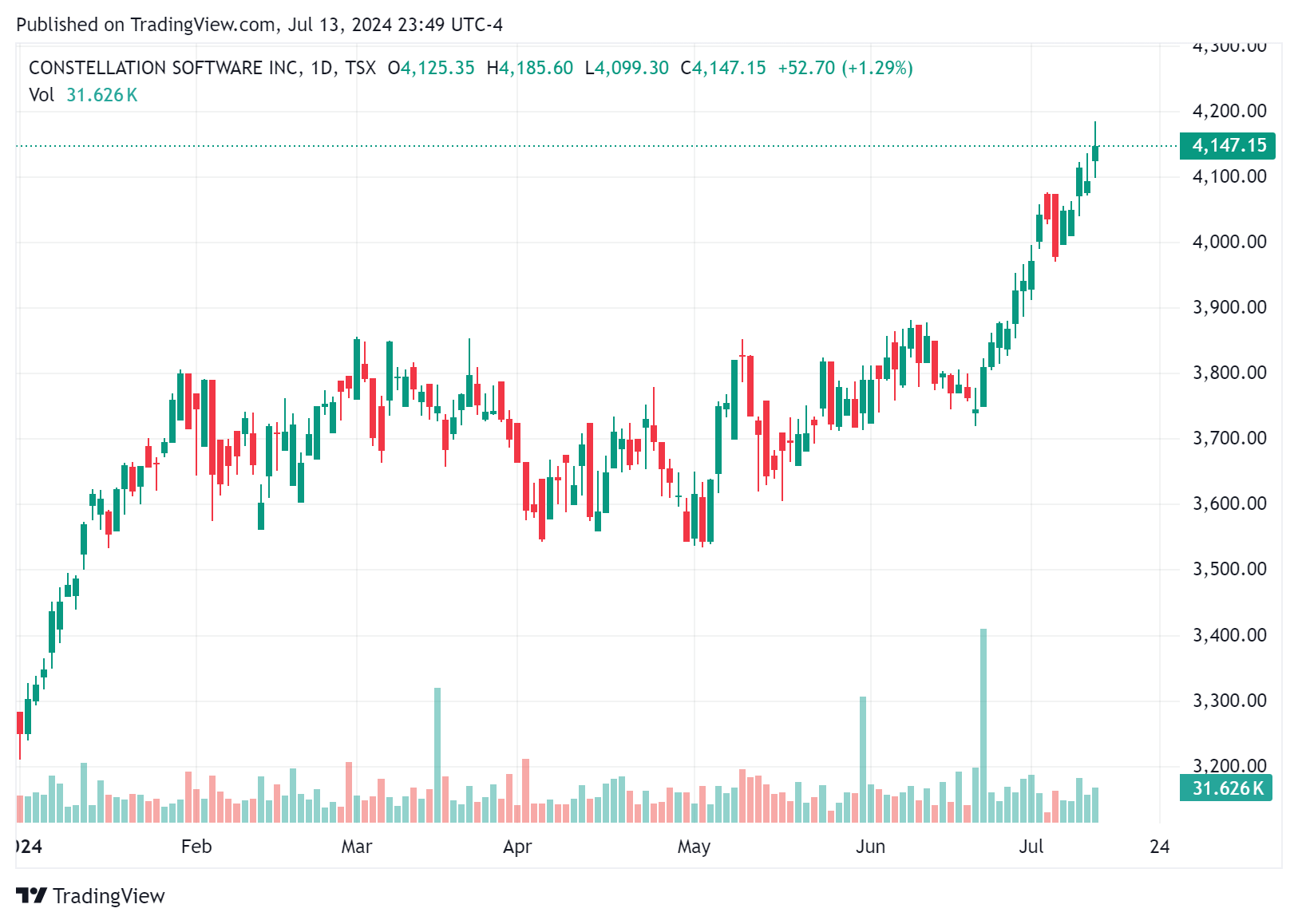
Constellation Software ($CSU)

TradingView chart

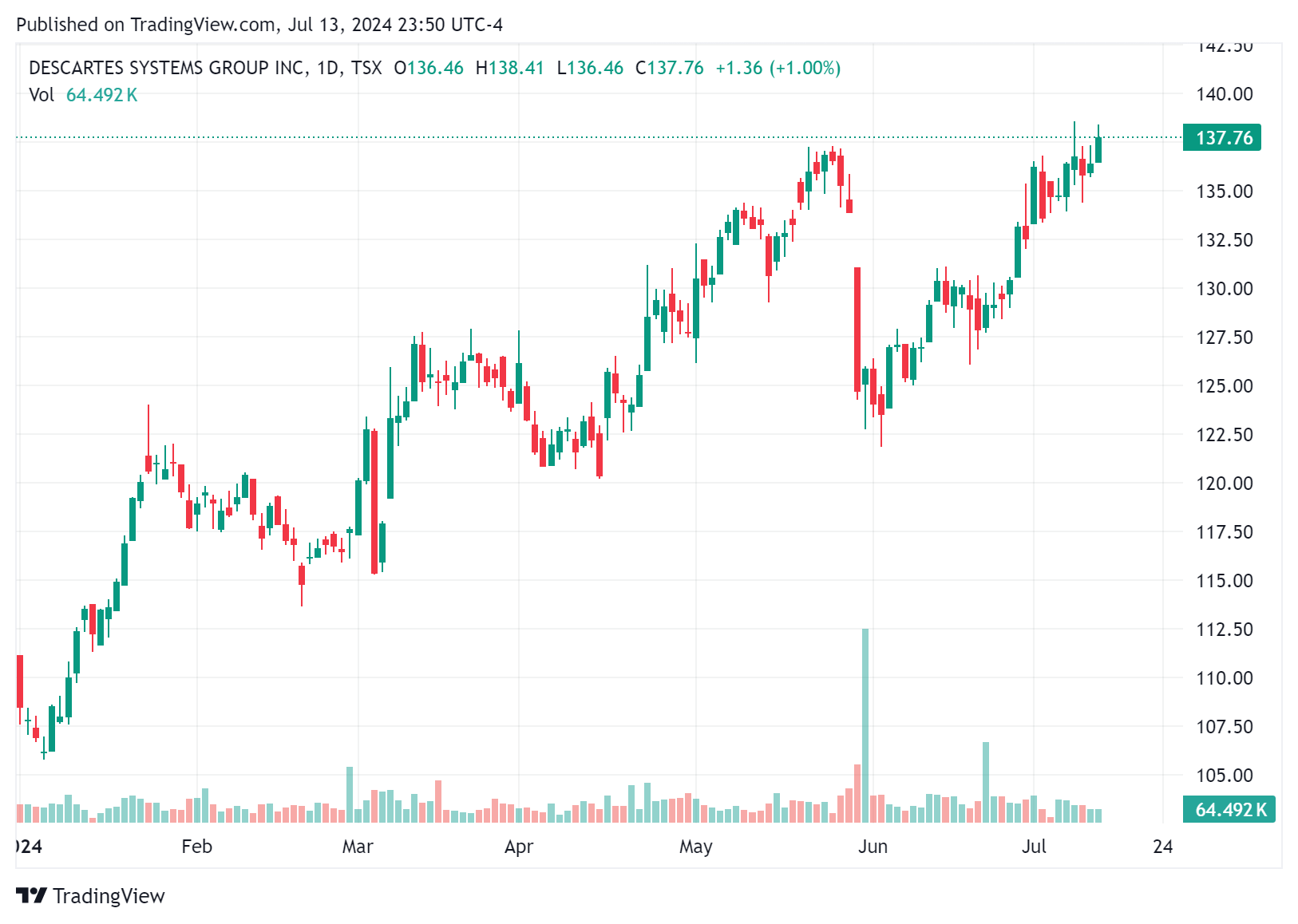
Descartes Systems Group ($DSG)

TradingView chart

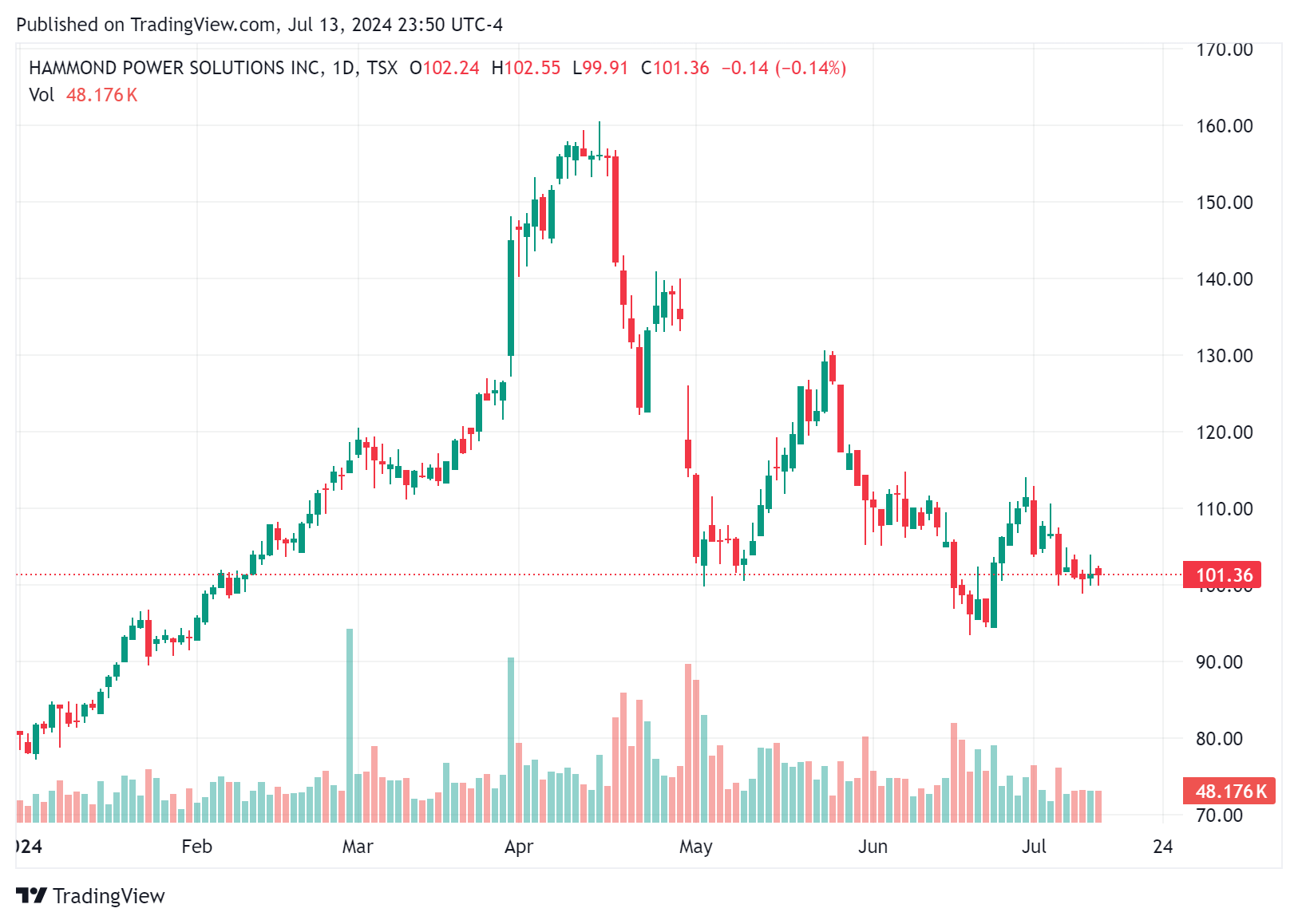
Hammond Power Solutions ($HPS.A)

TradingView chart

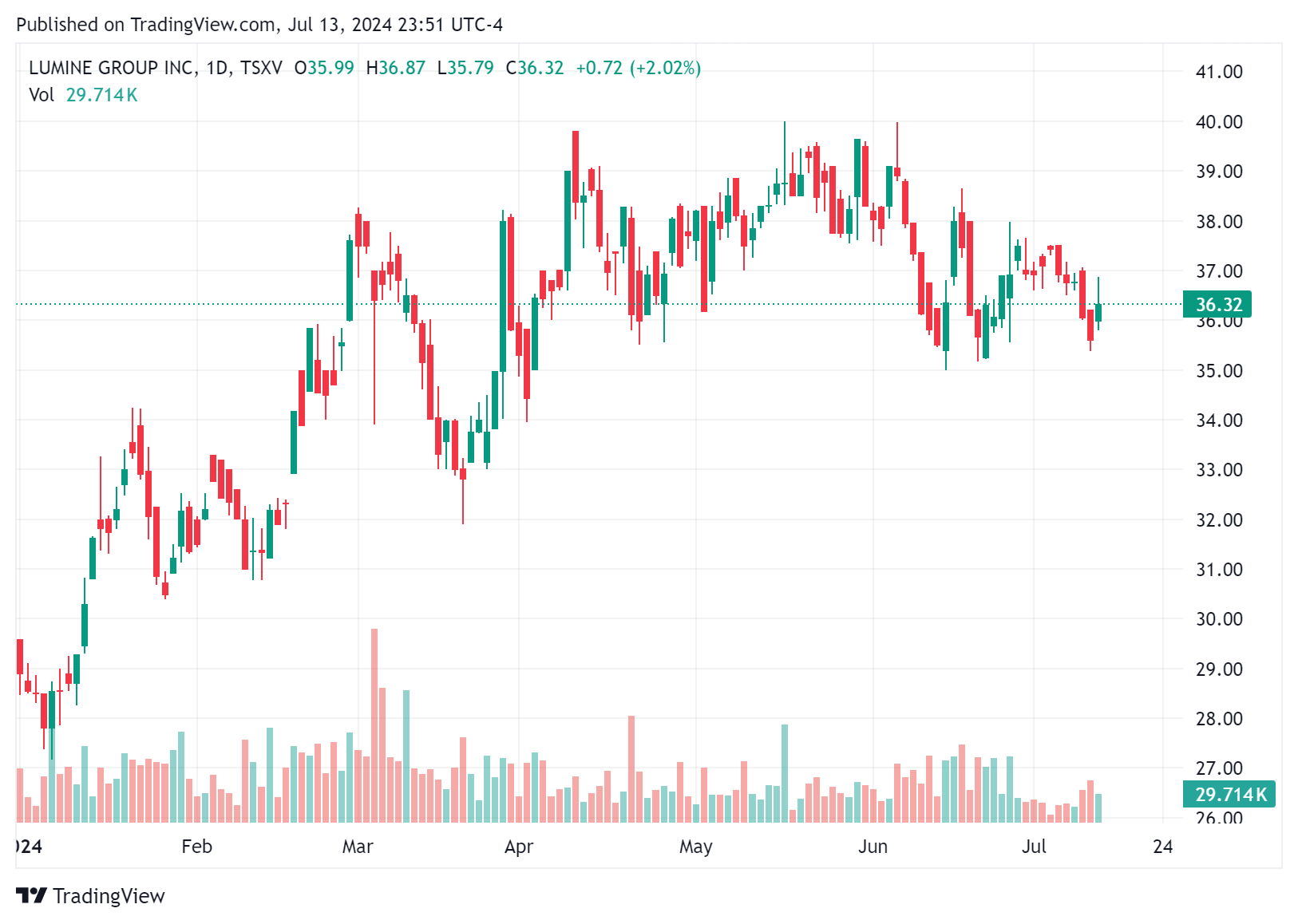
Lumine Group ($LMN.v)

TradingView chart

Subscribe Now to My FREE Newsletter (Join 5,000+ Subscribers!)

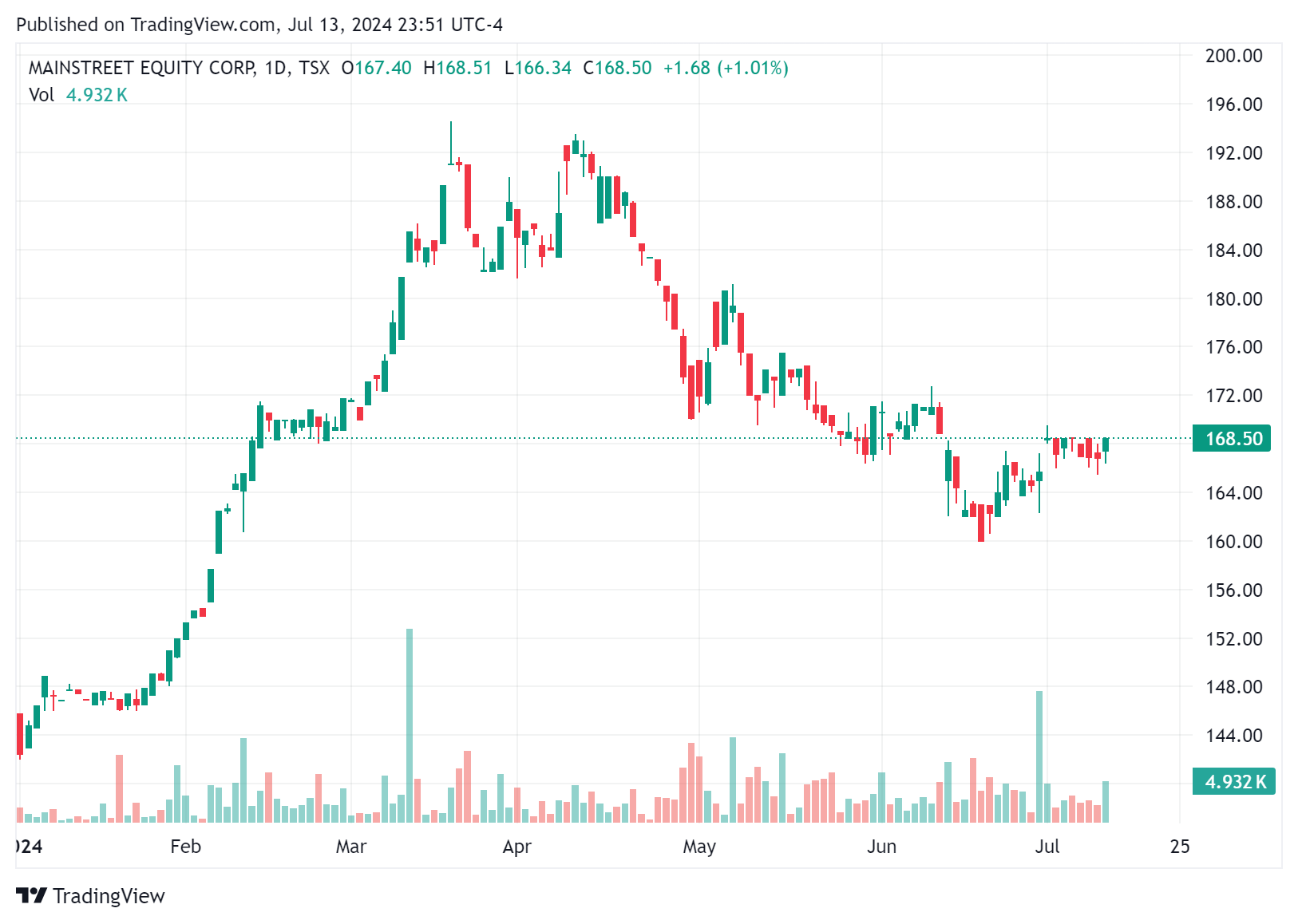
Mainstreet Equity ($MEQ)

TradingView chart

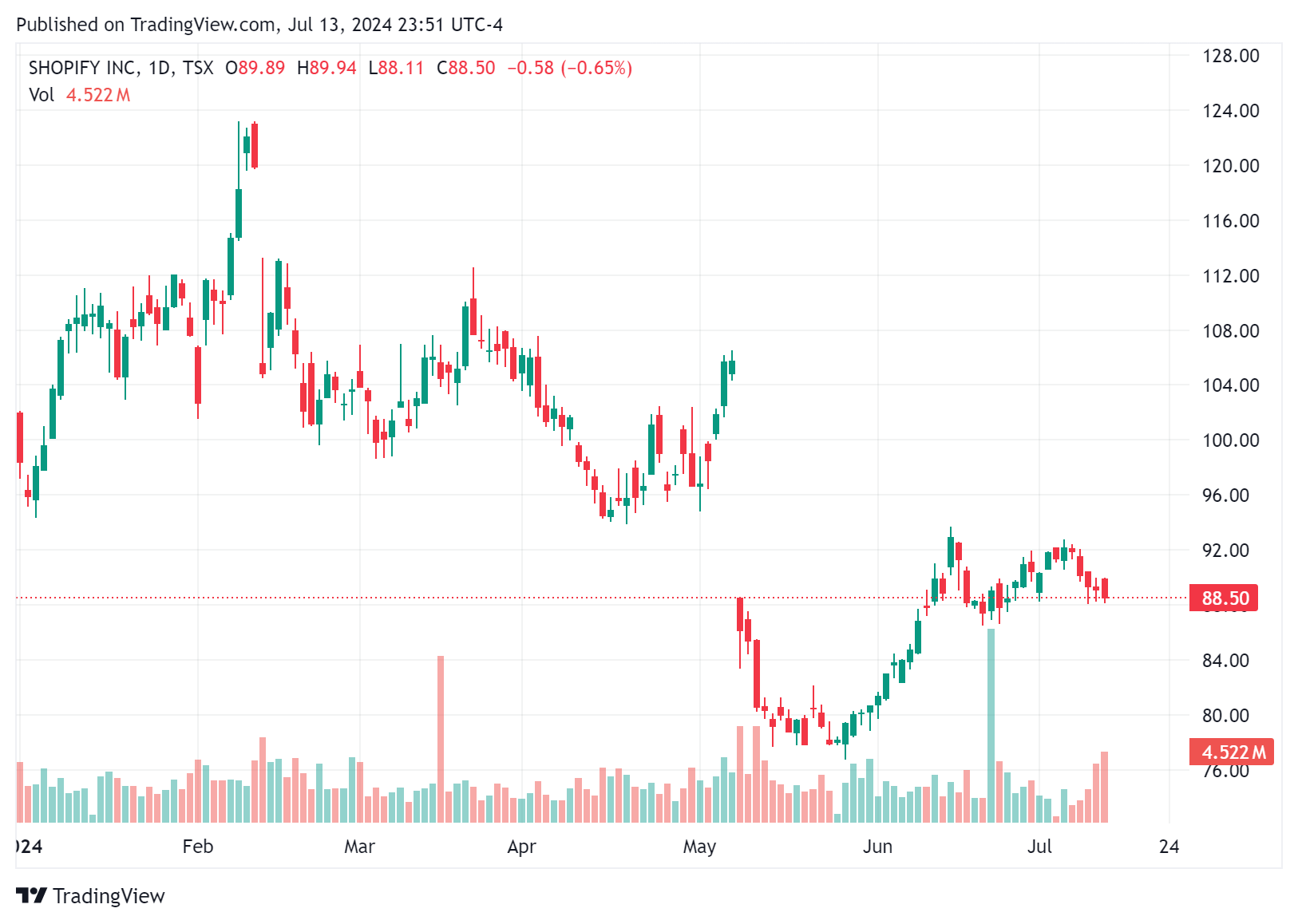
Shopify ($SHOP)

TradingView chart

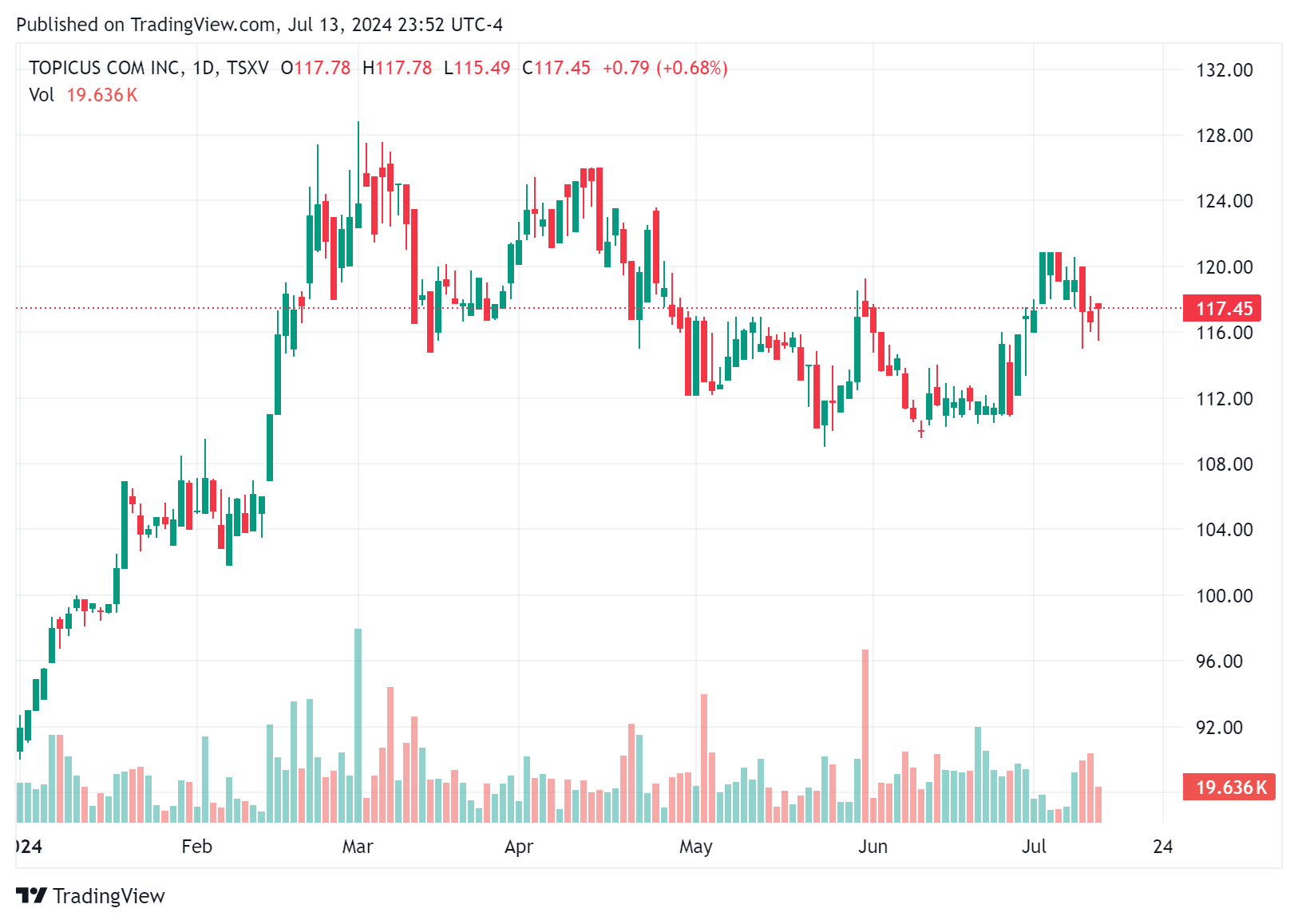
Topicus.com ($TOI.v)

TradingView chart

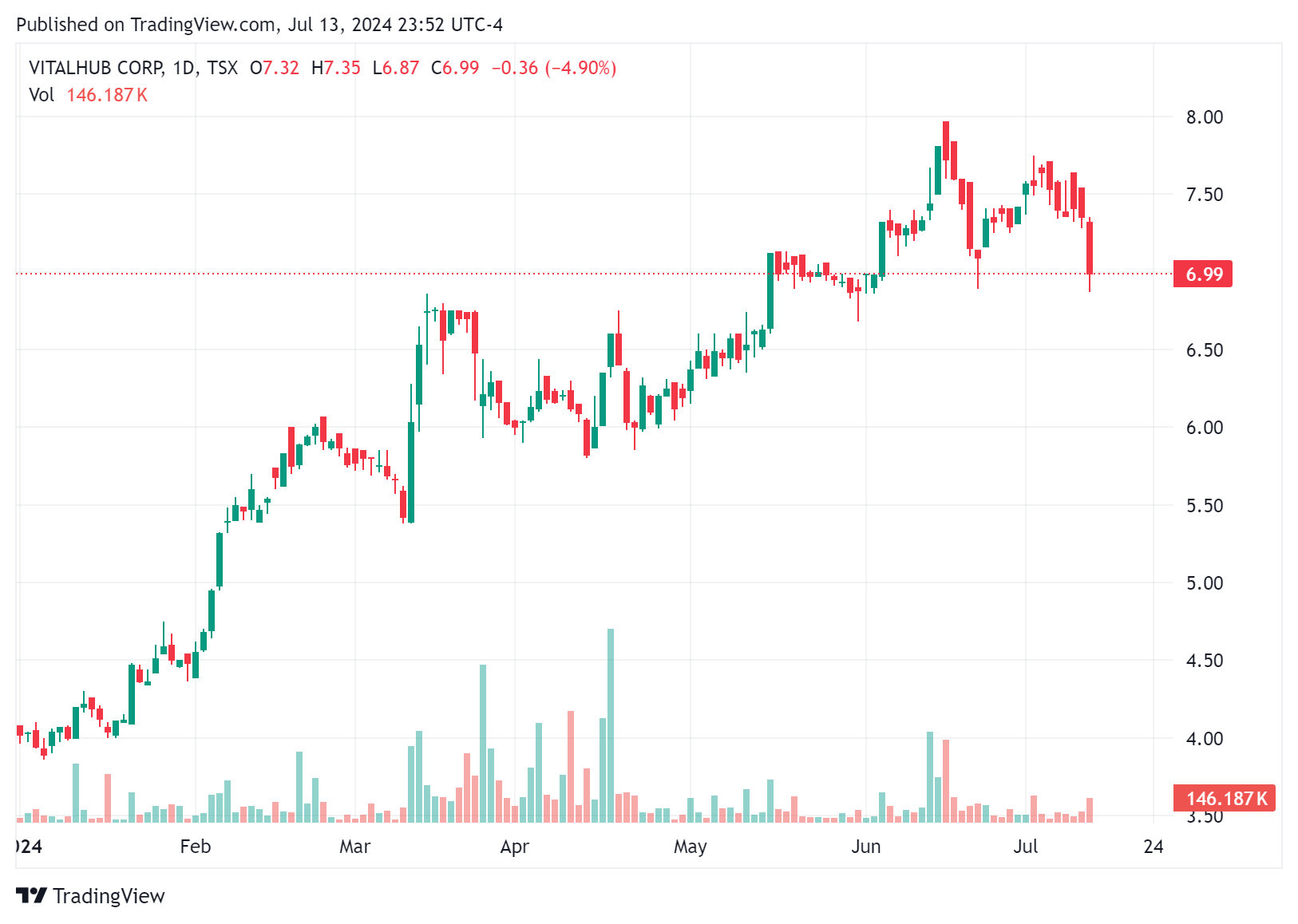
Vitalhub ($VHI)

TradingView chart

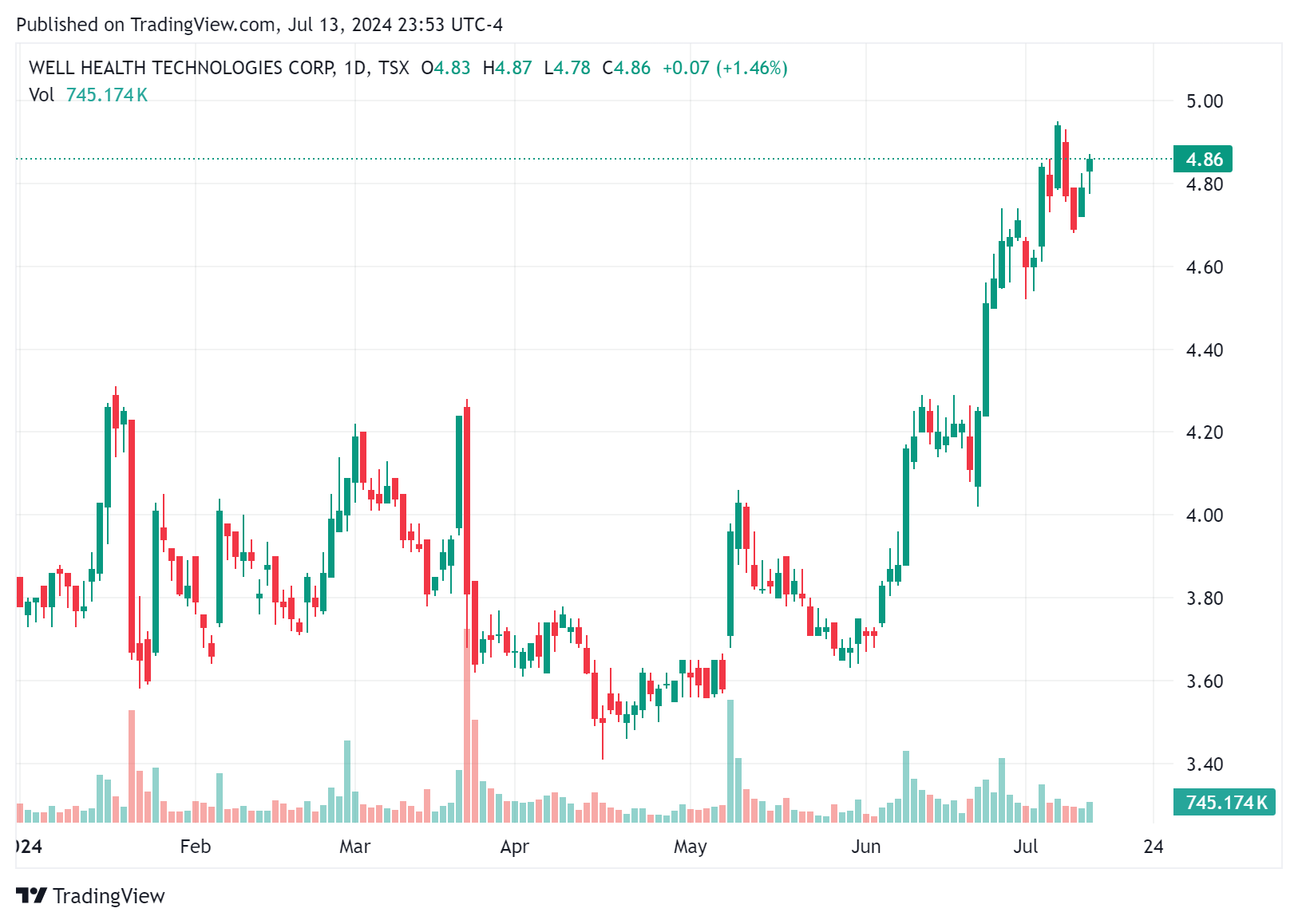
WELL Health Technologies ($WELL)

TradingView chart

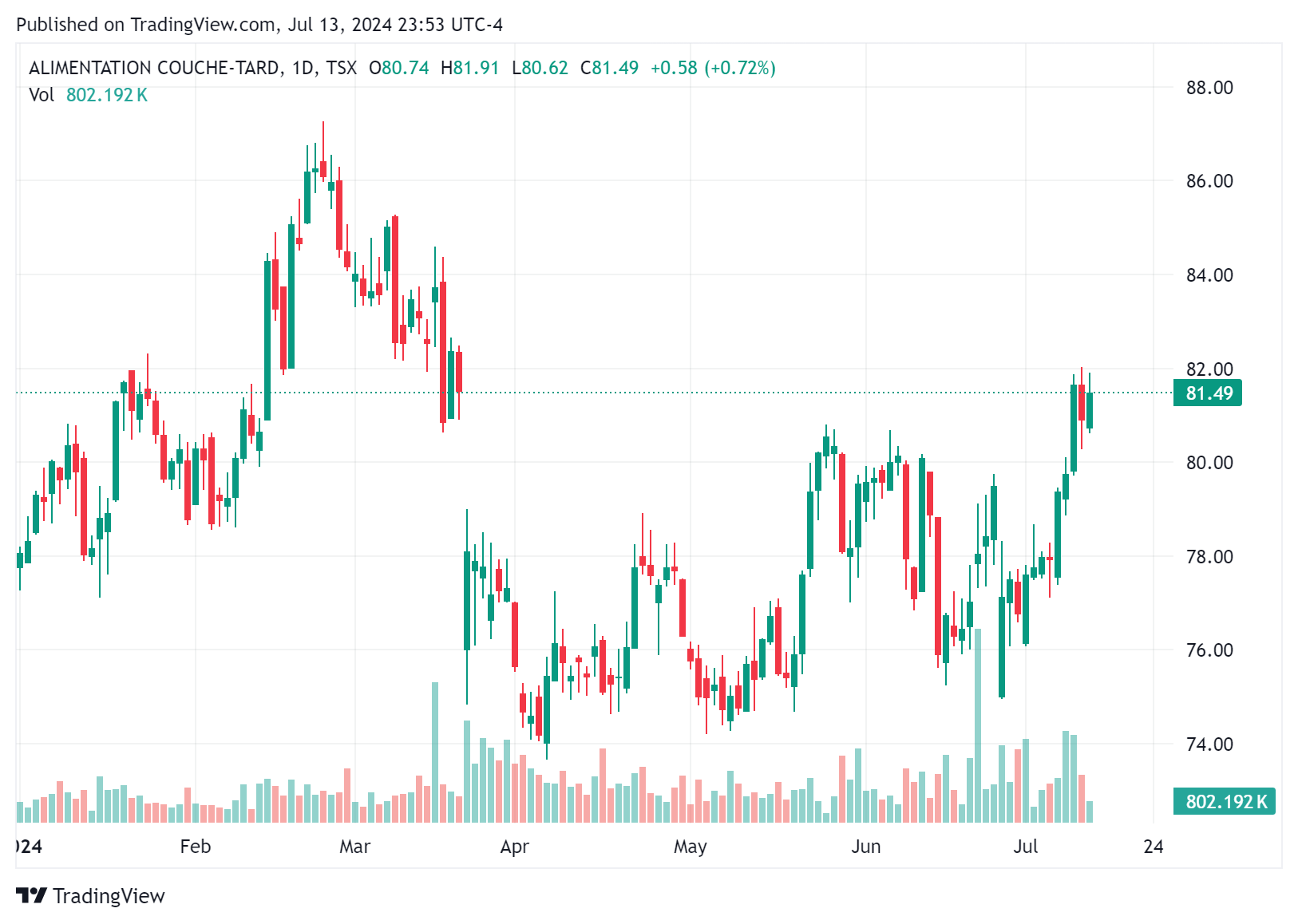
Alimentation Couche-Tard ($ATD)

TradingView chart

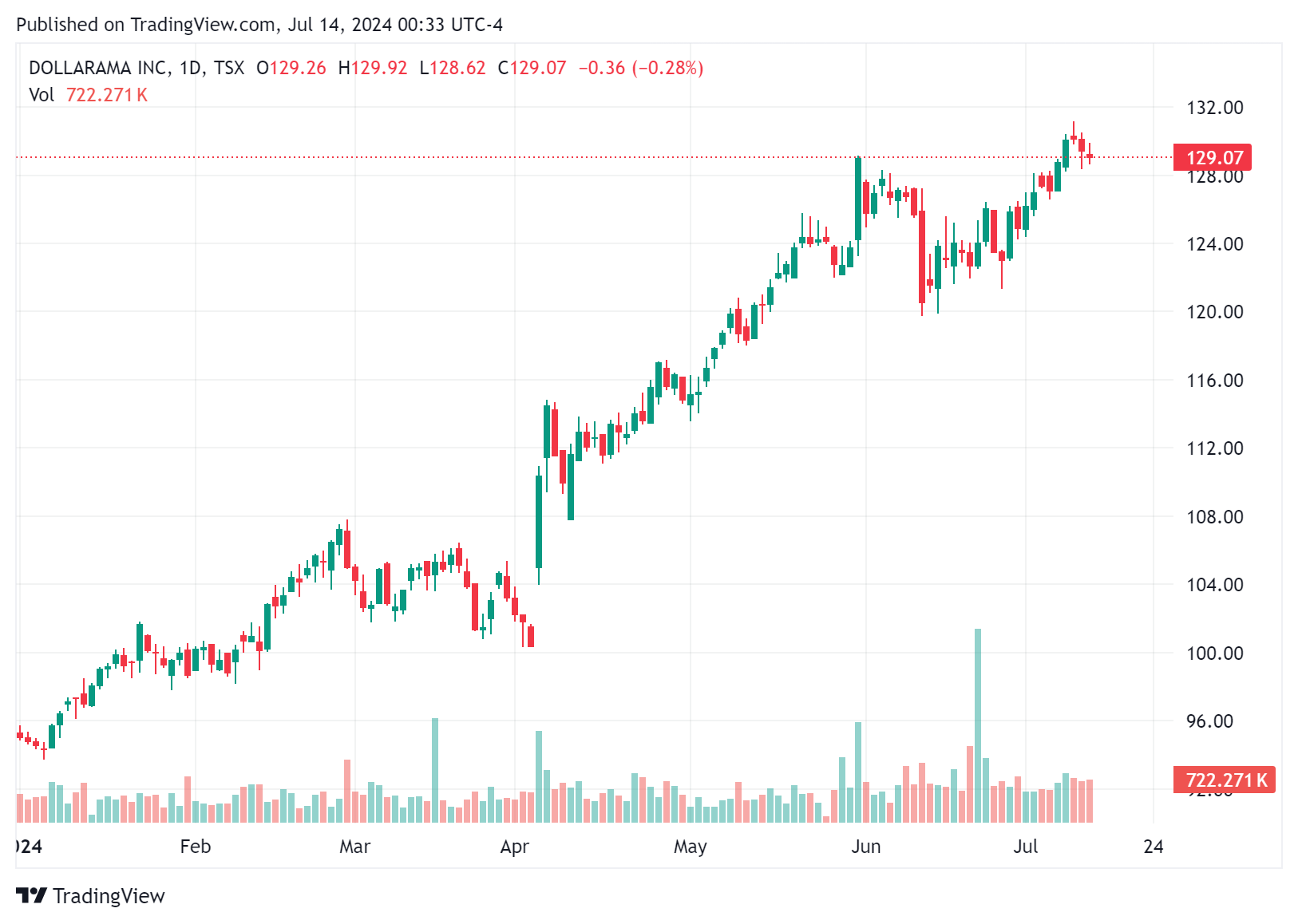
Dollarama ($DOL)

TradingView chart

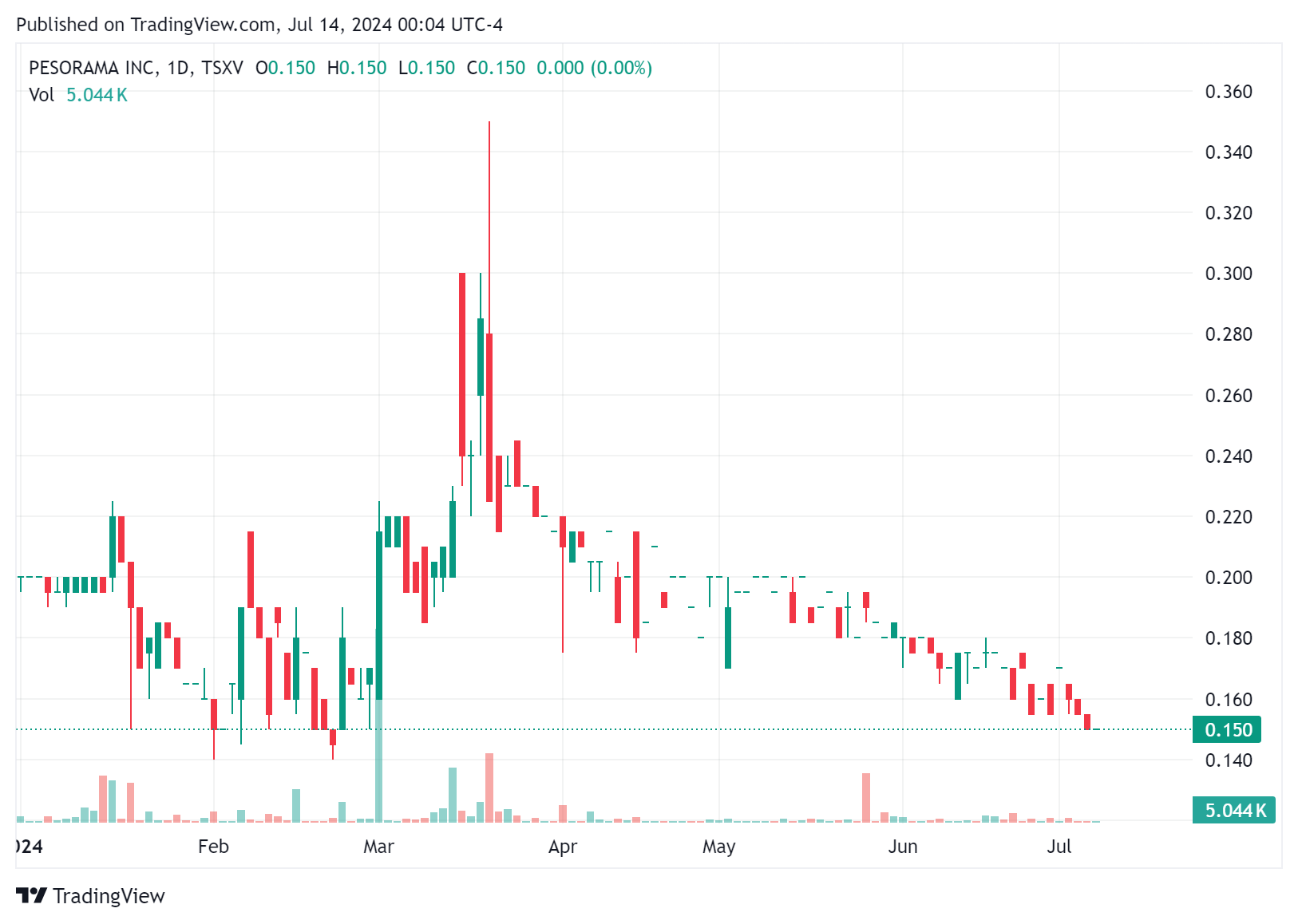
Pesorama ($PESO.v)

TradingView chart

Subscribe Now to My FREE Newsletter (Join 5,000+ Subscribers!)

What are your favourite stocks currently?

Regards,
Robin (r.speziale@gmail.com)

***

Author’s Ownership Disclosure (July 16, 2024): CSU (yes), DSG (yes), HPS.A (yes), LMN.v (yes), MEQ (yes), SHOP (yes), TOI.v (yes), VHI (yes), WELL (yes), ATD (yes), DOL (yes), PESO.v (yes)

One Stock Portfolio

Investing

Subscribe Now to My FREE Newsletter (Join 5,000+ Subscribers!)

It almost feels like a sin.

The one stock portfolio.
What about diversification?

But if you think about it, most of the world’s wealthiest people put all of their eggs into one basket – their business.

Why is investing in a stock portfolio so different?

We’re told to “diversify, diversify, and diversify some more” to protect ourselves. But is it the right thing to do?

A diverse portfolio might make you comfortable in 30 years’ time, but it won’t make you rich and it certainly won’t change your life.

After 18 years of playing this game, the thought of a more concentrated portfolio has become increasingly alluring (albeit still a bit sinful) to me. So not necessarily a one stock portfolio from the get-go, but if I play my cards right and make a bold bet – the right positioning early on and capital appreciation over time might make it a 80%-in-one-stock portfolio.

Concentration = conviction.

Buffett and Munger tell us to carry around a symbolic ‘punch card’ and that before we invest in a stock – remember that there’s only so many punches in that card available to us during our lifetimes.

It’s to help us tame our insatiable desire to constantly buy more stocks, diluting the future returns in our portfolio.

That seems to have worked out pretty well for them.

Subscribe Now to My FREE Newsletter (Join 5,000+ Subscribers!)

I recently read the book, Richer, Wiser, Happier by William Green and in it Green writes about Nick Sleep of the now closed Nomad Investment Partnership. Sleep was quite the magician because he magically turned $1 into $10. The Partnership returned 921.1% over 13 years. Here’s the kicker – those results were mostly driven by only 3 stocks – Amazon, Costco, and Berkshire Hathaway. After closing the fund in 2014, Sleep just took his portion of those three stocks with him to form his personal portfolio.

Others have concentrated too (some even unintentionally):

Philip Fisher, one of Warren Buffett’s early idols and author of one of my favourite books of all time – Common Stocks and Uncommon Profits – credited most of his investment success and personal wealth to one stock; Motorola. Fisher said: “if you are in the right companies, the potential rise can be so enormous that everything else is secondary. Every $1,000 I and my clients put into Motorola in 1957 is now worth $1,993,846 — after all the ups and downs of the stock and of the market.” Fisher smartly first bought Motorola stock in 1955 and courageously held on until his death in 2004.

Benjamin Graham, who taught Buffett at Columbia Business School ironically made most of his life-changing wealth in a growth stock, not a value stock – the latter of which he based his entire educational and professional career. That stock? Geico. Graham said: “the aggregate of profits accruing from this single investment decision [Geico] far exceeded the sum of all the others realized through 20 years of wide-ranging operations in the partners’ specialized fields, involving much investigation, endless pondering, and countless individual decisions.” In 1948, 12 years after GEICO’s founding, Graham’s firm (Graham-Newman Corp.) bought 50% of GEICO for $712,000. By 1972, the value of that investment had grown to $400 million.

Rakesh Jhunjhunwala, who recently passed away, attributed the vast amount of his wealth to the Titan Company. This Tata group business rose from around ₹3 (during the time Rakesh first built a position in 2002) to ₹3000 where it currently trades at now. Yes, you read that right; a 1,000x return. At the time of his death, the Rakesh estate held 44,850,970 Titan Company shares, around ~5% of their total public float. When asked in 2010 by a reporter from The Economic Times if he would ever sell any shares, Rakesh said: “I will sell Titan one day, but I do not know when. I have a dream. I will sell my share for a billion dollars, otherwise I would not hold on to the stock.” Amazingly Rakesh never sold out of his position in Titan even through all of the market turbulence. Today that position is worth around $1.6B USD. Now that’s vision + conviction!

Subscribe Now to My FREE Newsletter (Join 5,000+ Subscribers!)

This Former Poker Player Now Runs a MicroCap Fund in Canada With Millions Under Management

Investing

Subscribe Now to My FREE Newsletter (Join 5,000+ Subscribers!)

(Original Interview: July 31, 2023)

You’re in for a treat.

I recently caught up with Mathieu Martin.

He’s a fellow DIY Investor (now turned Portfolio Manager) who I originally met years ago through the blog he co-founded – Espace MicroCaps.

The MicroCap world is small, and Mathieu is one of the good ones.

Now with a couple of years under his belt as Portfolio Manager of the MicroCap Fund at Rivemont Investments (based in beautiful Montreal), Mathieu has some stories to share about investing in the micro-cap space.

Enjoy 😉

***

Robin: It’s great catching up. For the readers of my newsletter, please tell us about your background.

Mathieu: Thanks, Robin. Nice to talk again. I have a somewhat unusual background. My parents were self-employed small business owners and taught me early on that you could make a living as an entrepreneur. I tried many ways to earn money when I was young, but nothing worked out. I worked for my father’s business for several years, first as a delivery man for medical equipment, then in sales, and then as a small store manager. I started playing poker in my free time and quickly developed a passion for it.

How did you become interested in the stock market?

After a few years, I had significant savings (at least for someone in his mid-20s) but didn’t know anything about investing. I didn’t go to university and had no finance background at all. One of my friends, Philippe Bergeron-Bélanger, started telling me about his investment strategy which involved buying obscure Canadian microcap companies. I was intrigued, and I quickly got hooked. I realized that, like in poker, you can win money if you find inefficiencies to exploit, and there were plenty of inefficiencies in the microcap sector.

In 2014, I started reading finance books, attending conferences, talking to other investors, and accumulating investing experience by trial and error (many errors back then). My friend Philippe invited me to become his partner in a blog he had started called Espace MicroCaps. Our goal with the blog was to share educational articles and some of our best investment ideas and to build a community of like-minded investors in Quebec.

That’s how we connected – through the blog. Good times.

Yeah fast forward a few years later, the community was thriving. We developed our network across Canada and got known for the quality of our research and stock picks. I was able to compound the capital in my TFSA at 40%+ CAGR (unaudited) during those first few years. Philippe did even better. Friends and family started to inquire about what we were doing and how they could participate.

Excellent results! And then you turned your investment success and passion into a dream job…

Yes, exactly. In 2018, we convinced Rivemont Investments, a forward-thinking asset management firm in Quebec, to launch a microcap strategy called the Rivemont MicroCap Fund. That was essentially creating a vehicle where our friends and family (at first) could invest to get exposure to our investment ideas. We were hired as outside consultants to provide fundamental research and portfolio strategy to Rivemont’s team.

What was your journey from consultant to portfolio manager?

In the meantime, I enrolled in the Chartered Financial Analyst (CFA) program. For those who don’t know, the CFA requires a university degree or four years of work experience (in any field) to allow you to enroll. Enrolling in such a demanding program without any formal education or background in finance was a significant undertaking, but I did anyway. I passed all three exams on the first try and earned my CFA charter in November 2020. That then allowed me to join Rivemont as a senior analyst and eventually as portfolio manager of the microcap strategy in December 2021.

You conquered the CFA. That’s a really inspiring story. Thanks for sharing. Tell us about your strategy at the Rivemont MicroCap Fund.

Our mandate is to invest in North American microcap stocks with a market cap of $300M or less. We focus more specifically on the Canadian market because it’s our home turf and where our network is most developed. There are about 4,400 public companies in Canada, of which about 3,500 are considered microcaps. There are a lot of opportunities to look at, and very few investors (or at least professional investors) are looking at them, which makes the sector ripe for finding mispricings.

Subscribe Now to My FREE Newsletter (Join 5,000+ Subscribers!)

With so many stocks out there – what’s your filtering methodology?

Part of what makes our strategy unique is what we avoid. The goal is to shrink the investable universe to a more manageable level and to know this universe better than most people. We typically avoid anything commodity-related (mining, oil and gas), which removes about two-thirds of the Canadian market. We avoid pre-revenue companies, largely unprofitable companies, story stocks, etc. That leaves us with about 150-200 companies we can do a great job of following more closely.

Ok so out of the ~ 3,500 micro caps trading in Canada, only around 5% are actually worth further investigation. Can you walk us through your evaluation process for these short-listed stocks?

We evaluate and rate companies on three main dimensions: business quality (moat), management quality, and valuation. We meet a lot of management teams and typically meet a company several times before investing. It’s crucial to put in the reps and take meetings with lots of management teams to become good at assessing management quality. Unfortunately, most people overpromise and underdeliver. When you can find a management team that does the opposite, you know you’ve found something special.

Makes sense. In smaller companies you place as much (or more) importance in the jockey (management) as you do in the horse (business). what’s your portfolio size and concentration?

We aim to construct a portfolio with 15 to 25 of our best ideas, with a high concentration in the top 5 holdings. Currently, our top 5 collectively represent over 60% of the assets under management in the strategy.

What about industry breakdown?

We are also very concentrated in terms of industries. Technology and healthcare make up about 80% of the portfolio, with the rest split between consumer goods, finance, and industrial. We are bottom-up investors, so the only reason for being concentrated in two primary industries is simply because we tend to find high-quality companies that meet our criteria mainly in these two sectors.

What’s your edge over other funds investing in small companies?

An important aspect that differentiates us from other microcap funds in Canada is that we try to invest in the smallest and most illiquid companies out there. While most other small/microcap funds will typically focus on the $100M to $1 billion market cap range, the median market cap of our portfolio companies is $34M (and about $40M on a weighted average basis). That allows us to find great companies early and generate outsized returns when we are right.

Tell us about the biggest winner in the fund.

Our biggest winner since the fund’s inception was Xebec Adsorption (spoiler alert: the company is now bankrupt). We found it back in 2018 at an investor conference, and it was later recommended to us by a smart investor in our network. The company sold bio-gas upgrading equipment to produce renewable natural gas.

The market cap was about $40M back then, and the company had recorded $15M in revenue the previous year (2017). In May 2018, they announced a large order from a group in Europe for $51M over three years, which more than doubled the revenue run-rate and provided huge validation of their products and technology. The stock barely moved in the following weeks, and we started accumulating a position. Then the discovery happened.

The company continued announcing new sales and aggressively grew its revenue over the next few years. Several analysts from investment banks started to launch coverage on the company, and all the funds and cleantech ETFs began to pile in.

In 3 years, they basically went from 0 analyst coverage to 10-15 analysts and from a valuation of 2-3x EV/Revenue to 10-15x, on top of growing their revenue 300-400% during that period. The market cap almost reached 2 billion $ at the peak and was a 16-bagger for us. At that point, we felt the stock was extremely overvalued and priced for perfection. We were fortunate enough to realize that and took a lot of profits on the way up and also on the way back down when the company started to miss expectations. In aggregate, including the warrants from financings we participated in, the company was roughly a 10-bagger on our invested capital.

What ultimately went wrong at Xebec Adsorption?

After we sold, the company had several operational issues and cost overruns on its projects, which led to severe financial difficulties and a turnover of the whole management team. It ultimately went bankrupt in late 2022.

What are the biggest takeaways from your biggest winner? It obviously wasn’t a long-term hold (as you would have hoped) but you were fortunate to lock-in those gains as you closely followed the company’s performance.

Subscribe Now to My FREE Newsletter (Join 5,000+ Subscribers!)

The main takeaways for me were:

1)     It is extremely rare to find a company that will execute year after year and become a much bigger company sustainably, like XPEL, for example (we don’t currently own it). Most microcaps will have a few good years and then encounter challenges that will break them.

2)     You always have to monitor microcaps and reassess if your thesis is still unfolding as you expect. Don’t be afraid to change your mind when you see cracks starting to appear.

3)     You must be willing to sell (at least some) and take profits when the valuation is overvalued. Take that capital and funnel it to smaller, more undervalued and undiscovered ideas.

Although I expected to hold Xebec for several years and saw the potential for them to be worth several billion $ in market cap eventually, I had to change my mind quickly when the thesis changed. That’s how we got a 10-bagger out of a now-bankrupt company. Some luck, some skills and a great timing.

Let’s look forward. What’s your favourite ‘punch-card idea’ now? If the stock market closed today and you had to choose one stock for the next 10 years…

My favorite investment idea by far right now is Kraken Robotics (TSX-V: PNG – we own the stock, and this is not investment advice). Kraken is a marine technology company providing complex subsea sensors, batteries, and robotic systems for exploring our oceans.

How long have you owned Kraken Robotics?

It’s a company we’ve owned since the early days of the microcap strategy. At the time, the company had generated $3.5 million in revenue in its most recent fiscal year (2017). Five years later (2022), the company posted revenues of $41 million with an EBITDA of $5.3 million.

Kraken also has a substantial backlog for the coming years, having announced more than $120 million in new contract wins in the last eighteen months.

Earlier this year, the company provided guidance for 2023. They forecast revenue of $66 to $78 million this year with an EBITDA of $12 to $17 million, representing revenue growth of 76% and EBITDA growth of 275% at the mid-point of the guidance ranges. We have been highly impressed with the execution of the business plan since we started following the company, and we believe that Kraken still has a lot of room to go.

There’s been some recent softness in the stock price…

The stock is currently depressed because we suspect the founder (now retired) is selling part of his position in the market, which creates substantial downward pressure on the stock. Our research leads us to believe that there are no negative fundamental reasons why he would be selling.

Subscribe Now to My FREE Newsletter (Join 5,000+ Subscribers!)

What’s your outlook for the company?

We model 2023 at the high end of the guidance ranges and believe the company currently trades at only 5-6x forward EV/EBITDA. We believe this is incredibly cheap for a company with these growth metrics and a track record of execution. Again, this is only our opinion and not investment advice – please do your own research.

What about the ever-important aspect of risk management? Explain your approach, including why/when you sell stocks in the fund.

I touched on it in the Xebec case study. The main reasons why we reduce our positions or sell completely are the following:

1)     The investment thesis deteriorates.

2)     The stock gets extremely overvalued.

3)     We find a new opportunity that’s significantly better than something we own in the portfolio.

In general, we scale into our positions over time, starting with a 1-2% weighting at initiation and increasing to 10-15% when we develop enough conviction (which is rare). There is typically a lot of turnover in the smaller positions, but we tend to hold the larger ones for several years.

Anything in particular you’re observing now in this market?

I consider myself a bottom-up stock picker, so I don’t spend much time on the macro stuff and trying to predict the economy or what the market will do. However, I’ve noticed lately that there’s a growing disconnect between smallcap and largecap valuations. The S&P 500 is currently trading at 26x trailing P/E, while smallcaps (using the Russell 2000 index as a proxy) are trading at only 12x. This is a massive gap in absolute terms and relative to Russell 2000’s historical mean of 17-18x P/E.

I’ve been noticing the same…

Yeah. The market can stay irrational for longer than we hope or expect, so I’m not saying this will change tomorrow. But I believe that this gap has to narrow or close entirely at some point, which would lead to a significant outperformance of the small/microcap asset class. I’m personally extremely bullish on microcaps with a long-term horizon.

Thanks for this interview, Mathieu. It’s been great to catch-up, learn more about you and the Rivemont MicroCap Fund. Yours is a most interesting and inspiring story. But outside the investing world, what do you do for fun?

I run ultramarathons in the mountains. I’ve run a few 50-80km trail races, and my longest one was 106km. Those events can take up to 15-18 hours to complete and not only require being in excellent physical condition but also having the mental strength to suffer for extended periods. The grit and perseverance I developed through running are very helpful when enduring the stock market’s volatility, especially after the past couple of years of extreme suffering for us microcap investors.

I love the grit and can-do attitude! Any closing comments?

Late in every race, I tell myself just to keep putting one foot in front of the other. Moving forward is the only way to reach the finish line eventually. When I do, the pain will subside and my body will recover before attempting to climb bigger mountains the next time. You can apply the same thinking to microcap investing. The bear market will end at some point. Microcaps will recover and go on to reach higher peaks. We just have to stay in the game long enough by holding or finding great companies to own!

Thanks, Mathieu.
(Want to contact Mathieu? mathieu.martin@rivemont.ca)

Subscribe Now to My FREE Newsletter (Join 5,000+ Subscribers!)

Goodbye SEDAR, Hello SEDAR+ Plus

Investing

Subscribe Now to My FREE Newsletter (Join 5,000+ Subscribers!)

I’m going to miss it.

I first used SEDAR (System for Electronic Document Analysis and Retrieval) in 2005.

SEDAR, for those who don’t know, houses all of the financial statements and news releases that publicly traded Canadian companies upload to the website.

So if you want to be the first to know about company financials and news – you need to use SEDAR – because most companies aren’t even reported on by major news outlets like BNN. Only the big ones.

In 2005, it was my Accounting 101 Professor who told our class about the archaic website, SEDAR, asking us to download any company’s latest annual financial statement of our choosing and then run some basic calculations (e.g. ROE, etc.).

SEDAR was originally launched on January 1, 1997 and for over 25 years, it was never updated. It looked old. That was the running joke.

Until now…

This week, SEDAR+ officially launched, replacing the old SEDAR website. My first impression? I miss the old SEDAR 😦

Joke’s on us!

It feels like they’ve taken the Bloomberg keyboard away from us old-timers who have grown accustomed to the original SEDAR, and replaced it with something that might look better.. but doesn’t function like we want it.

There’s no going back now.

Oh well!

Subscribe Now to My FREE Newsletter (Join 5,000+ Subscribers!)

MicroCap Success Story

Investing

Subscribe Now to My FREE Newsletter (Join 5,000+ Subscribers!)

Imagine acquiring a 1%+ stake in a public company for under ~ $1 per share, and then its stock price goes parabolic? The company reaches a billion dollar market cap and makes you a multi-millionaire.

That’s the dream, right?

The beauty of hunting in micro-cap land is that it’s possible, but not guaranteed, of course. (remember: investing is risky)

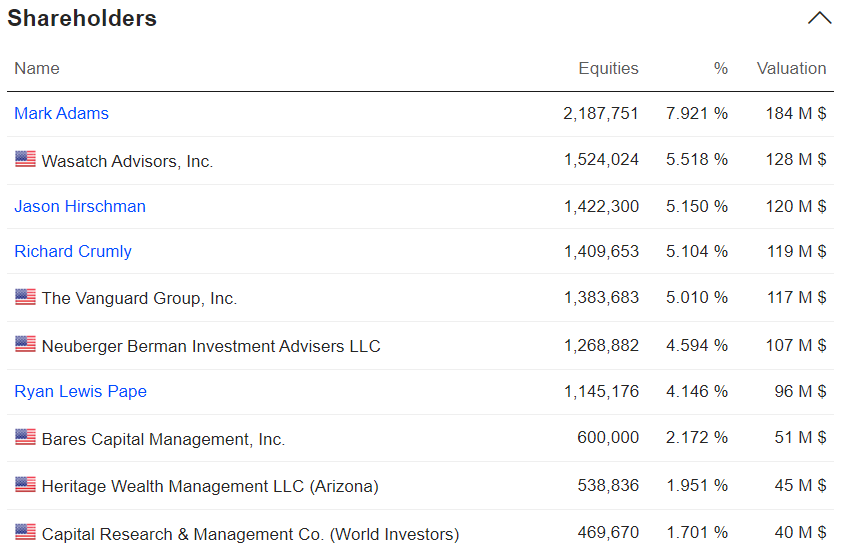
This MicroCap Success Story happened to a DIY investor named Jason Hirschman who invested early on in Xpel Inc., a company that sells protective films and coatings, primarily for cars; automotive paint protection film, surface protection film, automotive and architectural window films, and ceramic coatings.

Currently holding 1,422,300 (5.150 %) shares in what is now a $2.3 billion market cap company, Jason owns a bigger stake in Xpel than even its CEO – Ryan Pape.

Source: https://www.marketscreener.com/quote/stock/XPEL-INC-16725576/company/

Search “Jason Hirschman” on YouTube and you’ll find lots of info-packed interviews where Jason shares his process. Inspiring, indeed.

Xpel has made more millionaires out of DIY investors, including one of my readers who has asked to just be called “Max”.

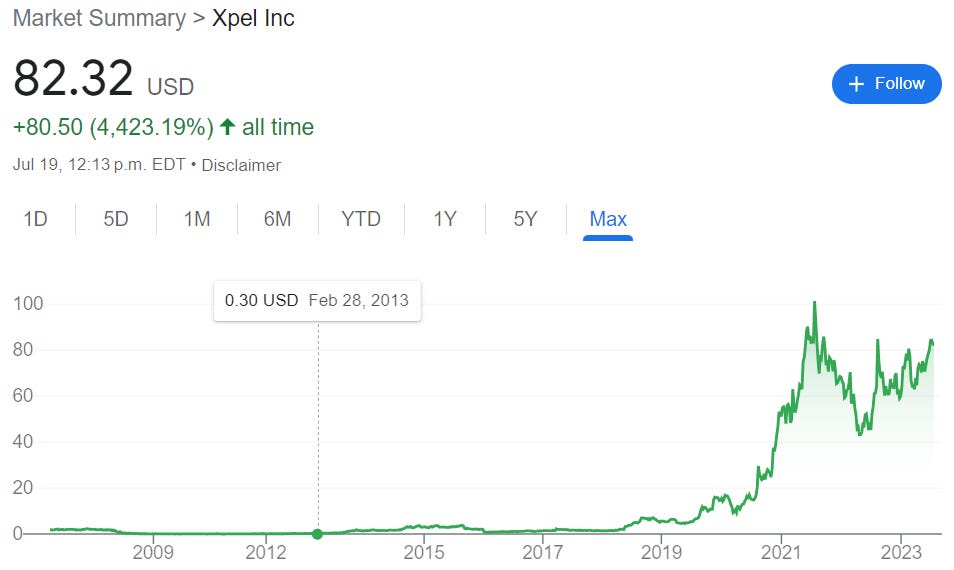
Max started acquiring shares in Xpel at the low cost of $0.31 per share. Now the company trades at a whopping $82 per share in USD as the company voluntarily delisted from the TSX Venture in August 2019 to solely trade on the U.S. Nasdaq exchange.

At the time, Max said that his position in Xpel was worth 7 figures.. but by now it might be well into the 8 figure range unless he sold along the way.

I wrote about Max in my book, Capital Compounders (2018). Here’s the chapter:

***

Rags to Riches (XPEL)

By: Max

In February 2013, XPEL caught my attention as it started to move up ever so slightly. On February 28, 2013, I bought 73,000 shares at $0.31. Why; several reasons:

1. Stock trending higher

2. Very clean company, no options or warrants and large insider position; roughly 30% +

3. Valuation was key;  $0.31 x 25 million shares = $7,000,000 market cap

4. Superior software for the cutting of patterns

    I rode the wave up and bought and sold till it peaked and turned down. I sold 150,000 shares in total till I was down to 48,000 shares at the end of Dec, 2017. Through 5 years of  exceptional revenue growth,  the growth didn’t fall to the bottom line and the company was very tight lipped about anything they were doing.

    The 3M lawsuit created another opportunity as investors threw in the towel and feared the company would even going out of business. When I compared many companies to XPEL, I found XPEL to be cheap on a revenue to market cap basis compared to 98% of all the other companies I came across.

    Post settlement with 3M, I repurchased around 75,000 shares between $1.50 and $2.45. averaging around $2.00.  I reinvested around $200,000 Canadian dollars because it was cheap. I did not know if XPEL could execute the business plan but my downside was covered in my opinion. By the way, XPEL did show up on Joel Greenblatt’s screening as a value buy.

    I am long 90% of my position still in XPEL. It has become a 7 figure valuation for me in Canadian dollars. All of the stock is in my RRSP and TFSA. So I’m not paying the taxman yet.

    The lessons learned and employed were the following:

    1. Valuation is key.  Don’t put yourself in a position to lose money, although frivolous lawsuits can be a hindrance. Understanding risk is key. Lessons taught by many. Howard Marks resonated with me on that particular point.

    2. To make outsized profits, concentrated positions are necessary. Munger and Druckenmiller are examples.

    3. Understand the company inside out. This I got lucky with as I was involved from the inception but I kept my eye on the ball the whole time.

    4. Liquidate a position on the way down. This allowed me to sell 75% of the position before reloading.  This is a Livermore rule.  You never know where a top is but you can see it turn.

      I don’t ever believe I can do that again but it has been life changing for me. Part of it is being in the right place at the right time. So luck plays a part in it no doubt.

      ***

      Do you have a MicroCap Success story that you want to share? Email me and I’ll publish it in the next newsletter.

      Author’s Ownership Disclosure (July 20, 2023): Xpel Inc. (yes)

      Subscribe Now to My FREE Newsletter (Join 5,000+ Subscribers!)

      Small Cap Renaissance: The next bull market might be coming sooner than you think…

      Investing

      Subscribe Now to My FREE Newsletter (Join 5,000+ Subscribers!)

      Slowly, then all at once.

      I’m starting to see money flow back into smaller companies (sub $1B market cap) on our Canadian exchanges. Albeit slowly and not distributed but that may soon change. Insiders and smart buyers are nibbling. Even some substandard stocks (I won’t name names) are being short-squeezed here.

      Who’s left to sell at this point?

      So if you can allocate capital to outstanding small companies now you should be in a good position during the next bull run.

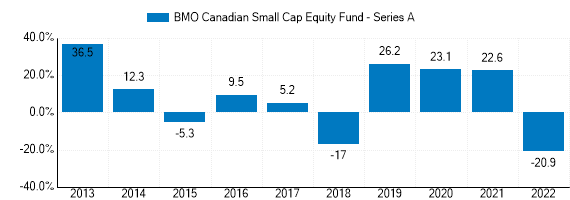
      The often used benchmark for this space – BMO Canadian Small Cap Equity Fund – is currently down -3.99% YTD. Last year it was down -20.9%, which was its worst return in 10 years. But horrible years rarely follow miserable years.

      Will the pendulum swing back up? History says yes.

      bar graph shows percentage rate of fund’s performance by year

      Optimism is in the air:

      – IPOs are slowly picking up
      – Increased talk on Twitter about micro and small-caps
      – Better than expected earnings results
      – Seemingly unrelenting inflation is finally being tamed
      – Investors hiding in large-cap defensive stocks are starting to come out of their shells
      – Smaller innovative companies riding strong tailwinds and placing big bets on the future just can’t be ignored any longer

      Subscribe Now to My FREE Newsletter (Join 5,000+ Subscribers!)