Enjoy the interview! 🍿👇 In this episode, Paul Harris discusses the evolution of wealth management, emphasizing a holistic approach that integrates financial planning, tax management, and insurance. He reflects on the changes in the asset management industry, the importance of adapting to new technologies, and the significance of maintaining strong client relationships. Paul shares insights on market predictions for 2024, his investment philosophy focusing on concentrated portfolios, and the value of understanding fixed income. He also highlights the importance of reading fiction for personal growth and enjoyment.
DISCLAIMER: This content is for informational purposes only, and should not be construed as offering of investment advice or stock recommendations. This content is based on the author’s independent analysis and research and does not guarantee the information’s accuracy or completeness. The information contained in this video is subject to change without notice, and the author assumes no responsibility to update the information contained in this video. All information contained herein this video should be independently verified with the sources and companies mentioned. The author is not responsible for errors or omissions. The author does not purport to tell or suggest which investment securities viewers should buy or sell for themselves. Those viewers seeking direct investment advice should consult a qualified, registered, investment professional. The author is not a professional or financial advisor, and does not provide financial advice. Viewers are advised to conduct their own due diligence prior to considering buying or selling any stock. The author will not be liable for any loss or damage caused by a viewer’s reliance on information obtained in any of this content. It’s important to understand that investing involves risk, including loss of principal. The author is not engaged in any investor relations agreements with any of the publicly traded companies mentioned. The author does not receive compensation of any kind from any publicly traded companies that are mentioned in any of this content. The author has acquired and may trade shares of some of the companies mentioned through open market transactions and for investment purposes only. Refer to the “author’s ownership disclosure” where applicable. There may be affiliate links to Amazon, and other companies in which the author is compensated if any of the affiliate products are purchased from Amazon.ca/.com or any other companies.
Enjoy the interview! 🍿👇 In this episode of the Capital Compounders Show, host Robin Speziale interviews Bruce Campbell from Stonecastle Investment Management. They discuss the advantages and challenges of investing from Kelowna, BC, the significance of the firm’s name, and the current trends in the investment market, particularly focusing on small and mid-cap stocks. Bruce shares insights into his investment strategies, recent success stories, and the importance of behavioral finance in managing client expectations. He also provides predictions for 2025, highlighting potential investment opportunities and the impact of political changes in Canada.
DISCLAIMER: This content is for informational purposes only, and should not be construed as offering of investment advice or stock recommendations. This content is based on the author’s independent analysis and research and does not guarantee the information’s accuracy or completeness. The information contained in this video is subject to change without notice, and the author assumes no responsibility to update the information contained in this video. All information contained herein this video should be independently verified with the sources and companies mentioned. The author is not responsible for errors or omissions. The author does not purport to tell or suggest which investment securities viewers should buy or sell for themselves. Those viewers seeking direct investment advice should consult a qualified, registered, investment professional. The author is not a professional or financial advisor, and does not provide financial advice. Viewers are advised to conduct their own due diligence prior to considering buying or selling any stock. The author will not be liable for any loss or damage caused by a viewer’s reliance on information obtained in any of this content. It’s important to understand that investing involves risk, including loss of principal. The author is not engaged in any investor relations agreements with any of the publicly traded companies mentioned. The author does not receive compensation of any kind from any publicly traded companies that are mentioned in any of this content. The author has acquired and may trade shares of some of the companies mentioned through open market transactions and for investment purposes only. Refer to the “author’s ownership disclosure” where applicable. There may be affiliate links to Amazon, and other companies in which the author is compensated if any of the affiliate products are purchased from Amazon.ca/.com or any other companies.
Enjoy the interview! 🍿👇 In this episode, Robin Speziale interviews Dan Matlow, CEO of VitalHub, and Brian Goffenberg, CFO, discussing their entrepreneurial journeys, the founding of VitalHub, and the company’s growth through mergers and acquisitions. They explore the challenges faced in the healthcare technology sector, the importance of building relationships, and the strategic focus on patient flow monitoring. The conversation also touches on the company’s market positioning, total addressable market, and insights for young entrepreneurs.
Ownership Disclosure: VitalHub ($VHI) – Yes
DISCLAIMER: This content is for informational purposes only, and should not be construed as offering of investment advice or stock recommendations. This content is based on the author’s independent analysis and research and does not guarantee the information’s accuracy or completeness. The information contained in this video is subject to change without notice, and the author assumes no responsibility to update the information contained in this video. All information contained herein this video should be independently verified with the sources and companies mentioned. The author is not responsible for errors or omissions. The author does not purport to tell or suggest which investment securities viewers should buy or sell for themselves. Those viewers seeking direct investment advice should consult a qualified, registered, investment professional. The author is not a professional or financial advisor, and does not provide financial advice. Viewers are advised to conduct their own due diligence prior to considering buying or selling any stock. The author will not be liable for any loss or damage caused by a viewer’s reliance on information obtained in any of this content. It’s important to understand that investing involves risk, including loss of principal. The author is not engaged in any investor relations agreements with any of the publicly traded companies mentioned. The author does not receive compensation of any kind from any publicly traded companies that are mentioned in any of this content. The author has acquired and may trade shares of some of the companies mentioned through open market transactions and for investment purposes only. Refer to the “author’s ownership disclosure” where applicable. There may be affiliate links to Amazon, and other companies in which the author is compensated if any of the affiliate products are purchased from Amazon.ca/.com or any other companies.
We’re so back. Depressed valuations, coupled with declining interest rates and returning ‘animal spirits’ are fueling the next bull run in Canadian small caps. And there’s one hedge fund manager in particular who’s capitalizing bigly. In fact, his fund was just named the #1 Hedge Fund by Performance in Canada for 2024…
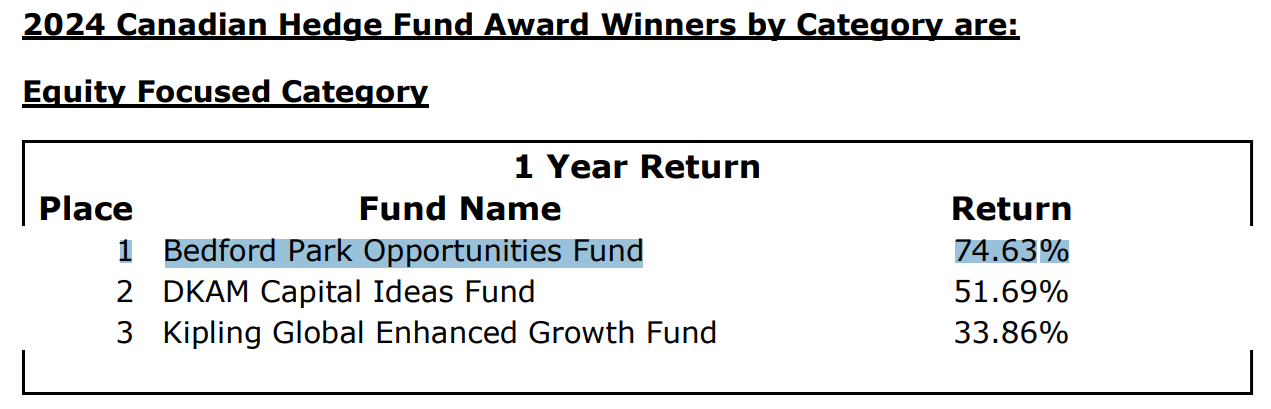
Up a whopping +74% (net of fees and expenses) for the 12-month period ended June 30, 2024, Jordan Zinberg’s Bedford Park Opportunities Fund was recently awarded first place at the Canadian Hedge Fund Awards for Best 1 Year Return in the Equity-Focused category.
Zooming out, the fund’s 5-year annualized return as of October 31, 2024 stands at an impressive 18.4% net of fees and expenses.
Zinberg got his start at RBC Dominion Securities, and then joined Donville Kent Asset Management (DKAM) in the early years of Jason Donville’s freshly launched hedge fund – contributing to its explosive growth throughout an almost 10-year stretch as Jason’s right hand-man. Then in 2018, Zinberg ventured out to launch his own hedge fund – Bedford Park Capital.
The Bedford Park Opportunities Fund runs a concentrated portfolio of small, and mid-cap Canadian stocks. Among its top holdings are:
Upon closer examination, the multi-baggers $SHLE, and $PRL did most of the heavy lifting for the fund’s record-breaking +74% year. Looking at my own portfolio, I have some overlap with Bedford Park’s top holdings; $MEQ, and $LMN.v.
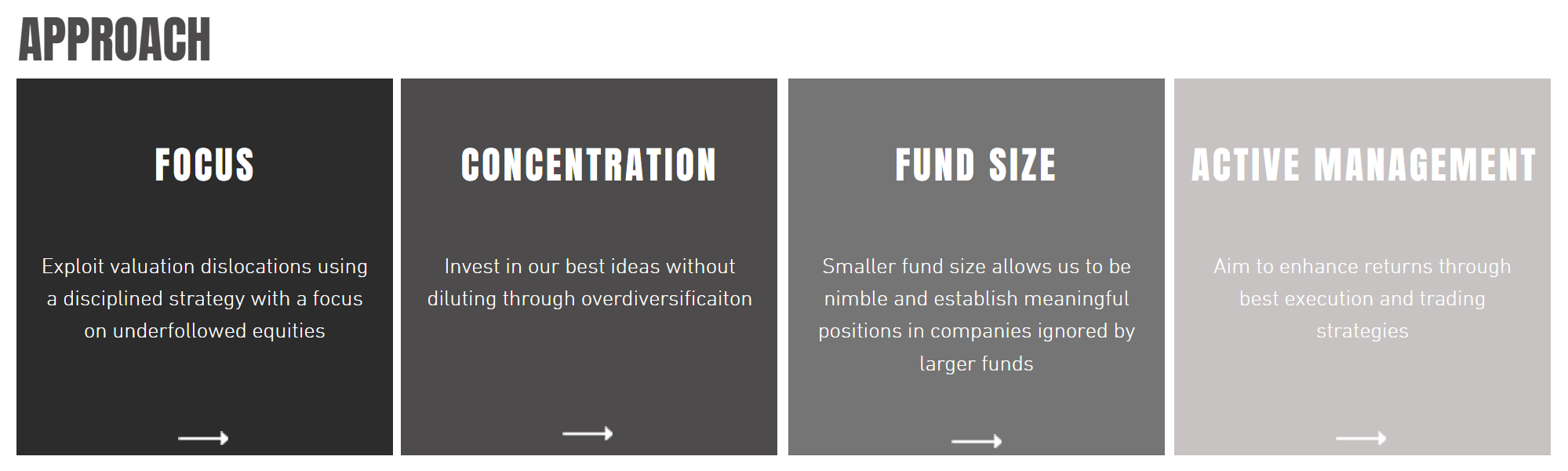
Bedford Park’s website reveals their 4-pronged approach to investing in the public markets:
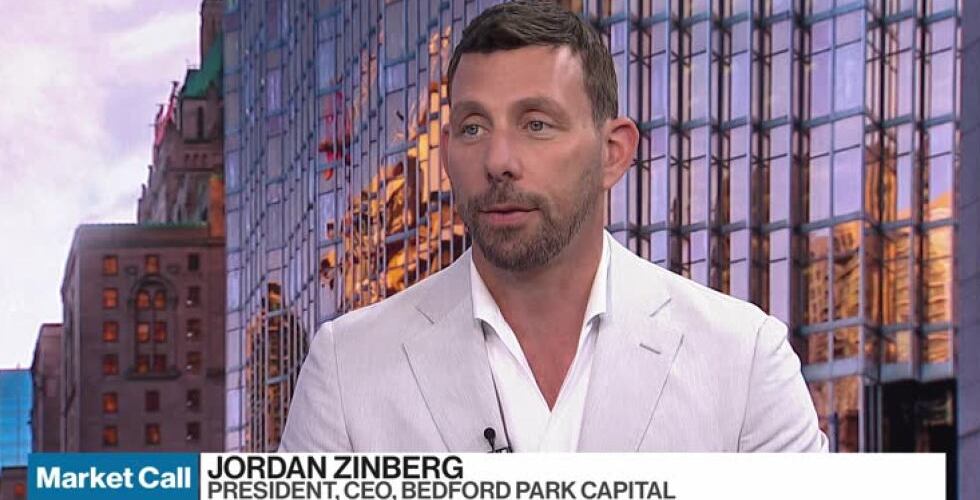
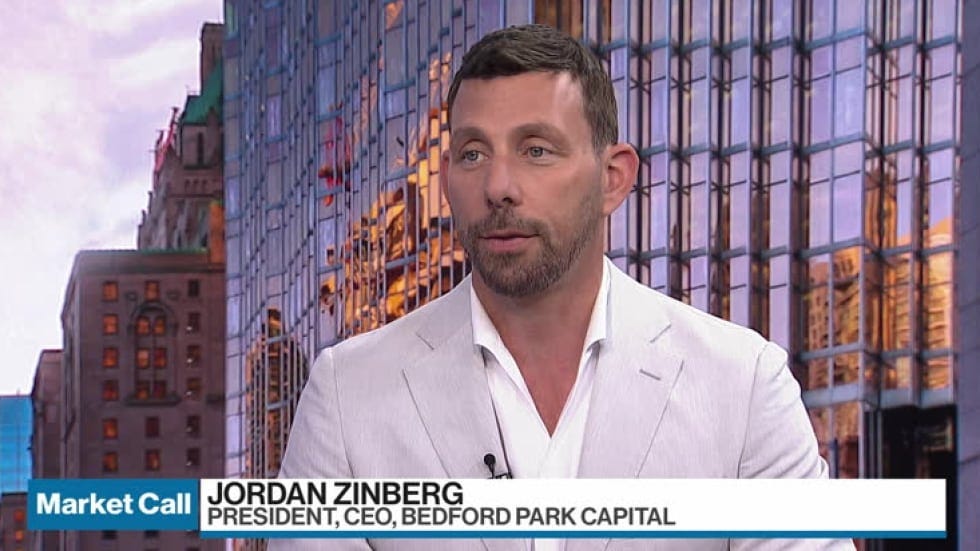
You can tune into BNN where Zinberg is frequently featured as a guest on their market Call segment. For Zinberg’s past opinions from the show, you can visit my friends at Stockchase who document all the stocks mentioned on Market Call.
I will absolutely be continuing to follow Jordan Zinberg’s Bedford Park Opportunities Fund into 2025 and beyond. While for anyone it would be challenging to immediately repeat a blow-out year, I’m confident the best is yet to come. Maybe Jordan will share his best ideas for 2025 that I can broadcast to all of you in a future newsletter (stay tuned…).
In other news:
– I’m planning a major relaunch of my Youtube channel, and will be interviewing some amazing CEO’s from my favourite companies across Canada. Subscribe now so you don’t miss the re-launch, and subsequent interviews
– I recently visited Sheldon Inwentash (founder, ThreeD Capital), and his son Jakson at their 130 Spadina Avenue Toronto office. Sheldon has a big vision for his next venture capital firm – ThreeD Capital (CNSX: IDK) – and so I was curious to hear how everything was going – including their key investments. You can listen to our exclusive conversation here(note: I do not hold any ThreeD Capital shares, nor was I paid for this interview)
– You might not know this, but DKAM / Jason Donville is back onX.com (Twitter). You can follow Donville + team here: @DonvilleKent. Notably, DKAM placed 2nd at the Canadian Hedge Fund Awards for the 2024 year. Their fund was up +52%!!
– It’s hard to believe, but my bestselling book Market Masters was released 8 years ago, time flies!
– I stumbled upon a really great clip of Bill Ackman as he opens up about his divorce and then rebuilding life from a low point. Much respect to Bill Ackman for showing this kind of vulnerability. Life’s not always easy…
– Maclean’s has released their annual list of Canada’s Richest People – “an extensively researched ranking of the country’s wealthiest grocers, tech giants, developers, investors and other mega moguls”
– David Barr (PenderFund) released an update on the Pender Small Cap Opportunities fund. You can watch the full video here
– I can’t help but think, what’s going on at Bell Canada ($BCE)? While the 10% divy yield is tempting, I’m a growth investor at the core. Will pass. But is anyone biting?
– VitalHub ($VHI) recently made their their 20th and largest acquisition to-date of Strata Health! Will be exciting to see if VitalHub can become Canada’s next billion dollar company
– WELL Health ($WELL) recently reached a significant milestone, surpassing a $1 billion annualized revenue run-rate with record Q3-2024 revenue of $251.7 million—a 27% increase over Q3-2023, driven by strong organic growth of 23%. Tremendous progress!
– Stocks & Stones recently revealed some shocking, and encouraging stats from the TSX Venture exchange; volume YoY is up a whopping +50%, and value traded ($) up +59%. Booyah – let’s hope this Canadian micro & small-cap bull run is just getting started 🙂
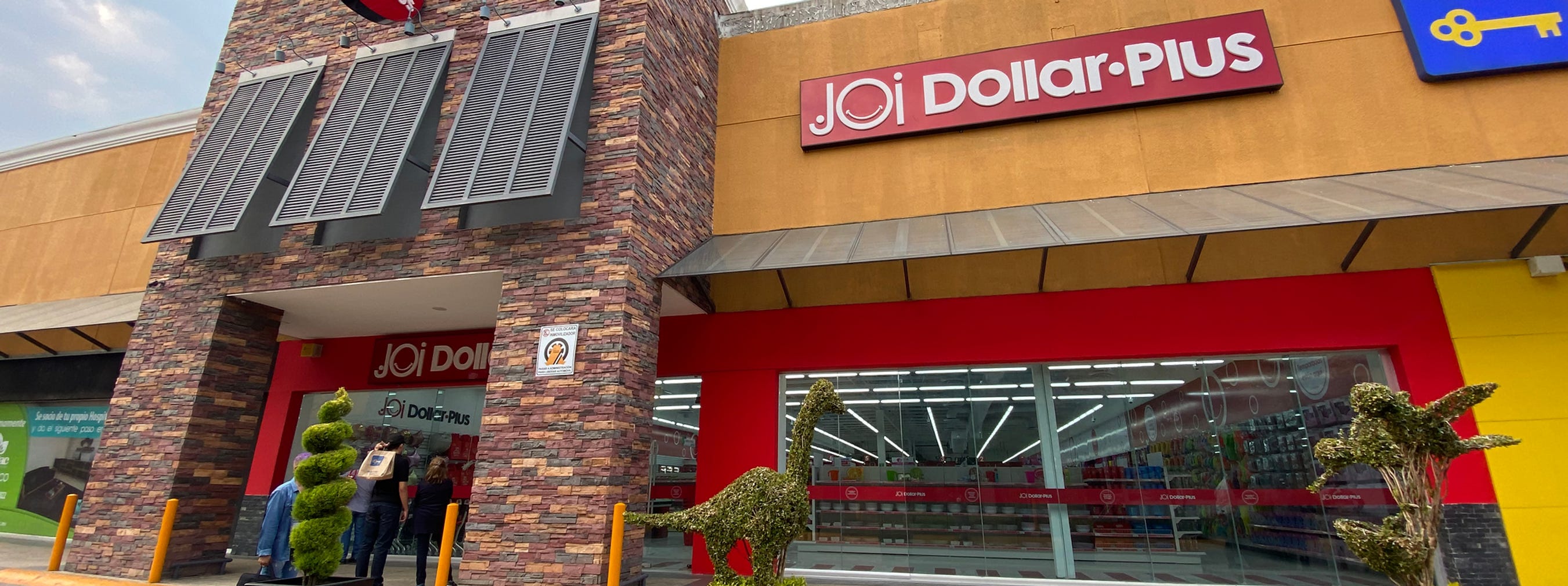
– Since writing this feature on the ‘Dollar Store Wars‘ shaping up in Mexico, Pesorama ($PESO.v) opened their 24th Joi Dollar Plus store in Mexico City on Oct 26, 2024. Then notably on November 5th, Sumesh Paul Pathak (board member) made a new insider purchase totaling 200,000 shares @ 0.12 cents per share.
[Based on Q2 2024 13F Filings] Every 3 months, I like to check up on what the BIG Superinvestors – Warren Buffett, Bill Ackman, Francois Rochon, etc. – are investing in, as well as a select group of lesser known funds / investors that you’ll find featured below.
Have a look. Are there any surprises that jump out at you?
📈 Highlights for me:
Buffett sells 50% of his Apple stake, trims 21% of Capital One, adds 262% to Sirius XM, and initiates new positions in Ulta Beauty, and HEICO
Ackman initiates new positions in Nike, and Brookfield, trimming his stakes in Chipotle by 23%, and Alphabet by 20%
Rochon doubles down on his Starbucks stake at a low point (and before the new CEO announcement)
Loeb adds 320% to Uber Technologies, 72% to Taiwan Semiconductor, and initiates a new position in Apple, rendering the company his fund’s 7th largest holding
Icahn initiates a new position in Caesars Entertainment
Tepper increases his Lyft position by 1,600%
Burry adds 88% to Baidu, and 24% to Alibaba, upping his overall bet on China
(Terry) Smith adds 39% to Texas Instruments
Chou increases his Stellantis stake by 1,400%, and makes many new additions to the fund
Watsa adds 51% to his Taiwan Semiconductor stake, and sheds the majority of his position in Micron Technology
Klarman reduces his Alphabet stake by 64%
Miller initiates a new position in Build-A-Bear Workshop
Dorsey sheds 45% of his stake in Alphabet, and initiates a new position in Sprout Social
Li Lu, following in the foot steps of Buffett (albeit, late), initiates a new position in Occidental Petroleum
Einhorn initiates new positions in Peloton Interactive, Capri Holdings, and IAC, while doubling his stake in HP
Coleman(Tiger Global) initiates new positions in United Health, Qualcomm, Applied Materials, Zkh Group, and Rubrik, while increasing his stake in Grab Holdings by 39%
Gayner initiates a new and notable position in Franco Nevada
Druckenmiller adds to his #1 holding (Coherent Corp), and trims his stakes in the iShares Russell 2000 (Call), Microsoft, General Electric, and Nvidia
Greenblatt increases his stake in Nvidia (3rd largest position)
Dalio increases his stakes in Amazon, and Microsoft, while trimming his position in Apple
Pabrai increases his stake in Arch Resources by 180%
(Cathie) Wood increases her stakes in Tesla, Roku, Roblox, Palantir Technologies, Shopify, Intellia Therapeutics, PagerDuty, and Recursion Pharma
(Steve) Cohen initiates a new position in Apple, increases his bet on Dell Technologies by 1,666%, and trims Broadcom by 67%
(Howard) Marks initiates new positions in Liberty Global, Trip.com Group, Gerdau, and Altice USA, while nearly tripling his position in small-cap stock Vacasa
AltaRock Partners initiates a new position in Fair Isaac, increases their stake in Moody’s by 36%, and sheds Charter Communications by 99%
AKO Capital initiates new positions in Amazon, and Canadian National Railway, adds 143% to Accenture, and sheds 48% of their Estee Lauder position
RV Capital initiates new positions in Deere & Co., and Salesforce
Polen Capital significantly ups its stake in Shopify by 1672%, rendering it a top 20 holding, and also initiates a new position in Pinduoduo PDD Holdings (Temu parent company)
Greenlea Lane Capital initiates a new position in Tesla, and increases its bet on Trupanion by 159%
Shawspring Partners significantly reduces its stakes in Sea, and Coupang by 55%, and 35% respectively, while initiating new positions in nCino, and Procore Technologies, as well as increasing its bet on Blend Labs by 59%
Wedgewood Partners increases its take in Edwards Lifesciences by 44%
Abrams Capital Management initiates a new position in Loar Holdings – effectively rendering the company its largest in the fund (40%) – and sells 73% of its stake in U-Haul Holding
TCI Fund Management adds 398% to its existing stake in Alphabet (going against the general selling trend seen by others), and initiates a new position in Ferrovial
FPA Crescent Fund initiates a new position in Vail Resorts, and sheds 42% of its stake in Broadcom
Makaira Partners initiates a new position in recent IPO Savers Value Village, and increases its bet on Cactus by 5x
* Please note that these 13F filings are as of June 30, 2024 and therefore might not accurately reflect today’s positions of these investors/funds
While DIY investors (like myself) don’t have access to expensive Bloomberg terminals, in-the-know brokers, or top-notch analysts, there are completely free resources available online that I use on a frequent basis (and you can too):
Today is my birthday. We’re going on a road trip with our newborn – Victoria. It’ll be nice to get away and enjoy the outdoors. If you want to help me stay caffeinated on the drive, you can buy me a coffee 😉 (got any coffee shop recommendations? Let me know!)
We’re nearing the end of summer. This is usually the time of year that I enjoy reading new books – typically on investing. But, like most of you, I’ve read (and re-read) most of the well known books on investing – The Intelligent Investor, One Up on Wall Street, Common Stocks and Uncommon Profits, etc.
If you’re looking for new reads, the good thing is that there’s absolutely hidden gems that can be discovered.. little known books on investing that were published but not well advertised, distributed, or shared word-of-mouth… Some of these books you’ll see listed below (#4, #7, #8, #14, #16) I actually found at local thrift stores near me.
So, here are the 19 must-read little known investing books that you’ve probably never heard of (and if you have, you’re elite-level good!):
The battle for dominance in Mexico’s under-developed dollar store market is intensifying, with two Canadian retailers – Pesorama (“JOi Dollar Plus” stores) and Dollarama (via the Dollarcity banner) – planning expansion across the country, targeting Mexico’s burgeoning budget shoppers.
Operating only 800 stores across Mexico, the domestic incumbent is Waldo’s Dollar Mart. Compare that 800 count to Dollarama’s 1,500+ store footprint in Canada – with its 40M population vs Mexico’s 130M (more than 3x) – and it’s clear to see that there’s opportunity for multiple dollar store players to expand throughout Mexico. The future leadership position, though, is now up for grabs.
While both Pesorama and Dollarama have ambitious plans, let’s not rule out the Americans, of course. Dollar General recently celebrated its international expansion into Mexico with its first “Mi Súper Dollar General” store grand opening in early March 2023.
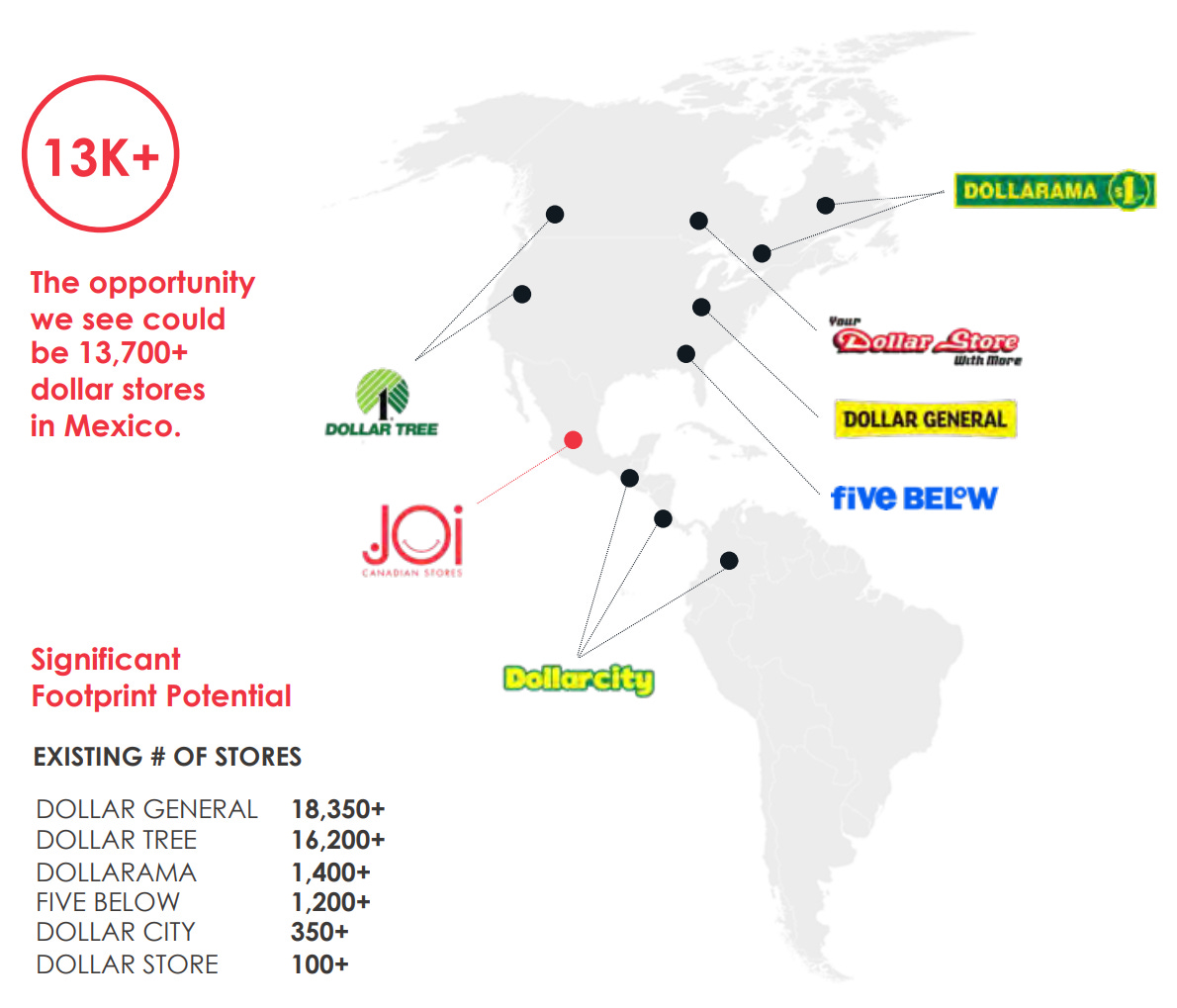
Just how big is the Dollar Store opportunity in Mexico? Pesorama, which already operates 23 JOi Dollar Plus stores across Mexico, estimated in their October 2022 Investor Presentation that there could eventually be room for “13,700+ dollar stores in Mexico”. This might be possible given how many dollar stores currently operate profitably throughout North America and LATAM (see below).
Source: October 2022 Pesorama Investor Presentation
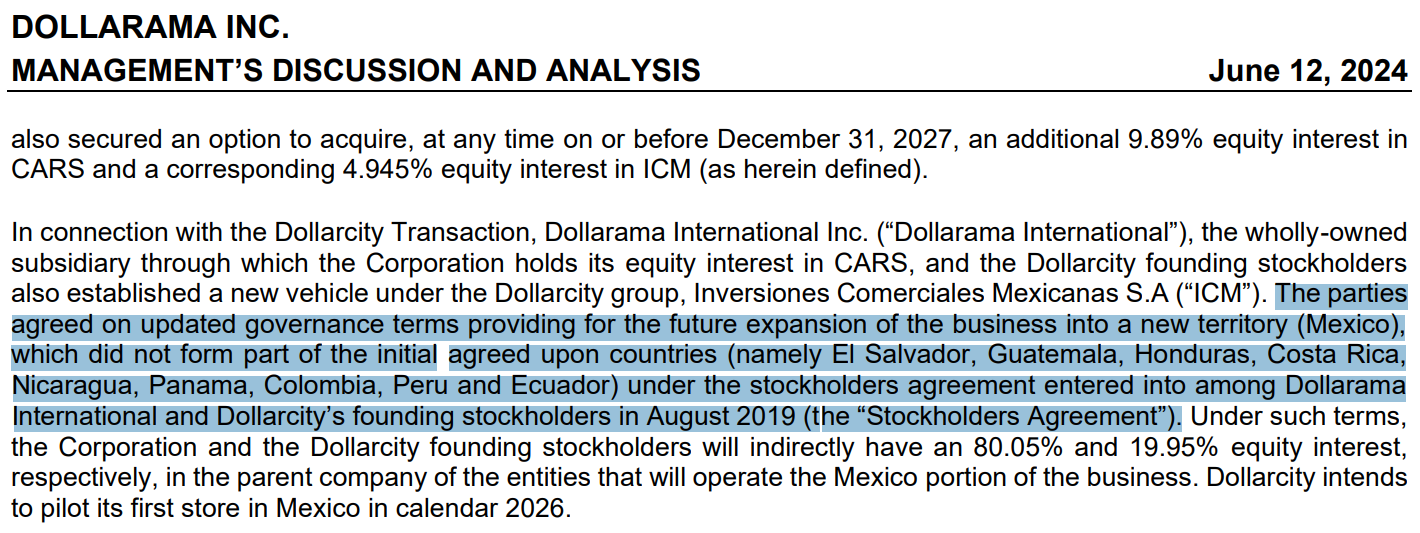
Is Dollarama late to the party, and catching up? What I find most interesting is how Dollarama announced their expansion plans into Mexico, leading me to believe that the Canadian dollar store juggernaut is possibly now playing catch-up. In Dollarama’s Q1 2025 Management Discussion & Analysis (June 12, 2024), management admitted that:
“[Mexico]did not form part of the initial agreed upon countries (namely El Salvador, Guatemala, Honduras, Costa Rica, Nicaragua, Panama, Colombia, Peru and Ecuador) under the stockholders agreement entered into among Dollarama International and Dollarcity’s founding stockholders in August 2019 (the “Stockholders Agreement”)” (see that excerpt below)
Perhaps Pesorama’s entry and expansion of its JOi Dollar Plus stores across Mexico, including other new entrants (e.g. Dollar General), caught the attention of Dollarama’s upper management. How could they just sit back and watch? But the better question – i.e., why Dollarama did not originally plan to expand into Mexico, with a population and retail market size far exceeding those aforementioned LATAM countries – is beyond me.
Dollarama, through the Dollarcity banner, plans to pilot its first dollar store in Mexico in calendar year 2026, giving the competition (both old and new) another ~2 years to expand across the country. The current leader, Waldo’s Dollar Mart, plans to open approximately 70 stores a year going forward in Mexico, meaning that they will be operating close to 1,000 dollar stores around the time of Dollarcity’s first store launch.
Dollarama is placing a big bet on the LATAM region to fuel its future growth, and try to outcompete its peers. As at March 31, 2024, Dollarcity had 547 stores with 324 locations in Colombia, 99 in Guatemala, 72 in El Salvador and 52 in Peru. Dollarcity’s revised long-term store target in these four current markets of operation is up to 1,050 stores by 2031, versus its previous target of 850 stores by 2029. That said, this increased target reflects anticipated growth mainly in Peru and Colombia and does not take into account any future expansion in Mexico.
Current Market Caps of the BIG 3 North American Dollar Stores:
– Dollar General: $25.8B USD – Dollar Tree: $22.3B USD – Dollarama: $36.9B CAD
Just how aggressive Dollarama’s Dollarcity push into Mexico will be is still undetermined. Management will most likely reveal their full expansion plan as a result of the first store opening in 2026.
On the crucial importance of LATAM growth for Dollarama, Neil Rossy, President and CEO of Dollarama said on their latest earnings call:
“Dollarcity continues to represent a compelling, long-term growth platform for Dollarama, with the Dollarcity leadership team successfully executing on its strategy throughout the course of our over decade-long partnership… Since we initially acquired a majority equity interest in 2019, Dollarcity has more than tripled its revenues and significantly grown its presence in key LATAM markets, demonstrating the underlying strength of its business model and the appetite for our value proposition from LATAM consumers.”
Indeed, with so much market opportunity up for grabs, the dollar store wars in Mexico are set to reshape the country’s retail sector in the coming years. Waldo’s Dollar Mart, while currently leading, will likely need to innovate and upgrade their existing stores to maintain its market position amid increasing competition from Dollarama, Pesorama, Dollar General, and other international entrants. With these Canadian and American dollar store brands introducing fresh new store formats, compelling customer experience, and a wide-range of products into Mexico, the Mexican consumer will surely benefit from the future dollar store marketplace.
With the rise of dollar store competition intensifying in Mexico, how do you think this will all play out?
Let’s have a look at some of the MicroCaps that I have been interested in.
WELL Health Technologies (WELL)
What it does: WELL Health Technologies Corp is the owner and operator of a portfolio of primary clinics delivering healthcare-related services It operates through below segments: Clinical services, Digital services, and others. It also engages in the Electronic Medical Records business that supports the digitization of clinics. Its objective is to empower doctors to provide the best and most advanced care possible leveraging the latest trends in digital health.
What it does: XPEL, Inc. manufactures, sells, distributes, and installs after-market automotive products in the United States, China, Canada, Continental Europe, the United Kingdom, Asia Pacific, Latin America, the Middle East/Africa, and internationally. The company offers automotive surface and paint protection, headlight protection, and automotive and architectural window films, as well as proprietary software
What it does: Kneat.com Inc is in the business of developing and marketing a software application for modelling regulated data-intensive processes for regulated industries, focusing on the life sciences industry. The company has developed Kneat Gx solution which provides management real-time visibility and control and increases product, quality, and compliance. In addition, the company provides software-related services including training, installation, upgrades, consulting and maintenance.
What it does: Kraken Robotics Inc is a Canada based company engaged in the design, manufacture and sale of software-centric sensors and underwater robotic systems. It operates in the business segments of Sensors and Platforms which is the design, manufacture and sale and provision of services for underwater sonar and laser scanner sensor equipment and underwater vehicle platform; and Power which is the design, manufacture and sale of subsea power equipment such as drives, thrusters, and batteries
What it does: Nova Leap Health Corp operates in the healthcare industry. The company is a provider of personal home care and support services. The principal business activities of the company and its subsidiaries are to provide skilled and non-medical home care to clients. Its service offering includes meal preparation, housekeeping, transportation, personal care and medication reminders.
What it does: Sangoma Technologies Corp is a provider of hardware and software components that enable Internet protocol communications systems for both telecom and datacom applications. It is engaged in the development, manufacturing, distribution, and support of voice and data connectivity components for software-based communication applications
What it does: Redishred Capital Corp manages and operates the Proshred brand and business platform in the United States and internationally. It operates the Proshred system under two business models, franchising in the United States, via direct ownership of shredding trucks and facilities in eight locations in the United States. It also operates a hard-drive destruction service.
What it does: NamSys Inc is engaged in providing software solutions for currency management and control systems for financial institutions, retailers, currency carriers, casino and mass transit operators, and various government agencies. The company is also engaged in processing for the banking and merchant industries. The company generates its revenue in the form of software license fees, Hosted services, maintenance and product support, and professional services
What it does: Airiq Inc develops and operates a telematics asset management system using specialized software, digitized mapping, wireless communications, the internet, and the Global Positioning System. Geographically, the company has operations in Canada and the United States which is the key revenue driver.
What it does: Hamilton Thorne Ltd is engaged in providing precision instruments, consumables, software and services that reduce cost, increase productivity, improve results and enable breakthroughs in Assisted Reproductive Technologies (ART) and developmental biology research markets.
What it does: Goodfood is a leading online grocery company in Canada. They deliver fresh meals and grocery products coast to coast and make it easier for their members to enjoy delicious meals at home, every week. Goodfood’s mission is to make the impossible come true, from farm to kitchen, and they achieve that by empowering members to complete their weekly meal planning and grocery shopping in less than 1 minute.
What it does: Enthusiast Gaming Holdings Inc is a gaming company building authentic lifestyle gamers. It has an online network of over 80, owned and affiliated, gaming related websites and a network of 900 YouTube channels reaching 150 million visitors. It also owns and operates Canada’s video-gaming expo, Enthusiast Gaming Live Expo “EGLX”. Its products and services fall into three principal segments: content, advertising and events.
What it does: AcuityAds Holdings Inc is a provider of a web-based platform for advertisers to connect to their end-users. The programmatic marketing platform includes Acuity’s machine learning technology that uses data for real-time advertising on social media.
What it does: Quorum Information Technologies Inc is an information technology company engaged in the automotive retail business. It develops, markets, implements and supports its software product, XSELLERATOR a Dealership Management System for the automotive market. XSELLERATOR automates, integrates and streamlines a range of processes across departments in a dealership.
What it does: Blackline Safety is a global connected safety technology leader. Providing comprehensive live-monitoring and wireless gas detection, they help teams working in hazardous environments respond to emergencies in real-time and manage efficient evacuations, accounting for everyone’s safety along the way.
What it does: Tecsys Inc is engaged in the development and sale of enterprise supply chain management software for distribution, warehousing, transportation logistics, point-of-use and order management. It also provides related consulting, education and support services. The company serves healthcare systems, services parts, third-party logistics, retail and general wholesale distribution industries.
As a child, do you remember that story about Chicken Little?
It all starts when Chicken Little believes the sky is falling after a small acorn falls on his head.
“The sky is falling!” Chicken Little shouted, telling all of his friends along the way that the world was coming to an end. The story concludes when a Fox invites Chicken Little and all of the other animals into his lair for “protection”, and then eats them – one by one – for dinner.
The moral of the story is not to be a “Chicken” but to have courage, and also not to believe everything one is told. It’s a classic story told to many of us as children, but then seems to get lost on us later in life.
We’ve seen a lot of fear-mongering out there during the COVID-19 pandemic, and I’m taking note for my naughty list. These are the same people who proclaim “the sky is falling” after each bump in the road. It’s as if they feel empowered during times of unrest.
Imagine not ever being scared, and thus as a result; making better decisions, and bolder bets.
Sometimes that just means making a decision, and then doing nothing.
In 1931, Grace Groner, from Lake Forest, Illinois, was hired as a secretary at Abbott Laboratories, where she worked for more than four decades.
As you can imagine, Grace’s salary was low and so she lived a very modest life.
In 1935, a few years after she started her job at Abbott Labs, Grace bought three shares of the company’s stock for about $60 per share. Her total investment was $180.
Grace never sold. She held onto those Abbott Labs shares through splits, and dividend payouts. Grace reinvested all of those dividends like clockwork.
In January 2010, Grace Groner passed away. It was then revealed that her estate was worth a surprising $7 million USD, thanks to the current value of her Abbott Labs shares.
I really like this story. Compounding is magic. It’s true though, Grace Groner is an anomaly. There’s a lot of companies that don’t make it that long, and most people don’t hold on even to the good companies through booms and busts in the stock market.
But still – I want to be more like Grace, and less like that guy who shares photos of his trading room with 6 computer monitors installed on the wall.
I’m hearing some chatter from the “bears” out there (esp. on Twitter) that we’ll soon be facing more significant draw-downs in the stock market throughout 2020 due to COVID-19, and that the experience will mirror the carnage from the Great Depression.
That’s just wrong. It won’t even be close.
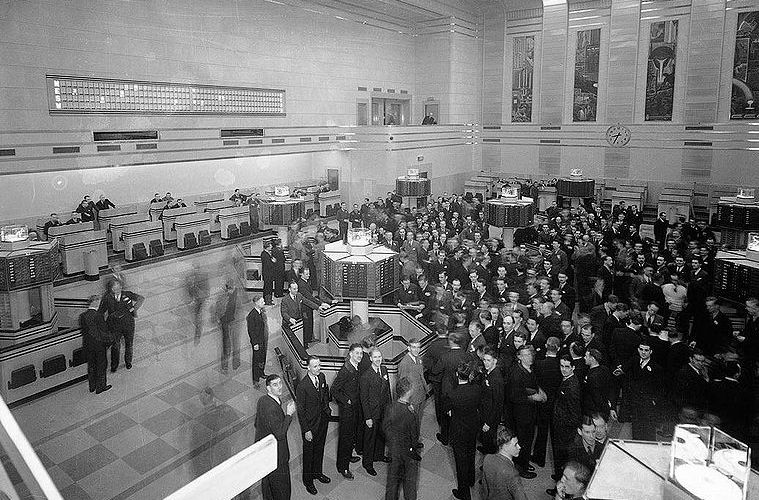
The Great Depression was a different beast.
From peak to trough, the Great Depression draw-down in the Dow Jones Industrial Average was -90%. Basically, everything was on the verge of going to zero.
(Get ready for my amateur charting skills…)
The Great Depression (1929 – 1932)
Some people are pointing to the first leg of the decline from the Great Depression (-50% ; see first circle in chart above), saying this is what we’re seeing now in March 2020, and that we have much further to fall after the recent “relief rally” that saw +20% gains from lows.
Those same people are also referencing this Boom/Bust Cycle chart below, saying with utmost confidence that we’re still currently at the “Return to normal” point near the top, and not near the point of greatest “Despair”. That’s plain wrong. These are very misguided people. We’re not heading into a multi-year period of slow death in the stock market.
Sure, we might fall further from here. But it won’t be a significant fall. No way.
Back to the Great Depression…
Why was it so bad from 1929 – 1932 (-90% Draw-down)?
In hindsight, it’s simple. The Federal Reserve at the time did not increase the monetary base, and by not injecting liquidity into the banking system to prevent it from crumbling, it passively watched the economy completely implode starting in 1929. Really terrible.
In the US:
– One third of all Banks shuttered (e.g. New York Bank of United States).
– There were rampant bank-runs.
– Loans were called en masse.
– GDP declined by 30%.
– Industrial production fell by nearly 47%.
– International trade fell by more than 50%.
– Unemployment rose to 23% and in some countries rose as high as 33%.
– Farming communities and rural areas suffered as crop prices fell by about 60%.
It was bad.
It was systemic.
Some historians say that the economy didn’t really recover until after WWII, from the resulting “baby-boom” and family formation throughout the Western World.
The late Economist Milton Friedman argued that the downward turn in the economy, starting with the stock market crash in 1929, would merely have been an ordinary recession if the Federal Reserve had taken aggressive action.
This view was endorsed by Federal Reserve Chairman Ben Bernanke (2006-2014), who was in office throughout the Financial Crisis of 2008, in a speech honouring Friedman:
Let me end my talk by abusing slightly my status as an official representative of the Federal Reserve. I would like to say to Milton…: Regarding the Great Depression, you’re right. We did it. We’re very sorry. But thanks to you, we won’t do it again.
So, when you compare today to the Great Depression, really — there is no comparison.
Today – the Federal Reserve has committed UNLIMITED Quantitative Easing (QE), combined with cutting the interest rate down to 0%. Further, the US Government recently passed $2 Trillion in stimulus. Similar efforts are being made around the world (see my earlier post for all documented stimulus packages). For those of you like me who are in Canada, the Central Bank of Canada cut its interest rate down to 0.25% (March 27, 2020), and the Canadian Government launched a $107B stimulus package.
OK – with that out of the way, I think our recovery will look more like that from 1987 (“Black Monday”) or from 2007/2008 (“Financial Crisis”). Probably a mixture of both.
Here are those charts below, along with today’s current chart (2020).
Financial Crisis (2007/2008)
The US certainly learned its lesson from the Great Depression. The first circled bottom above is when the massive $700B Troubled Asset Relief Program (TARP) was passed by Congress and signed into law by President George Bush on October 3, 2008. Around that same time, the Federal Reserve used its independent authority to spend $1.2 trillion on purchasing various financial assets and making emergency loans to address the financial crisis, above-and-beyond the $700B authorized by Congress from the federal budget. The Federal Reserve also cut its key interest rate to a range of between zero percent and 0.25%.
Yes – the market fell further up until the March 2009 nadir, after the stimulus/relief actions were launched. That’s also a possibility today. However, it didn’t fall much further from there.
The first circled bottom above is when on October 20, 1987, Fed Chairman Alan Greenspan made this statement: “The Federal Reserve, consistent with its responsibilities as the Nation’s central bank, affirmed today its readiness to serve as a source of liquidity to support the economic and financial system”. The Fed then acted to provide market liquidity and prevent the crisis from expanding into other markets. It immediately began injecting its reserves into the financial system via purchases on the open market. This rapidly pushed the federal funds rate down by 0.5%. The Fed continued its expansive open market purchases of securities for weeks.
And again, yes – the market fell after a relief rally, but retested its lows before the year was done, and then rallied into 1988. In fact, that rally turned into an incredibly long bull market.
COVID-19 Pandemic(2020)
Here we are today; March 27, 2020. Around -25% from highs, after a much-needed “relief rally”. Nobody knows exactly where the market will go from here in the short term. I especially don’t know where it’ll go tomorrow, next week, next month, or even next year (I wish!). What I do know, however, is that this is no Great Depression. Faaaaaar from it.
Wait, though. You might be thinking, “so what – COVID-19 cases are still on the rise…markets will keep falling”. That might be true… to a point. This virus is a tragic thing. I don’t want to seem insensitive here…. But the stock market will recover before COVID-19 cases peak. That’s just how the stock market works. And the spread has happened in phases; starting in Asia, then affecting Europe, and now North America.
We’ll get through this soon, saving as many people along the way.
At the end of the day – it’s impossible to time the market.
Some people dip in and out during crashes.
Or they sell-out, and just sit on the sidelines .
That’s not the smart thing to do.
Here’s why:
If you sell and are still on the sidelines during a recovery, it can be difficult to catch up. Missing even a few of the best days in the market can significantly undermine your performance.
I’ve posted below a visual (Growth of $10,000 invested on January 1, 1980) of what I’m talking about, courtesy of Fidelity.
Its shows that you lose out by missing the best days in the market, which are usually clustered around very large draw-down periods in the stock market, like the one we’re currently experiencing most recently in 2020 due to COVID-19.
Don’t believe me? OK – let’s go further back… to 1930
Looking at data going back to 1930, Bank of America found that if an investor missed the S&P 500′s 10 best days in each decade, total returns would be just 91%, significantly below the 14,962% return for investors who held steady through the downturns.
Bank of America noted this eye-popping stat while urging investors to “avoid panic selling,” pointing out that the “best days generally follow the worst days for stocks.”
Morale of the story: stay invested in quality stocks in the stock market; don’t miss out on (or abruptly stop) the long-term magic of compounding; and avoid panic selling unless you really need the money for an emergency.
Finally, following up on my comment about about bearish chatter (esp. on Twitter), it never really helps to listen to what’s being discussed out there. What’s important is your own independent research in the companies that you care about, and your own frame of mind.
It’s easy to sell when you see people talking about how bad it can get. There’s such thing as “Perma-Bears” out there – people who are always cautious, and sit on the sidelines throughout every bull market known to man. Don’t let these people influence you.











You must be logged in to post a comment.