
1. Brand. The business must possess a readily identifiable brand with favourable consumer perception.
2. Growth. The business must be able to grow its market share domestically and/or globally.
3. Track Record. The business must have a track record; else one cannot project its future.
4. Relevancy. The business must be relevant in multiple markets in that the business can expand its products into varying countries with ease.
5. Management. The business must possess able managers that focus on building shareholder value by; maintaining high return on equity, buying back shares, and owning personal stake in the business.
6. Competitive Advantage. The business must possess such a strong competitive advantage that other businesses fail to entrench on its market.
7. Earnings. The business must be growing its earnings over time.
8. Pricing Power. The business must be able to increase prices over time in line with inflation or greater.
9. Return on Equity. The business must enjoy high return on equity. Otherwise, it is not building shareholder value.
10. Consistency. The business must be consistent. The inconsistent business changes with the wind.
11. Profit Margin. The business must generate consistently high profit margins.
12. Personal Appeal. The business must appeal to you. You must love to such an extent its products or services that you can endorse the business without hesitation.
13. Book Value. The business must be growing its book value and, in turn, its underlying value.
14. Simplicity. The business must be selling a product or service that anyone can understand.
15. Repeat Use. The business must sell a product or service that is purchased consistently and continuously by the consumer.
16. Utility. The business must possess lasting utility such that underlying its brand, its products or services satisfy a consumer need or want.
17. Market Leader. The business must be a market leader. The market leader enjoys little competition.
18. Consumer Base. The business must enjoy a large consumer base, preferably both domestically and globally, so that it is not plagued by volatile revenues.
19. Employee Morale. The business’s employees must be happy to work there. A happy top line creates a better bottom line.
20. Adaptability. A quality business must be relevant forever by understanding how to sell in future markets.
21. Self Growth. The business must not grow by financing credit but instead grow by effectively allocating its retained earnings.
22. Debt. The business must not be burdened by significant long term debt, otherwise risk staggered growth.
Investing
Manulife Financial: Stock Valuation
Investing>Originally written July, 2010
Manulife Financial is North America’s largest and the world’s fourth largest insurance business. Although Manulife Financial’s main operations are located in North America, it controls significant operations in Asia, spanning ten countries there. And while the successful investor values highly Manulife Financial, the common investor currently does not. Manulife Financial, as of July 2010, traded with a historically low P/E of 7.49. The common investor feels that because Manulife Financial did not hedge its segregated funds before the financial crisis, that each stock market correction will effectively hammer it. However, Manulife Financial’s portfolio consists of quality holdings; real estate in Canada, USA and Asia totalling $6 billion, stock’s totalling $5.3 billion, and money market funds and bonds totalling billions. Finally, even as Manulife Financial increasingly hedges its segregated funds, targeting a 70% hedge by 2012, common investor sentiment is “too little too late”. However, by comparing Manulife Financial’s underlying business to that of Great-West Life Co, another Canadian insurance business, one should conclude Manulife Financial’s stock is grossly undervalued.
First, Manulife Financial’s $29 billion book value is higher than its $28 billion market capitalization. Evidently, the successful investor can buy a piece of Manulife Financial for no premium. Second, Manulife Financial’s cash holdings and investments are substantial. Manulife Financial’s management is clearly maximizing its float – the money it receives from policy holders that is then invested or held in cash holdings. And overall, Great-West Lifeco’s fundamentals pale in comparison to those of Manulife Financial. However, Great-West Lifeco’s market capitalization falls only $4 billion short of that of Manulife’s. Further, because Manulife Financial is not trading with a premium, the successful investor would unlock its cash value. As of 2010, Manulife Financial held $19 billion in cash holdings, which comprised 68% of its market capitalization and 66% of its book value. However, before unlocking Manulife Financials cash value, the successful investor would take into account its $6 billion in long term debt. The equation to unlock Manulife’s cash value helps valuate Manulife Financial’s real stock price:
Manulife Financial’s real stock price = actual stock price [$15] + (cash per share [$10.8] – long term debt per share [$3.52])
Finally, the equation delivers Manulife’s real stock price, $22.28, an increase of 49% over its actual $15 stock price.
Why a Stock Increases
InvestingThe successful investor invests in a stock not based on its momentum, but on its underlying value, earnings, and future earnings potential. To emphasize, a stock’s price is driven by its growth over the long term. Logically, if earnings increase, a business will grow. For example, the successful investor would invest currently in Wal-Mart’s stock because he believes Wal-Mart’s market capitalization will be higher in 2040. While the successful investor cannot predict Wal-Mart’s future growth with utmost accuracy, he can with some certainty project its future growth based on its past growth. Thus, if by 2040, Wal-Mart triples its net income to $42 billion, Wal-Mart’s stock price, and in effect its market capitalization, should also triple to about $150 and $540 billion respectively, returning 10% compounded annually from 2010 to 2040. However, understand that a stock’s price increases in line with its underlying growth only in the long term. In the short term, a stock’s price increases in line with investor sentiment. As Ben Graham, the father of value investing, once said, “in the short run, the market is a voting machine, but in the long run it is a weighing machine.”
Top 10 Best Investing Books
InvestingAfter reading 100+ books on investing, I share the top 10 best investing books below. These 10 investing books are essential reading and will formulate the core principles of your investing strategies. I added my book, Lessons From The Successful Investor, to the list as I am confident it will be an investing classic in due time.
1. The Essays of Warren Buffet, Lawrence Cunningham
2. Poor Charlie’s Almanack, Charlie Munger
3. The Intelligent Investor, Ben Graham
4. Common Stocks and Uncommon Profits, Philip Fisher
5. One Up On Wall Street, Peter Lynch
6. The Snowball, Alice Shroeder
7. The Investment Zoo, Stephen Jarislowsky
8. Super Stocks, Ken Fisher
9. The Richest Man in Babylon, George S. Clason
10. Lessons From The Successful Investor, Robin R. Speziale
The Antiquity Theory
InvestingMy uncle has worked in the antique market for over 15 years. Over that extensive period, he has indulged our family with the countless successes he has had. However, he explains that like the stock market, the antique business has its ups and downs. But like the successful investor, my uncle has persisted with the antique business and has in turn earned significant returns.
Firstly, my uncle sticks to a disciplined buying plan. He does not over pay for an antique at auction. For if he were to overpay, his returns on that antique would suffer. However, if he comes upon a rare opportunity, essentially finding a quality, high demand antique, in which knows has eager collectors, he will pay a small premium.
Secondly, he buys antiques that he understands. He has studied a significant amount about antiques, and has effectively acquired a niche in certain antiques. Thus, when my uncle attends antique auctions, he can efficiently appraise the fair value of those antiques he understands. My uncle explains that the best buying opportunity at an auction is when he knows more about an antique than other buyers present. With that advantage, he can effectively bid lower or at fair value to acquire an antique, while others remain perplexed by its value.
Thirdly, he likes to buy old and rare antiques. He explains that some in the antique market purchase relatively new items, hoping in the future those items become valuable antiques. However, he considers that approach to be a guessing game and thus sticks to buying antiques that he knows bear value now.
Fourthly, he explains that he buys antiques that possess a market of loyal collectors. Thus, he focuses his purchases on quality, brand name antiques. If he were to buy an obscure antique that antique would likely possess a small group of collectors. However, Coca Cola memorabilia, for instance, possesses a vast group of collectors that create constant demand. Conversely, my uncle explains that buying an antique that is in high supply in the market is not an intelligent decision. For instance, because those antiques such as Royal Doulton were mass produced in the past, their current antiquity is not rare and hence not valued highly by most collectors.
Finally, he stresses again that like the stock market, the antique market is full with amateur antique buyers. However, he likes this since he can buy valuable antiques without those amateurs knowing their true value.
My uncle represents, like the successful investor, an individual who can beat the market. He beats the antique market in that he is able to achieve higher returns on his antique purchases because he knows how to valuate an antique; measuring its auction price against its true value and formulating a return on investment on the spot. In all, his example is another reason, besides the psychological deficiency theory, to discount the market efficiency theory. For instance, the efficient market theory would assert that buyers at an antique auction contained all available information on present antiques and hence the true value of those antiques would be known and effectively priced in. A bargain antique, then, would not exist. However, my uncle purchases antiques at bargain prices consistently, because he knows more than the average buyer. And in turn, he can sell those mispriced antiques and gain 500% return at times.
– – –
Chapter from my e-book Lessons From The Successful Investor
Available for the Kindle, Kobo, Sony e-reader, iPhone, iPad, and more
>Buy my e-book
Portfolio Management
InvestingOne can learn modern portfolio theory, and still not be able to invest like the successful investor. Modern portfolio theory is the culmination of ideas that in no way correlate to investing success. Instead of modern portfolio theory, the successful investor practises good old portfolio management.
For instance, the successful investor holds only quality businesses in his portfolio. He does not diversify by industry, sector, or country. And he certainly does not rebalance asset classes. He manages quality businesses in his portfolio, in the form of equity. Bonds, gold, and GIC’s are not quality investments. The successful investor manages his portfolio like he would a holding company. He creates a consolidated report annually, consisting of his portfolio’s average revenue, net income, profit margin, and return on equity. His main focus is on both profit margin and return on equity, for he knows those two metrics determine the core growth of his portfolio.
Annually, the successful investor plots his portfolio’s capital appreciation, or price advance, against the S&P 500. He makes sure to beat the S&P 500’s total return by 5%, but is not devastated if he misses that mark. Also, he averages the dividend yield on his portfolio and calculates the dividend income he receives from his portfolio each year, while noting its annual growth. Annually, the successful investor reinvests his dividends in new holdings or shores up current holdings if valuations are attractive. And, if cash is available that was not deployed throughout the year for stock purchases, the successful investor conducts a stock screen on the S&P 500 and S&P/TSX to filter attractive stocks of quality businesses. If attractive stocks are found, he will purchase those stocks, if not, he will reinvest in current holdings. The successful investor does not succumb to investing in hundreds of businesses. He manages a focused portfolio of about 7 to 30 businesses with clear competitive advantages, and only adds businesses that will maintain his portfolio’s average profit margin and return on equity. Logically then, he does not erode his portfolio’s value.
The successful investor does not check his portfolio daily; for he knows his businesses are running smoothly and are constantly building shareholder value. Quarterly, however, the successful investor checks his portfolio for dividend income earned from the businesses he owns. This makes him happy and proud owner of these successful businesses. Moreover, the successful investor dislikes very much selling his quality businesses. If a quality business generates consistently growing income, why should he sell that business? However, the successful investor does sell a business when its underlying fundamentals deteriorate considerably, pulling down his portfolio’s profit margin and return on equity to historical lows. However, the successful investor is o.k with holding good quality businesses, for he knows his great quality businesses maintain his portfolio’s high returns. If he were to sell every great quality business that turned good quality, he would incur significant brokerage costs. Only quality businesses that are deteriorating significantly are sold.
In all, the successful investor invests in quality businesses with clear competitive advantages, reports on their performance, builds his stake in those quality businesses and invests in new quality businesses annually, watches his dividend income, not stock prices, and in turn, becomes wealthy.
– – –
Chapter from my e-book Lessons From The Successful Investor
Available for the Kindle, Kobo, Sony e-reader, iPhone, iPad, and more
>Buy my e-book
Published My e-Book: Lessons From The Successful Investor
Investing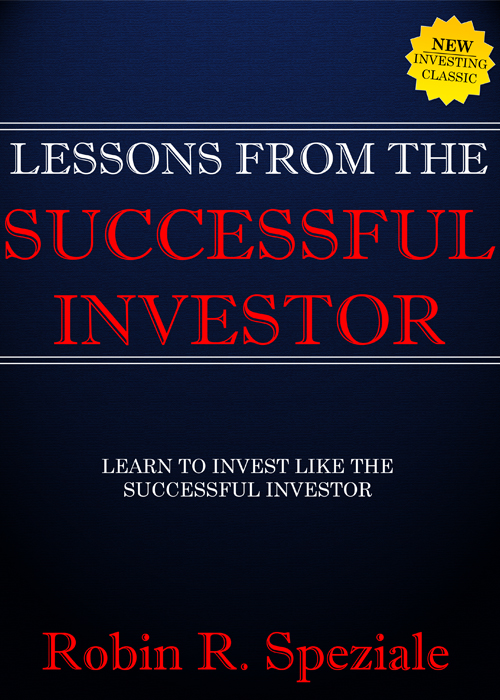
Cover for Lessons From The Successful Investor
My new e-book, Lessons From The Successful Investor, has been published! I wrote my e-book over the course of 4 months during the summer of 2010. It took 20 drafts, but I finished it! I thought about submitting to literary agents and publishing houses but decided to publish Lessons From The Successful Investor as an e-book. The e-book format is advantageous: low cost, mass coverage, easier to promote, and let’s face it, it’s the future of reading.
Lessons From The Successful Investor is about investing, but more importantly, how to invest successfully.
Here’s the introduction to my e-book:
Lessons From The Successful Investor will show you for the first time how to invest like the successful investor. And although his investing lessons are not revolutionary, they endure the test of time. There exist a few core lessons that underlie successful investing, and while these lessons do not change, the common investor does. For the successful investor, investing is like picking cherries.
As a gift to my readers, I will be giving away my e-book, Lessons From The Successful Investor, free for a limited time. Here are instructions to get my e-book free:
1. Go to http://www.smashwords.com/books/view/23181
2. Click Add to Cart
3. Sign up
4. Input coupon code (BA22P)
5. Download my e-book FREE
– – –
Lessons From The Successful Investor was featured in the Mississauga News.
What is a TFSA? It’s TFSA Season Again
Investing
TFSA stands for Tax Free Savings Account.
The TFSA is a tax shelter devised in the 2008 Canadian Federal Budget and introduced January 2, 2009.
Think of the TFSA as a money shelter. Come January 1, 2010, you can sign up for a TFSA account, if you have’nt done so already. The TFSA will let you store $5,000 per year in the shelter.
Can you invest stocks, bonds and mutual funds in the TFSA?
Yes. You can invest in the following investment products with the TFSA.
– Stocks
– Bonds (Canadian Savings Bonds are a popular choice)
– Mutual Funds
– REIT’s
– and more…
The taxman, the government, and the bank cannot touch your TFSA money or investments. No taxes will be deducted. No dividends will be deducted. No withdrawal will be charged.
If you make $10,000 from your first $5,000 TSFA investment, you are taxed $0 and left with the $10,000 gain. Outside the TFSA shelter, that $10,000 you make is taxed and a smaller $8,250* gain is left over.
Just to note, the TFSA contribution limit changes every year subject to inflation.
10 Tips For Investing During a Recession
Investing1- Buy stocks on sale. When a recession hits, investors pull out of the stock market. This leaves you the opportunity to pick up good stocks on sale. I picked up RBC at $30 and Manulife at $12.
2- Ignore the Media. Newspaper companies sell more newspapers with negative headline news. Naturally, the media will pump fear into you. Ignore this fear, and invest in stocks.
3- Remember, the economy will bounce back. Have you ever been super sick and thought you’d never get better? That’s how people think during a recession. The economy will bounce back, study historical trends.
4- Dividends will make you comfortable. Even if the stock market keeps on tanking after you invest, the dividends from stocks will make you happy. RBC sent me a 6% Dividend per quarter during the recession.
5- If you can’t stomache a 40% loss, don’t invest. Near the low point of the stock market crash – March 2009 – my stock losses amounted to 40%. But I sucked it up, and now I’m making money because I kept those stocks.
6- Don’t time the market. Warren Buffet was way off when he invested in GE and Goldman Sachs. But he’s laughing to the the bank now, with capital appreciation and annuity.
7- If you want to time the market…The stock market will reach it’s lowest point once all the unemployment, bankrupty and low earnings in the news are the WORST that can be reported. So when the media shifts focus to news like the Swine flu (as it did in March 2009) times are better for the economy.
8- If you invest, invest big. You’ll be kicking yourself in the butt if you buy 1 share in RBC when one year after the recession the return is 150% and you could have made thousands.
9- Don’t listen to your teacher. Don’t listen to teachers, analysts or politicians. They’re too busy in their ivory tower to know what how the recession is impacting the real world. If you see more people driving new cars and buying Starbucks coffee, chances are the economy is turning around. Invest.
10- Urgency to Invest. Don’t wait until the media starts reporting about good times in the economy. Invest when people are fully depressed about the economy. You know you’re too late to invest when the analysts start slapping buy ratings on every stock on the market.
Stock Market Predictions for 2009 and 2010
InvestingThe stock market is a complex machine that takes many factors into account. Among the most significant are psychological factors. With 2009’s low stock price levels, the bulk of mutual funds that experienced mass redemption in 2008 are gaining confidence, figuring this may be the end of turbulence.
This positive attitude is self-fulfilling: Money Managers will begin to deploy hard kept cash reserves and pump up undervalued stocks. A herd mentality will kick in and an onslaught of mutual fund companies will follow suit and inject cash into stocks so they don’t miss the stock market boom in 2010.
However, a factor that could slow stock markets in 2010 is the still looming credit collapse. Credit for so long was the steroid that pumped up companies to disproportionate levels. The era of easy, fast credit is over and thus a new era of internal capital investment will reign.
Because internal capital investment is fueled by income a company generates and its cash flow, investments will be conservatively planned and pursued and thus growth will be slower. 2010 stock market performance will fall in line with future gradual growth of corporations. As Warren Buffet put it: “The party is over”
 Robin R. Speziale
You must be logged in to post a comment.