

 Subscribe Now to My FREE Newsletter (Join 5,000+ Subscribers!)
My interview with Jason Donville of Donville Kent Asset Management originally appeared in my national bestselling book, Market Masters, which is available at Chapters, Indigo, and Coles as well as Costco and Amazon.ca.
*** Email Me Now for a FREE copy of my new book – Capital Compounders ***
***
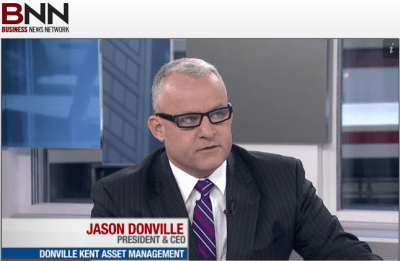
Aside from his phenomenal stock- picking prowess, market-crushing returns, and beaming confidence, Jason is built like a truck, a physical asset that perhaps benefits him on the lacrosse field more than it does in the office at Donville Kent Asset Management (DKAM). An avid field lacrosse player, Jason also personally mentored his two sons in the sport, and currently coaches the Edge Lacrosse elite travel team. With no disrespect, though, I’d wager that Jason scores even higher in his hedge fund than he does on the lacrosse field. To say that Jason’s brain trumps his brawn is no small claim, but it is nevertheless true.
DKAM’s flagship Capital Ideas Fund has been the envy of Bay Street. Within just seven years, the Capital Ideas Fund has beaten the TSX Composite Index by 350% in cumulative gains. That’s 350% in “alpha,” or the amount by which Jason’s performance exceeded the benchmark index. From 2008 to 2015, the fund achieved a whopping 525% in cumulative gains. That’s a 27.9% annualized return since inception. How did Jason not only beat the index but achieve such high alpha? Straight from the Capital Ideas Fund letter:
Through the application of our focused investment strategy, we search for companies that possess high levels of return on equity, reasonable valuations, and positive share price momentum. Portfolio companies typically have a track record of achieving high returns on equity, and are capable of generating high returns on equity for many years without the addition of significant amounts of equity capital other than that which is being generated internally. These companies are run by strong management teams that have a significant ownership stake in the business.
The return on equity (ROE) metric is crucial to Jason’s hedge fund’s success. ROE is not just a figure. It’s an initial hurdle that a company must pass, Jason’s rigorous test (ROE greater or equal to 20%), in order for any security to progress to future stages of analysis. During our interview we discussed everything from Jason’s philosophy, to his process and his strategy, along with the unorthodox way Jason entered the investment world — starting in the navy.
Jason has curly gelled-back silver hair and wears thick, round glasses. On the day we met he was dressed down in jeans and a shirt with rolled-up sleeves. Throughout the interview I noticed that Jason’s brain sometimes works faster than his mouth. From time to time he needs to rewind after he speaks, as though he can’t vocally articulate his thoughts and ideas at the same rate that his brain produces them. His brain is always working at full speed. If his brain was a car, it’d be a Ferrari. Before starting the interview with Jason, I thought, “Jason would be a great guy to have a beer with. He’s a guy’s guy, on and off the lacrosse field and his hedge fund’s trading floor.”
Subscribe Now to My FREE Newsletter (Join 5,000+ Subscribers!)
Pre-Interview Lessons
Alpha: the amount by which an investor’s performance exceeds his or her benchmark index.
Broker or Brokerage: an agent who handles the public’s orders to buy and sell securities, commodities, or other property. A commission is generally charged for this service.
Capital Allocation: when management makes investments in a company to improve operations, revenues, and expand product lines, or to make new acquisitions. Successful capital allocation requires an ample return on that investment (return on invested capital, or ROIC).
Fed: The U.S. Federal Reserve, the American central bank that sets monetary and fiscal policy (such as overnight rates and money supply) and motions to control factors such as inflation. Similar to the Central Bank of Canada.
Front-Run: when a broker places a trade based on privileged information before a large client places a trade in order to profit at the outset.
Growth: stocks that have higher-than-average return potential or positive financial changes to a company (e.g., revenue growth).
Management: the salaried team of individuals who manage a company. May or may not be the founders or family owners, and may or may not own a stake in the company.
Porter five forces: a framework containing five “micro environment forces” developed by Michael E. Porter to analyze the level of competition that a company faces within an industry. Those forces — threat of new entrants, bargaining power of suppliers, bargaining power of buyers, threat of substitutes, and industry rivalry — can affect a company’s ability to make a profit.
Turnaround: the outcome by which a fledgling company improves itself to regain and sometimes even surpass its previous success. An example of a turnaround would be Apple in the late nineties to the early 2000s.
Subscribe Now to My FREE Newsletter (Join 5,000+ Subscribers!)
Jason Donville Interview:
Where did you grow up in Canada?
I was born in Scarborough but my parents and I moved to Alberta when I was one. My parents were people stereotypically from Scarborough. Neither had graduated from high school. Both of them dropped out in grade 10. They were the lower-class white working poor. That’s what they were and they wanted something better out of life. Alberta was booming, so they went there for opportunity and we ended up staying there. So I actually grew up in Alberta.
My parents struggled for a good chunk of my childhood but my dad eventually became a tradesman and they’ve done well subsequently. My family was very pro-education. That was one of the good things about my childhood. You didn’t want to bring a bad report card home. But nobody in the family had a finance background or worked in a white-collar job. So that’s a not-so-typical hedge fund background.
It’s not typical at all. How did you get interested in the markets?
I had lots of part-time jobs when I was a kid. I was always fascinated by the stock market. In the mid-1970s the province of Alberta decided to privatize the Alberta Energy Company. Any citizen of the province of Alberta could then subscribe for a hundred shares down at the local bank branch. And my parents did that. Soon we started to receive annual reports in the mail from Alberta Energy. I would track the movement of the share price of Alberta Energy in the paper every day. My parents probably owned $1,000 of stock. So I just found this to be a really fascinating process. But even if you told me when I was 15 that I was going to become a hedge fund manager I would probably be skeptical. It was probably more likely that I was going to become a writer.
A writer?
Being a writer is a thread that weaves through my story. I had an uncle who was quite well educated. He introduced the International Baccalaureate program to Canada. He used to teach at Pearson College in British Columbia. Pearson is a private school for grades 11 and 12. Kids come from all over the world to attend Pearson College. Anyway, my uncle got the idea of a “renaissance man” in my head. As you know, a renaissance man is someone who is familiar with literature, mathematics, art, physics, and languages. Additionally, around age 16 a certain ambition kicked in. Not suddenly, but it dawned on me that I was a good student and that if I worked hard I would get great results. And then in grade 12 the Royal Military College came on to my radar as a place to go for my undergrad. For me, coming from a poor back- ground, going to RMC where everything was paid for was great. Plus, you spent your summer at sea or on a flight line. There was an incredible amount of adventure.
So how did writing weave into your story?
So I completed an undergraduate degree at RMC in liberal arts. Most of my course work was essays. After I graduated I enlisted in the navy. But before I left, one of my professors who were a retired infantry officer said, “Don, you’re a good writer. You should keep it up because you’ll be valuable.” You see, when you join your ship or your unit in the navy, junior officers are assigned secondary duties. My professor proceeded to say, “Tell them that you want all the secondary duties that involve writing.” So I did that — “Give me anything that involves writing; I’m a good writer,” I told my superior. It was a win-win because then the senior officer knew that he got a junior officer who could write well. There’s just so much administration work in the navy. You could be writing thank-you letters one day and the next day writing a charge report for some guy who got caught with marijuana in his possession. Every day I was just writing, writing, writing. Eventually it got to the point where I was writing for the navy base newspaper.
And then all of a sudden the admiral’s speech writer was going on maternity leave. He called my cabin and asked, “Jason, would you like to come up and work as a speech writer for six to twelve months?” And I said, “Wow, I would love to do that!” I ended up writing one speech that I still have in my possession for the NATO’s First Ministers’ Conference in 1989. After the navy, I enrolled in my MBA at Western University, where the curriculum was essentially all case study. There’s no Q&A. Once again, my writing skills helped me get fairly high grades there because I was a good writer. Two guys can express the same idea but the stronger writer will get the higher grade. After graduation, I bought a one-way ticket to Asia. There, I marketed myself as a good English writer with a good education but no industry background.
Singapore, right?
Yeah, so I got to Singapore in 1992 and just basically started to cold-call firms for a job. At that time, though, a lot of these Singaporean firms had Singapore or Asian analysts but English was either not their first language or wasn’t a strong first language. They grew up in a bilingual or trilingual environment. So even if they went to a Singaporean university or they went to a UK university, their English and their writing skills weren’t flawless. I would do my own analytical work but I could also help to clean up the other analysts’ reports. Once again, writing became a competitive advantage for me. Also, as is the same today, I had a quirky flair, or style, to my material. You’ll see it in my DKAM ROE Reporter newsletters. They’re not your typical newsletters. There’s storytelling. It’s like a TED talk.
Your newsletters are fun to read.
I’ve learned to tailor my writing to my audience. Finance can be dry but if you turn it into a story and if it’s a bit self-deprecating, but still has a message, people start to bond with you. They see through the analytical work and realize that there’s a decent person on the other side. Trust comes from that.
Strong writing skills have helped you throughout your entire life, in pretty much any endeavor.
Yeah, and when you’re working as an analyst, you’re writing some-
thing every day. So you’re like a journalist. You’re looking for journalistic scoops. You’re writing for deadlines all the time; you have time pressures. You don’t quite have the same level of fact-checking standards that a journalist has, but nonetheless if you put out some- thing that’s factually wrong, within an hour you will receive an email: “Didn’t the guy read the annual report?”
You eventually returned to Canada. Did you immediately move to Toronto to start your hedge fund, DKAM?
No, I came back to Calgary. Because that was my hometown. And part of it was because we were coming back for quality of life issues. Particularly on my wife’s side. I ended up being there for three years and started a small brokerage firm, Lightyear Capital. The problem was that as a non-oil-and-gas guy it was really hard to do what I liked.
It must have been a challenge to raise capital in Alberta. Everyone there invests in oil and gas for the most part.
Yeah, and it just wasn’t the right location for what I was doing. I needed to be in a headquarter town. Even if I was in the U.S., I couldn’t do what I do in Kansas City or in Minneapolis. I had to either be in Toronto or in New York City or in Hong Kong or in Tokyo. I couldn’t be in a regional city. If I was an oil-and-gas guy I certainly could be in Houston or in Calgary. But for the kind of companies I was interested in, I had to be in a city like Toronto.
So you closed Lightyear Capital?
I sold out to my partners and moved to Toronto, where I got a job with Sprott fairly quickly.
What was it like to work with Eric Sprott?
At that time, there was Sprott Asset Management, fund management, and then there was Cormack, the brokerage. Eric moved over to the asset management business and I was on the brokerage side. However, I would see Eric across the hallway. Eric knew me but this was 2002– 2003, which was when I was in the process to become a financial services specialist. However, Eric saw all financial services companies as a house of cards. He was friendly to me but he would say, “I’m really not interested in anything that you’re covering, with the only exception being Canadian Western Bank,” which is in Edmonton. Because, “when all the banks in the world fail, natural resources go through the roof, and CWB will be the last bank standing.”
Do you think he’s still sticking with that “the world is going to implode” macro thesis today?
I don’t know, because I haven’t spoken to Eric much in the last five years, other than just social pleasantries. I feel bad for those guys. First of all, everybody loves Eric Sprott because he treats everybody so well. Secondly, he had so many things right. However, you can get the macro thesis right but still not get the stock picks right. As far as the 2008–2009 crisis goes, he didn’t perform any better than anybody else. And then, once the financial crisis was over, he probably stayed on the natural resource trade too long, in my opinion. He became too fixated on gold and natural resources.
And was that the inflection point in the markets — the financial crisis — when you started up your own hedge fund, Donville Kent Asset Management?
Yes.
But why did you ultimately leave Sprott?
I was at that age where having a 25-year-old salesman tell a 40-year-old analyst to put his heels together was getting tedious. That was happening all the time. As an analyst, you were always junior no matter how many years you had been an analyst. The other issue would come up any time I made a PA trade. PA means personal account. I’ll give you an idea of the trading floor. There were about 20 traders and 15 salesman. So 30 or 40 guys in the room. Anyway, one day, the head trader got a ticket for somebody’s $500,000 purchase of MTY Food Group shares. It said “pro,” which meant that it was a staff member’s trade. The head trader turned to the sales desk and yelled, “Who is buying half a million shares in MTY Food Group? I’ve never even heard of this company before! What do I need to know about this stock?”
All of the salesmen were perplexed. “We have no clue what you’re talking about,” they said. The head trader then looked at the employee number on the trade ticket and shouted, “It’s Donville”He called me out and said, “If you are buying this kind of stock, why the don’t our clients have the first kick at it?” I responded, “I’m a financial services analyst. This is a quick-serve restaurant company.” He barked back, “I don’t give a flying what it is. If it’s good enough for you to buy in this kind of size then I expect that there should be a research report on this —” Blah blah blah. And then he looked me square in the eyes and said, “Do you just sit here and spend all of your time working on your PA and don’t write any research?”
That doesn’t sound like fun.
Yeah. At that time I was by far the most prolific research analyst there. You’ve seen all of the awards that I’ve won as best analyst and stuff like that. They acted on competitive jealousy. When my PA stocks would go up 50% they just got more jealous. So eventually my personal investing got harder to do inside of the brokerage. The expectation was that the analyst would just write research and never actually invest their own money. Which is crazy, because the analysts who become good stock-pickers are actually your most valuable resources. So, for me, it was time to move on. I initially left to go to Home Capital to start their hedge fund. I was there for about five months but then the financial crisis storm clouds started to form and so we just agreed that it wasn’t going to work. At that point, there were some legal costs that had been about $140,000. I just wrote Home Capital a cheque for $140,000 to pay for all the costs.
Interesting. You must have more fans across the country.
I used to be really good at responding to emails. People would email, “Hey, do you still like X stock?” I’d respond, “Yeah, I think it’s still a great company.” And then that person would post my comment on the Stockhouse message board — “I just talked to Donville and here’s what he said . . .”
So now I’m really careful with my comments through emails. Because there’s people out that are always trying to use it to promote their stocks.
That can damage your reputation. If investors want to follow your actual positions, they should read your ROE Reporter newsletter, right?
Yeah, and I’m on TV pretty frequently. I’m always very open about what we own and whenever I go on TV I’m allowed to disclose my top five positions, including their percentage allocation in my fund. I’m pretty good at that. But obviously, on any given day, if I’m adding to a position or subtracting from a position, I don’t want the market to know. Because I don’t want people to front-run me. So I just disclose stocks that are in a stable position in my hedge fund.
Your fund, Capital Ideas, was up 22.7% in 2014, which was double the index’s return. You were heavily exposed to pharmaceuticals, software, and IT. Why those three sectors?
Well, look around. The world is slowing down growth-wise. Most of that is actually explained by demographics. Obviously the lever- aging and de-leveraging of individual balance sheets, government balance sheets, and corporate balance sheets has an impact, too. But the bigger impact is a result of demographics. When I look around I think, “Where does growth come from?”
Let me give you an example. Leon’s Furniture. We don’t own it but it’s a great company. They’re not going to sell 15% more chesterfields next year. Because there’s no demographic surge to generate that growth. Where the growth of the world is coming from is new product development in knowledge-based industries, whether it’s a drug or a software system or a piece of technology that nobody owns. Whereas 99% of us already have chesterfields and maybe 1% of us are going to replace our chesterfield.
At one point in the last 15 years none of us had a smartphone. That was a growth industry — we all bought smartphones over a period of 15 years. Indeed, all of the action is in the knowledge-based industries, though the health care sector has the added benefit of a very attractive demographic profile. So while there’s no demographic surge right now for chesterfields, there is a demographic surge for the kinds of things that people in their sixties and seventies need for health reasons.
Interesting. And now, going into 2015, you have lowered your exposure to financial institutions.
Yeah.
Why?
Think about the market as a baseball game. Let’s say there’s nine innings in the game. We’re now six years into this bull market. You never know until it’s over, but we’re probably in the seventh or eighth or ninth inning of the baseball game. That’s usually a bad time to own financials. They don’t do particularly well late in the cycle and then they typically lead us into the trough. So at this stage in the cycle, I don’t want to own a lot of financials.
So weakness in the financial sector can be a leading indicator that the economy is headed for a downturn?
Yeah, markets predict things to the extent that you could get a sense of whether you’re in the sixth or seventh inning — that’s when you want to lighten up on certain holdings. Generally speaking, the time to buy financials is after the market’s been crushed. Now, for really high-quality financial services stocks, we’ll just hold on to them for the long term. But we wouldn’t be adding to or loading up on financials right now.
Would you put Canadian banks into the high-quality camp?
They don’t achieve the ROE that we want. We base decisions on adjusted ROE as opposed to stated ROE because the stated ROE doesn’t take into account the difference in the dividend policies of all these different companies. Conservatively, banks are going to make a 12% return per year in the market, year after year. And they’re going to realize that return in the form of a 4 to 5% dividend yield and a 7 to 8% capital appreciation. So for the average retail investor who wants to own individual stocks, the banks are actually a great deal. Particularly if you’re going to hold them for five or ten or fifteen years because our banks are really strong. Their share prices might come down just because of market sentiment but I’m not worried that they’re going to be doing any dividend cuts in the future. Again, though, we look for higher return on equity — 20%.
Your main focus is on ROE. However, you’ve said that while the companies in the TSX have competitive products and services, their ROEs are usually too low for you.
Not usually too low. They are low. If you start your analysis by looking at the companies that have really competitive products, you’ll find that they’re not really profitable. Why? Because of the capital structure and the capital allocation skills of the company. Let’s say that you and I enter a partnership to make a new smartphone. It has a very nice gross margin and even an attractive net profit margin. But we built up massive overhead, too. And that’s where the whole capital allocation game becomes really important.
So first we look for companies with ROE greater or equal to 20%. Second, we look for companies in that high-ROE group that are sustainable based on the competitiveness of their products. Third, we assess management’s ability to allocate capital at those companies. Once we validate those three things, we typically find companies that we can invest in.
But how do you determine which companies or products will be sustainable in the future?
I’m continuously looking through my database for high-ROE stocks.
So that’s any company that has an ROE of 20% or more. Then I look at the source of the ROE. Is it coming from leverage or is it coming from the sale of assets or is it coming from profit margin? Essentially, return on equity can be broken down into three pieces through DuPont anal- ysis. You’ve got good ROE and bad ROE. We want to make sure that the ROE is good ROE.
Once I’ve decided that any company is of interest to me, I’ll turn them on to my associates and say, “Get me a two-pager.” A two-pager is basically a seven-year history of the company’s financials. I often say to people, “If you’re thinking of investing in two companies and you run the numbers over the last seven years on both companies and you put them side by side, the good company will leap off the page at you.” That snapshot is so important in terms of understanding the difference between a good company and an okay or maybe even crappy company. The reason is because you can fake good ROE in one year. But to achieve high ROE seven years in a row is tough. You can show me the numbers and say, “Here, this is the company’s seven-year ROE track record,” and I’ll go, “I don’t even know what they do but there’s probably a really good company here.” Here’s a simple way to think about it: let’s say there’s a company that makes $20 million in profit and has $100 million in equity. Are you following me?
Yeah, that would work out to 20% ROE.
Yeah. At the end of the year, say you make that $20 million. So now the equity goes up to $120 million if management takes that $20 mil- lion of incremental profits and just puts it in the bank. If it’s in the bank then they’re going to make 1% on that. So the following year the return is still at $20 million just about because 1% interest is almost no interest at all. But now, let’s do the math, it’s 20 over 120. The next year after that it’s 20 over 140. See how fast the ROE comes down to 15%?
So when I see a company that has achieved an ROE of 23, 22, 23, 24, 23, 22, over the past seven years, without even knowing what industry they’re in, I go, “Wow! There’s something in place here. There’s some- thing magical going on here.” That’s the magic that you’re looking for in terms of those long-term sustainable companies. We can do that analysis in under an hour and that tells us whether we should spend more time getting to know a company.
Where do your associates get that long-term financial data?
We just pull it off SEDAR [System for Electronic Document Analysis and Retrieval, a mandatory documents system for Canadian public companies] and put those two pages together on each company. Those two-pagers look like the reports that Buffett used to read at the local library. That’s what we create in house. Nobody else does it that way. Though if they do it, it’s only on the large-cap stocks.
Yeah, Buffett used to peruse all of the Value Line reports.
Right, and it’s just boom boom boom boom boom. It’s just this straight “Give me the financial history of the last seven years.”
Okay, that covers how you would determine sustainability. Now what about management? How do you assess the quality of management? You mentioned they must be good capital allocators.
Okay, so there’s a whole bunch of stuff. The assessment of management is something that takes place over time. When you meet with management face to face you don’t get 10 hours with these guys; you get an hour. For our type of investing we want competitive advantage and then we want capital allocation skills. So most of the questions we ask when we meet face to face with management are focused on those two areas. “What’s happening in your environment? Anybody new, or any new upstarts, or anybody thinking of entering your market?” Because the great enemy of a high-ROE company is competition. If management says, “No. We’re not aware of anybody who is thinking of entering the market,” then that’s a great thing.
Then we get a read on their capital allocation skills. Now, cap- ital allocation takes different forms depending on what business or industry the company is in. In a lending environment like Home Capital where they just write mortgages each year, they don’t need to acquire anything or buy anything. Through their network they just put out more capital in the form of mortgages. So it’s very straight- forward for them to lend more money. In the case of a lot of the most attractive industries, though, and the reason why a lot of these soft- ware companies are so attractive, is that their client relationships are sticky and they’re also high-margin. Once you get clients, you never lose them. Well, that’s the same for everybody else in their industry. Therefore, by raising sales and promotional expenses they’re actually not going to get much more business because the additional business that they’re trying to acquire is actually equally sticky. And then they get to a certain point where the owner wants to move on and then big boys acquire them. Because again, just upping sales and promotion to steal away another client in a sticky business doesn’t work.
But often you’ll hear analysts say, “There’s no organic growth.” Well, this is not an organic growth story; this is growth through acquisition. MTY Food Group, which is all about fast foods, does acquisitions but they also open up new locations. So once again we look at MTY Food Group, see that their ROE has never gone below 23%, and determine that they’re clearly able to take a year’s profits and channel it back into the business to keep their ROE at that level. But so many analysts just talk about the organic growth. That’s craziness!
Why is organic growth so crazy?
Think about it. You and I get the rights to buy a McDonald’s in down- town Toronto. And after a year we do $3 million in sales. After year two we do $3.3 million in sales and then it just stays at $3.3 million but the profit margin is massive. However, there will be no organic growth any- more. Because once that location is fully up and running it doesn’t grow anymore. It just throws off massive cash flow. So saying, “Let’s just up the advertising” is just crazy. There’s no more growth there. Instead, what we should do is talk McDonald’s into giving us a second location. And yet the number of guys that will criticize these quick-serve restaurants for their lack of organic growth is crazy. It doesn’t work that way. Just visualize yourself as a guy running a McDonald’s franchise. Get those MBA and B-Comm buzzwords out of your head.
Do you exit a position if management’s ROE or capital allocation perfor- mance declines?
I’ll use Solium Capital as an example. When I first moved back to Canada 1999, I met the founders of Solium Capital. There was a guy with the Calgary Flames who was actually working for them as a salesman. Anyway, they were unprofitable but then merged with another company that brought in a whole bunch of really good technology. It has been profitable ever since. We’ve owned it off and on. I just recently sold out this year because the ROE dipped down to 17%. Regardless, it’s a good company. For a lot of guys, 17% ROE is still high enough.
Who are the top capital allocators in Canada? In the past, you’ve made mention of the CEO from Constellation Software.
Mark Leonard.
Who else?
Gerry Soloway at Home Capital would be another one. I don’t own Stantec because the ROE isn’t high enough, but I think that the management at Stantec are good capital allocators. Most of the companies we own have people running them that are very good capital allocators. Because if you can keep your ROE over 20% year after year, you almost by definition are a good allocator. But as the company gets larger, capital allocation becomes more a corporate skill, as opposed to an individual skill. For example, one can attribute the capital allocation skills of a small entrepreneurial company like MTY Food Group to the CEO rather than to the management team as a whole.
So I assume that you primarily take on positions in small- and mid-cap companies?
No, we are market cap agnostic. We buy into companies like Valeant and CGI, which have market caps over $15 billion. And then we buy into smaller companies with $100-million market caps in some cases. We don’t care about market cap. We care about the ROE.
And you only invest in Canadian companies?
Only in Canada. But this approach works anywhere. This isn’t unique to Canada. A few guys in Europe looked at my fund. They were either professors or grad students. I don’t remember. They wrote to me and said, “It’s hard to find companies in Europe that actually meet your criteria.” It’s true. The high ROEs are just not there. But in Asia it works. I used to do this in Indonesia, and in Singapore, and it worked in both of those markets.
But what if high ROE comes at a high cost? Currently, the Canadian markets’ valuations seem overstretched compared to the growth prospects in the country.
Yeah, valuations are quite rich right now. But we also have a risk-free rate that is somewhere between 1% and 0%. Theoretically, when you work through any of the valuation models, and the risk-free rate goes down to 1%, you can justify virtually any multiple. But a lot of analysts will say, “The historical multiple for the market has been 15 times and currently it’s at 18 times.” Yeah, but interest rates have never been this low in North America — below 1% or at 1% and probably moving lower.
What risk management mechanisms do you have in place if you’re wrong on the direction of the market?
We have always been able to go long and short. We short the market.
Our biggest tool for risk mitigation right now though is put options on the TSX. That’s an insurance policy. We buy puts out of money so that they are not that expensive. That won’t protect me from a 30% correction but it should protect me from a 10% correction. And it doesn’t cost me that much.
Regardless, your fund has captured massive upside in the market: 22.7% return in 2014, and 55% return in 2013.
We’ve done 27.9% annual returns since inception.
So, why would you close off the fund to new money? I just saw the announcement this week.
The reason we’re closing the fund is fairly straightforward. If you look at people who manage $200 to $300 million they can put up really good numbers. But when they start to manage billions of dollars then that gets really hard in Canada. The market will force you into the large-caps, which is the most liquid part of the market. I don’t mind owning large-caps but I don’t want to be in the situation where the small- and mid-caps don’t move the market. In Canada, the mid-cap segment is probably the most inefficient part of the market. So it’s quite simple: I want to outperform more than I want to manage $3 billion. I don’t want to be forced into basically owning the TSX 60.
So you achieve greater returns in the mid-cap segment of the market — it’s inefficient. But there must be other reasons that you outperform the market.
I think we have a better methodological mouse trap. I didn’t invent
this style of investing. This is Buffett’s style of investing. Why has Buffett been able to achieve a 20% return over 50 years? Because he focuses on companies that are growing at 20%. I also think though that measuring growth in terms of return on equity and book value per share is a better methodological way than measuring growth in terms of earnings per share. For example, for 50 years you can look at the Berkshire Hathaway annual reports; and what’s on the first page?
There’s the comparison between the S&P 500’s return and Berkshire Hathaway’s book value growth. Side by side.
He doesn’t spoon-feed you. But what’s he telling you right there on page one is “This is how you do it.”
Book value growth.
Right, so he said, “Focus on the growth and the book value per share.” Book value per share in old accounting terms was referred to as the net worth of the business. If you focus on companies where the net worth of the business is growing at a very steady clip, then the share price chart will take care of itself as long as the ROE stays intact.
So, why haven’t other money managers done what you’ve done to achieve the same high returns?
A friend of mine in New York used to say to me that “Everybody talks
Buffett but only a few people do Buffett.” So that would be one aspect of it. Unlike mutual fund managers who have concentration limits, we can concentrate holdings in our portfolio. They can’t put 12% of their money into their best idea. And honest to god, if I could only put up to 3% in any of my best ideas I think I would still outperform the market. But it wouldn’t be as easy as if I could instead put 50% of the fund into my five best ideas. Because if you’re a good stock-picker, concentration works in your favour, and if you’re not, you should own an ETF [exchange-traded fund] instead. Truthfully, though, if you’re going to use concentration and you’re not a good stock-picker, you’re going to be out of this business pretty quickly.
Have you ever met Buffett?
No, I’ve been to Omaha but I’ve never met him because I’m not in love with the man. I love his ideas and the way he thinks, but I’m not a rock star kind of guy who’s like, “Oh my god, to shake his hand would mean so much to me.” That doesn’t mean anything to me at all. Obviously, though, if he was around or he walked into my boardroom I would love to hear him speak. But Berkshire Hathaway’s annual report is good enough.
However, a lot of the best stuff that he wrote was 15 years ago. I have a printout of all the Berkshire Hathaway annual reports going back for the last 50 years. A lot of the stuff from the last 10 years has been more about praising people rather than offering insight into his investment process. So a lot of the stuff that’s the best about Buffett has actually been packaged and distilled by other writers. The same can be said of Benjamin Graham. People talk glowingly about reading The Intelligent Investor, which I’ve read a couple of times, but it’s dry.
It is dry. Especially the chapters on bonds.
It’s not a great read.
And it’s long.
Yeah, exactly. People who tell you that “Oh, yeah, The Intelligent Investor is my favourite book” are the same people who tell you that they love jazz but never go to a jazz club. They say it to be hip and cool. But it’s not. There’s only two chapters in there that I would recommend to our guys to read. But the people who’ve written about Buffett are fantastic, such as Mary Buffett’s Buffettelogy.
I’ve read Buffettology. It is a fantastic book.
Yeah, so Buffettology is great. If you can get through Snowball, it’s great, too. But also the one by the Wall Street Journal guy that was written about a decade earlier: American Capitalist. It’s only about 275 pages. But I think Buffettology is probably the best of all the stuff that’s been written on Buffett.
Some would argue that Buffett was an activist investor in his early days. Going back to your point that companies in the TSX have fantastic prod- ucts but through bloated overhead or poor capital allocation, their ROE is usually below 20%, have you ever considered becoming an activist hedge fund manager? Go on boards and improve capital allocation and ROE?
Not yet. Maybe that’s something down the road. But it’s not some- thing that’s on my radar screen. In part because we don’t buy turn- arounds. It might be because we don’t have the muscle. We wouldn’t own enough stock to be able to push for a turnaround. I continue to look for great companies that are a fair price as opposed to cheap stocks. And that’s what Buffett evolved into as well in his career.
What’s your outlook on the markets?
In terms of just raw P/E, price to book, and price to cash flow, it’s expensive in a historical context. However, if you believe that interest rates are going to stay where they are right now, the valuations are completely just and in theory can go higher. Here’s a simple way of looking at it. Flip over a 20 times P/E; it’s got an earnings yield of 5%. You can invest in that company or get 1% by putting your money on deposit. Now in the past we’ve been able to get a 10% earnings yield. But we might have also been able to get 7% on deposit at the bank. So you look at that as a ratio and go, “My god! As a ratio, stocks are actually, in relation to the risk-free rate, cheaper than they’ve been in the past.” Even on a spread basis, stocks are cheap.
But here’s the part that’s tough. If interest rates are going higher then we’re going to get into inflation. Where does inflation come from in a world where birth rates are plummeting? Where do we get the surge in aggregate demand that typically is the precursor to inflation? I don’t see it. Asia and Europe are both slowing down. There’s a whole bunch of countries in the world that have virtually negative birth rates. So where does it come from?
You’re obviously not worried about rate increases then.
I think we’re going to continue to be really nervous nellies about these multiples. But unless inflation goes up, I don’t see interest rates going dramatically higher.
The Fed downgraded their inflation projections.
I made hints at that in the January newsletter. Because when you live in Asia where there’s so many countries in such a small area, you become a lot more attuned to currency impacts than people realize. I was looking at what was happening to the Canadian dollar versus the U.S. dollar and thought, “Boy, the U.S. is going to slow down. By June we’re going to see the growth numbers in the U.S. come down dramatically because all the exporters are going to get killed.”
Yeah, P&G’s [Procter & Gamble’s] profits dropped dramatically on their last quarter.
Right, and that’s what I talked about in January. I don’t see interest rates shooting back up.
Any final advice?
Yeah, here’s my thesis on life. If you want to be a great doctor, don’t go ask a guy who’s a counsellor how to become a great doctor. Go ask a great doctor how to become a great doctor. If you want to be a great investor, then study the great investors and pick one who fits your style and then master that style. In terms of the way academics would define it, I’m a growth investor. And, actually, so is Buffett. But Buffett doesn’t like that title. While a lot of people call him a value investor based on the way academics look at value versus growth, he’s definitely not a value investor. He was before he met Munger, but then he became a growth investor.
Anyway, you must also understand your temperament. And the reason I say temperament is that if you’re a value investor then you’re investing in turnarounds. Therefore, you need to know how bankruptcy works. You’ve got to have an ability to know how boards can turn a company around. So when you say you’re going to be a really great value investor, there’s a bunch of skill sets that have to come with that. You need to be able to know that once a company goes into bankruptcy, how much is left over and how does that process work. There are a few guys who are value investors who don’t have that skill set.
I have an undergraduate background in economics and political science. A lot of what I do involves Porter five forces. It’s about competitive advantage. So if you want to invest like I do and you enjoy competitive advantage and you enjoy microeconomics and stuff like that, then this is a good style. But your style of investing has to fit your personality type. And I think that there’s a lot of more negativity in value investing because you’re buying companies that are cheap but are problematic. Whereas I’m buying awesome companies and just hoping that they’ll be awesome forever. I get to hang out with the really great CEOs all the time as opposed to having argumentative discussions with mediocre CEOs who aren’t doing a very good job running their companies.
JASON DONVILLE’S INVESTING STRATEGY
After the interview, Jason offered to take me on a tour of his office, which looks more like a university student’s dorm room than the typical office of a hedge fund manager. Trophies and medals lined the wall and a lacrosse helmet lay on the floor. There must have been five hundred books on his shelf. It was a comfortable place to work or to hang out, and a shrine to Jason’s passions in life.
Jason’s focus on ROE is the clearest of all the Market Masters. He only invests in companies that show at least seven years of ROE that is 20% or higher. I agree with him that ROE is a fantastic gauge of management’s ability to successfully allocate capital. So, after the interview, I ran my own filter of companies with greater or equal to 20% ROE on the TSX and subsequently invested in a handful of those securities that proved to have long-running and sustainable return on equity combined with enduring competitive advantages. I’m excited to see how those high-ROE securities play out in the market over time.
I was surprised just days before my interview with Jason when he issued a press release announcing that the DKAM Capital Ideas Fund was closing to any new money. Jason said in the release, “Many years ago, when the Capital Ideas Fund was quite small, I indicated that when the fund reached the $250-million level, we would close the fund (and trust) to outside investors. That day has arrived. As such, the DKAM Capital Ideas Fund LP and DKAM Capital Ideas Trust will not be accepting new capital as of April 1st, 2015.” I do hope that the fund opens again in the future as its returns are phenomenal. As Jason explained in our interview, though, when you start to manage billions of dollars, the market will force you into investing in large-cap companies, which is the most liquid part of the market. Large-caps certainly do not offer the same rate of return on the market as small-cap or mid-cap companies.
Jason’s investment philosophy and process are summarized on his website as follows.
INVESTMENT PHILOSOPHY
We believe that superior long-term investment returns can be achieved by focusing on companies that consistently earn high returns on equity (ROE) while possessing some form of competitive advantage that can be sustained on a multi- year basis. A competitive advantage is typically achieved by the existence of 1) a barrier to entry into the industry, 2) a superior product or service that is not easily replicatable, or 3) a superior physical location. Once we have identified a company with an attractive competitive advantage, we then look to acquire shares at a price we deem reasonable in relation to our assessments of the future cash flows of the business. In summary, we attempt to buy outstanding businesses at a reasonable price, rather than inferior businesses with low relative valuations.
INVESTMENT PROCESS
Idea Screening
Our first step is to screen Canadian public markets for stocks that are currently earning high returns on common equity, typically in excess of 20% at a minimum. Basic screens, on-going communication with our global network of industry contacts, industry publications, and financial media are all potential sources of new ideas.
Proprietary Database Ranking
Once we have identified a company that meets our initial criteria, we make several adjustments to company/analyst earnings forecasts in order to take into account non-cash items. Subsequent to the adjustments being made, we enter the relevant data into our proprietary database where each company’s ROE, valuation, and share price momentum are scored in relation to all other stocks in our universe.
Analytics
Those stocks that achieve the highest aggregate scores in our database are then subject to comprehensive quantitative analysis, which includes extensive earnings modelling as well as scenario analysis.
Management Evaluation
Our final step involves face to face meetings with company management, channel checks, and discussions with industry analysts. If this process is successful, the position is added to the portfolio, constantly monitored, and actively traded.
Subscribe Now to My FREE Newsletter (Join 5,000+ Subscribers!)
JASON DONVILLE INVESTING LESSONS
- “You can get the macro thesis right but still not get the stock picks ”
- “If I’m adding to a position or subtracting from a position, I don’t want the market to know. Because I don’t want people to front-run”
- “Where the growth of the world is coming from is new product development in knowledge-based industries. Whereas 99% of us already have chesterfields and maybe 1% of us are going to replace them”
- “Think about the market as a baseball. Let’s say there’s nine innings in the game. We’re now six years into this bull market. You never know until it’s over, but we’re probably in the seventh or eighth or ninth inning of the baseball game. That’s usually a bad time to own financials.”
- “The time to buy financials is after the market’s been corrected”
- “We base decisions on adjusted ROE as opposed to stated ROE because the stated ROE doesn’t take into account the difference in the dividend policies.”
- “First we look for companies with ROE greater or equal to 20%. Second, we look for companies in that high-ROE group that are sustainable based on the competitiveness of their products. Third, we assess management’s ability to allocate capital at those companies. Once we validate those three things, we typically find companies that we can invest in.”
- “Return on equity can be broken down into three pieces through DuPont analysis. You’ve got good ROE and bad ROE. We want to make sure that the ROE is good.”
- “You can fake good ROE in one year. But to achieve high ROE seven years in a row is tough. . . So when I see a company that has achieved an ROE of 23, 22, 23, 24, 23, 22, over the past seven years, without even knowing what industry they’re in, I go, ‘Wow! There’s something in place here.”
- “If you’re thinking of investing in two companies and you run the numbers over the last seven years on both companies and you put them side by side, the good company will leap off the page at you.”
- “The great enemy of a high-ROE company is competition.”
- “Most of the companies we own have people running them that are very good capital allocators. Because if you can keep your ROE over 20% year after year, you almost by definition are a good allocator.”
- “Our biggest tool for risk mitigation right now though is put options on the That’s an insurance policy. That won’t protect me from a 30% correction but it should protect me from a 10% correction.”
- “In Canada, the mid-cap segment is probably the most inefficient part.”
- “Measuring growth in terms of return on equity and book value per share is a better methodological way than measuring growth in terms of earnings per share.”
- “If you focus on companies where the net worth of the business is growing at a very steady clip then the share price chart will take care of itself.”
- “If you’re a good stock-picker, concentration works in your favour, and if you’re not, you should own an ETF.”
- “We don’t buy turnarounds.We wouldn’t own enough stock to be able to push for a turn- around.”
- “I continue to look for great companies that are fair price as opposed to cheap.”
- “If you want to be a great investor, then study the great investors and pick one that fits your style and then master that.”
- “Your style of investing has to fit your personality.”
- “I’m buying awesome companies and just hoping that they’ll be awesome. I get to hang out with the really great CEOs all the time as opposed to having argumentative discussions with mediocre CEOs who aren’t doing a very good job running their companies.”
Subscribe Now to My FREE Newsletter (Join 5,000+ Subscribers!)
Robin Speziale is the national bestselling author of Market Masters, which is available at Chapters, Indigo, and Coles as well as Costco and Amazon.ca. He lives in Toronto, Ontario. Learn more about Market Masters.






 Robin R. Speziale
You must be logged in to post a comment.