
Dollar Store Wars: The Rise of Two Canadian Retailers Planning to Disrupt the Mexican Marketplace

Investing

Subscribe Now to My FREE Newsletter (Join 5,000+ Subscribers!)

The battle for dominance in Mexico’s under-developed dollar store market is intensifying, with two Canadian retailers – Pesorama (“JOi Dollar Plus” stores) and Dollarama (via the Dollarcity banner) – planning expansion across the country, targeting Mexico’s burgeoning budget shoppers.

Operating only 800 stores across Mexico, the domestic incumbent is Waldo’s Dollar MartCompare that 800 count to Dollarama’s 1,500+ store footprint in Canada – with its 40M population vs Mexico’s 130M (more than 3x) – and it’s clear to see that there’s opportunity for multiple dollar store players to expand throughout Mexico. The future leadership position, though, is now up for grabs.

While both Pesorama and Dollarama have ambitious plans, let’s not rule out the Americans, of course. Dollar General recently celebrated its international expansion into Mexico with its first “Mi Súper Dollar General” store grand opening in early March 2023.

Just how big is the Dollar Store opportunity in Mexico? Pesorama, which already operates 23 JOi Dollar Plus stores across Mexico, estimated in their October 2022 Investor Presentation that there could eventually be room for “13,700+ dollar stores in Mexico”. This might be possible given how many dollar stores currently operate profitably throughout North America and LATAM (see below).
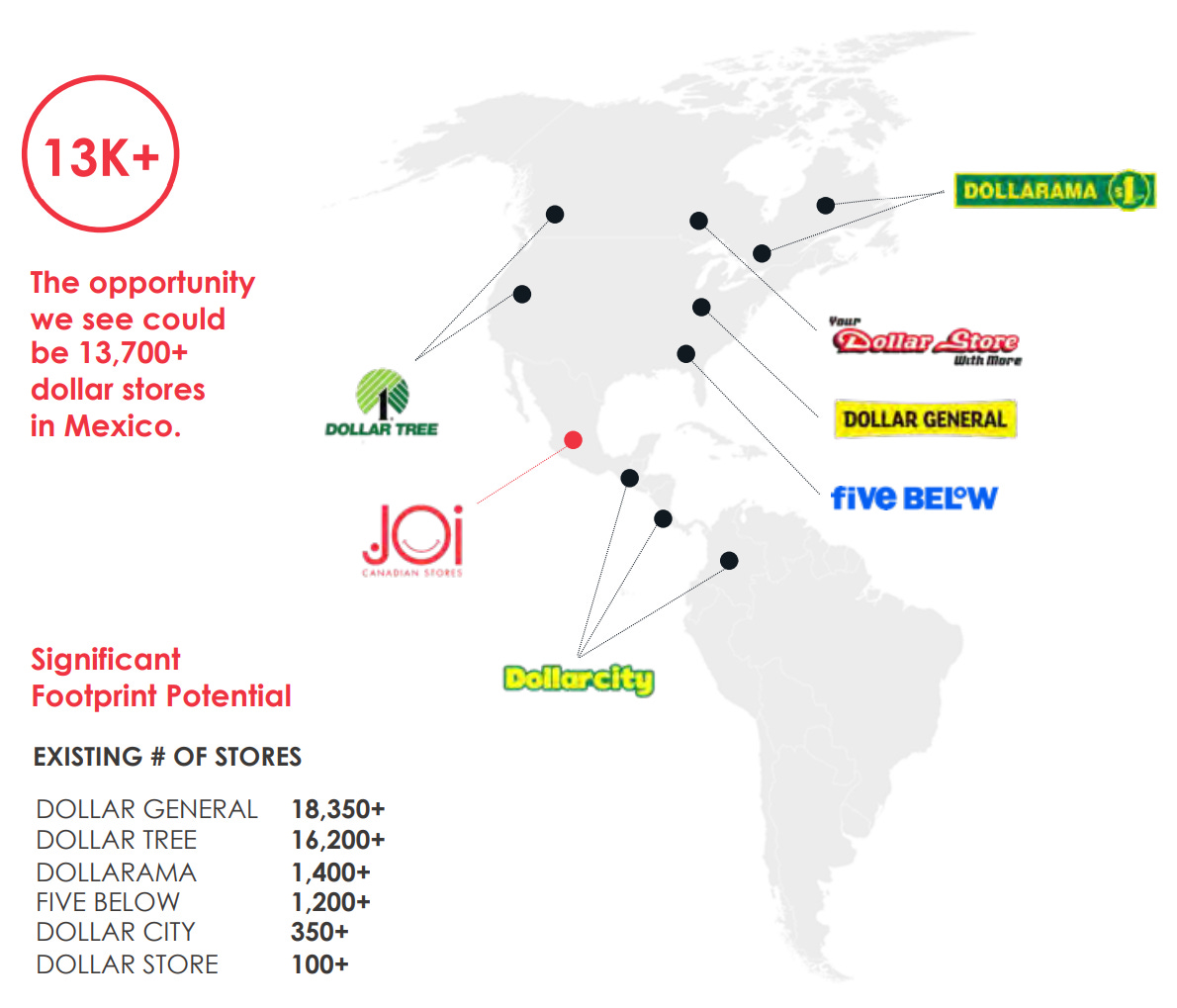
Source: October 2022 Pesorama Investor Presentation

Further, the Mexican retail market size is estimated at USD $94.40 billion in 2024, and is expected to reach USD $122.70 billion by 2029, growing at a CAGR of greater than 5% during this period (i.e., 2024-2029).

Mexico is a big deal.

Subscribe Now to My FREE Newsletter (Join 5,000+ Subscribers!)

Is Dollarama late to the party, and catching up? What I find most interesting is how Dollarama announced their expansion plans into Mexico, leading me to believe that the Canadian dollar store juggernaut is possibly now playing catch-up. In Dollarama’s Q1 2025 Management Discussion & Analysis (June 12, 2024), management admitted that:

[Mexico] did not form part of the initial agreed upon countries (namely El Salvador, Guatemala, Honduras, Costa Rica, Nicaragua, Panama, Colombia, Peru and Ecuador) under the stockholders agreement entered into among Dollarama International and Dollarcity’s founding stockholders in August 2019 (the “Stockholders Agreement”)” (see that excerpt below)
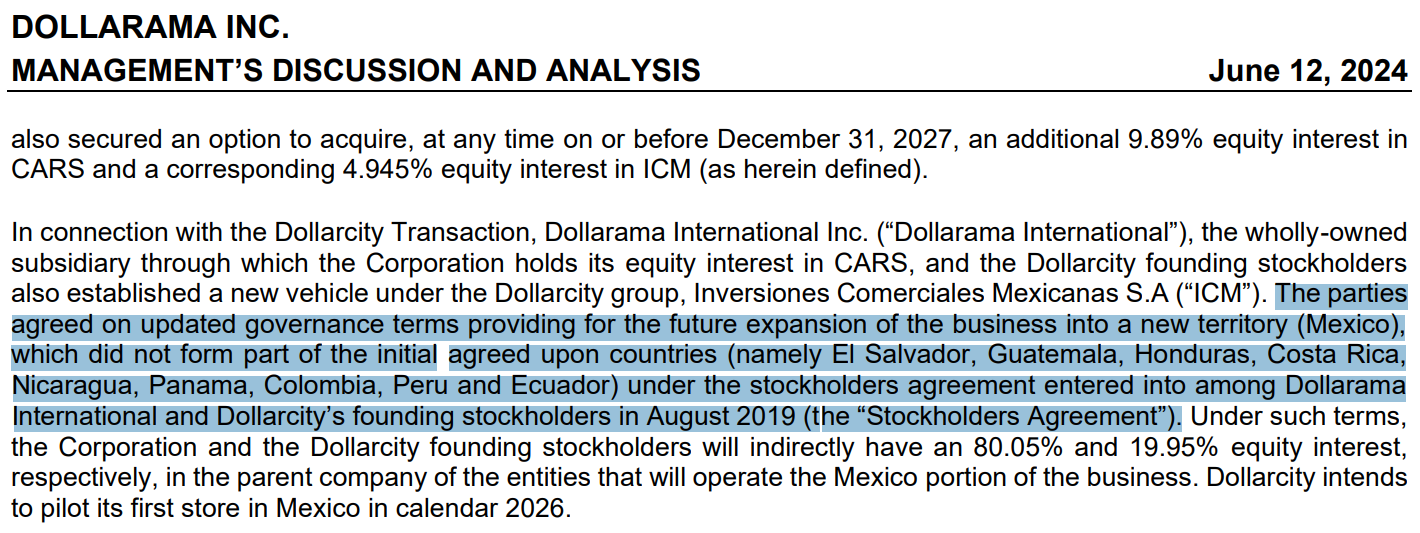
Source: Q1 2025 Dollarama Management Discussion & Analysis

Perhaps Pesorama’s entry and expansion of its JOi Dollar Plus stores across Mexico, including other new entrants (e.g. Dollar General), caught the attention of Dollarama’s upper management. How could they just sit back and watch? But the better question – i.e., why Dollarama did not originally plan to expand into Mexico, with a population and retail market size far exceeding those aforementioned LATAM countries – is beyond me.
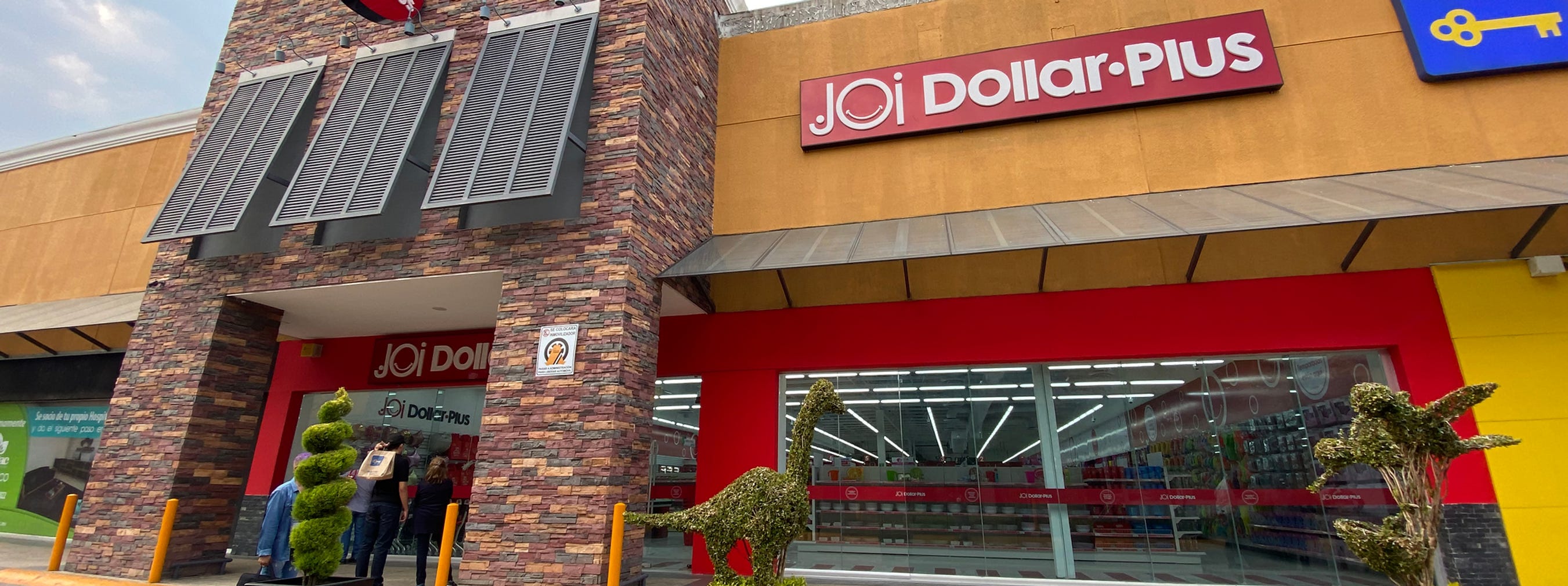
sucursal cuemanco JOi Dollar Plus.HEIC

Source: https://www.joi.mx/ubicaciones; JOi Dollar Plus location

Subscribe Now to My FREE Newsletter (Join 5,000+ Subscribers!)

Dollarama, through the Dollarcity banner, plans to pilot its first dollar store in Mexico in calendar year 2026, giving the competition (both old and new) another ~2 years to expand across the country. The current leader, Waldo’s Dollar Mart, plans to open approximately 70 stores a year going forward in Mexico, meaning that they will be operating close to 1,000 dollar stores around the time of Dollarcity’s first store launch.

Dollarama is placing a big bet on the LATAM region to fuel its future growth, and try to outcompete its peers. As at March 31, 2024, Dollarcity had 547 stores with 324 locations in Colombia, 99 in Guatemala, 72 in El Salvador and 52 in Peru. Dollarcity’s revised long-term store target in these four current markets of operation is up to 1,050 stores by 2031, versus its previous target of 850 stores by 2029. That said, this increased target reflects anticipated growth mainly in Peru and Colombia and does not take into account any future expansion in Mexico.

Current Market Caps of the BIG 3 North American Dollar Stores:

Dollar General: $25.8B USD
– Dollar Tree: $22.3B USD
– Dollarama: $36.9B CAD

Just how aggressive Dollarama’s Dollarcity push into Mexico will be is still undetermined. Management will most likely reveal their full expansion plan as a result of the first store opening in 2026.

On the crucial importance of LATAM growth for Dollarama, Neil Rossy, President and CEO of Dollarama said on their latest earnings call:

“Dollarcity continues to represent a compelling, long-term growth platform for Dollarama, with the Dollarcity leadership team successfully executing on its strategy throughout the course of our over decade-long partnership… Since we initially acquired a majority equity interest in 2019, Dollarcity has more than tripled its revenues and significantly grown its presence in key LATAM markets, demonstrating the underlying strength of its business model and the appetite for our value proposition from LATAM consumers.”

Indeed, with so much market opportunity up for grabs, the dollar store wars in Mexico are set to reshape the country’s retail sector in the coming years. Waldo’s Dollar Mart, while currently leading, will likely need to innovate and upgrade their existing stores to maintain its market position amid increasing competition from Dollarama, Pesorama, Dollar General, and other international entrants. With these Canadian and American dollar store brands introducing fresh new store formats, compelling customer experience, and a wide-range of products into Mexico, the Mexican consumer will surely benefit from the future dollar store marketplace.

With the rise of dollar store competition intensifying in Mexico, how do you think this will all play out?

Subscribe Now to My FREE Newsletter (Join 5,000+ Subscribers!)

Author’s Ownership Disclosure: $DOL.to (yes), $PESO.v (yes), $DG (no), $DLTR (no)

Good Things Come in Small Packages

Investing

(Originally written April 2020)
Subscribe Now to My FREE Newsletter (Join 5,000+ Subscribers!)

Good things do come in small packages. 

Let’s have a look at some of the MicroCaps that I have been interested in.

WELL Health Technologies (WELL)

What it does: WELL Health Technologies Corp is the owner and operator of a portfolio of primary clinics delivering healthcare-related services It operates through below segments: Clinical services, Digital services, and others. It also engages in the Electronic Medical Records business that supports the digitization of clinics. Its objective is to empower doctors to provide the best and most advanced care possible leveraging the latest trends in digital health.

Share Price: $1.69

Market Cap: $206M

Revenue (2019): $32.8M

Cash: $15.6M

Share Count: 122M

Website:https://www.well.company/

XPEL Technologies (XPEL)

What it does: XPEL, Inc. manufactures, sells, distributes, and installs after-market automotive products in the United States, China, Canada, Continental Europe, the United Kingdom, Asia Pacific, Latin America, the Middle East/Africa, and internationally. The company offers automotive surface and paint protection, headlight protection, and automotive and architectural window films, as well as proprietary software

Share Price: $11.63

Market Cap: $322M

Revenue (2019): $129M

Cash: $11.5M

Share Count: 28M

Website:https://www.xpel.com/

Kneat.com (KSI)

What it does: Kneat.com Inc is in the business of developing and marketing a software application for modelling regulated data-intensive processes for regulated industries, focusing on the life sciences industry. The company has developed Kneat Gx solution which provides management real-time visibility and control and increases product, quality, and compliance. In addition, the company provides software-related services including training, installation, upgrades, consulting and maintenance.

Share Price: $1.90

Market Cap: $127M

Revenue (TTM): $3M

Cash: $7M

Share Count: 67M

Website:http://www.kneat.com/

Kraken Robotics (PNG)

What it does: Kraken Robotics Inc is a Canada based company engaged in the design, manufacture and sale of software-centric sensors and underwater robotic systems. It operates in the business segments of Sensors and Platforms which is the design, manufacture and sale and provision of services for underwater sonar and laser scanner sensor equipment and underwater vehicle platform; and Power which is the design, manufacture and sale of subsea power equipment such as drives, thrusters, and batteries

Share Price: $0.40

Market Cap: $58M

Revenue (TTM): $12M

Cash: $2.7M

Share Count: 140M 

Website:http://www.krakenrobotics.com/

Nova Leap Health (NLH)

What it does: Nova Leap Health Corp operates in the healthcare industry. The company is a provider of personal home care and support services. The principal business activities of the company and its subsidiaries are to provide skilled and non-medical home care to clients. Its service offering includes meal preparation, housekeeping, transportation, personal care and medication reminders.

Share Price: $0.29

Market Cap: $18M

Revenue (2019): $17M

Cash: $1.6M

Share Count: 62M

Website:https://www.novaleaphealth.com/

Sangoma Technologies (STC)

What it does: Sangoma Technologies Corp is a provider of hardware and software components that enable Internet protocol communications systems for both telecom and datacom applications. It is engaged in the development, manufacturing, distribution, and support of voice and data connectivity components for software-based communication applications

Share Price: $1.73

Market Cap: $127M

Revenue (2019): $110M

Cash: $13.5M

Share Count: 74M

Website:https://www.sangoma.com/

Redishred Capital (KUT)

What it does: Redishred Capital Corp manages and operates the Proshred brand and business platform in the United States and internationally. It operates the Proshred system under two business models, franchising in the United States, via direct ownership of shredding trucks and facilities in eight locations in the United States. It also operates a hard-drive destruction service.

Share Price: $0.45

Market Cap: $35M

Revenue (TTM): $20.4M

Cash: $16.4M

Share Count: 78M

Website:http://www.redishred.com/

Namsys (CTZ)

What it does: NamSys Inc is engaged in providing software solutions for currency management and control systems for financial institutions, retailers, currency carriers, casino and mass transit operators, and various government agencies. The company is also engaged in processing for the banking and merchant industries. The company generates its revenue in the form of software license fees, Hosted services, maintenance and product support, and professional services

Share Price: $0.71

Market Cap: $19M

Revenue (2019): $4M

Cash: $4.8M

Share Count: 27M

Website: https://www.namsys.com

AirIQ (IQ)

What it does: Airiq Inc develops and operates a telematics asset management system using specialized software, digitized mapping, wireless communications, the internet, and the Global Positioning System. Geographically, the company has operations in Canada and the United States which is the key revenue driver.

Share Price: $0.22

Market Cap: $6.6M

Revenue (2019): $3.7M

Cash: $1.8M

Share Count: 30M

Website: https://www.airiq.com/

Hamilton Thorne (HTL)

What it does: Hamilton Thorne Ltd is engaged in providing precision instruments, consumables, software and services that reduce cost, increase productivity, improve results and enable breakthroughs in Assisted Reproductive Technologies (ART) and developmental biology research markets.

Share Price: $1.04

Market Cap: $133M

Revenue (2019): $32.6M

Cash: $10.3M

Share Count: 127M

Website: http://www.hamiltonthorne.ltd/

GoodFood (FOOD)

What it does: Goodfood is a leading online grocery company in Canada. They deliver fresh meals and grocery products coast to coast and make it easier for their members to enjoy delicious meals at home, every week. Goodfood’s mission is to make the impossible come true, from farm to kitchen, and they achieve that by empowering members to complete their weekly meal planning and grocery shopping in less than 1 minute.

Share Price: $3.47

Market Cap: $202M

Revenue (2019): $161M

Cash: $67M

Share Count: 58M

Website: https://www.makegoodfood.ca/

Enthusiast Gaming Holdings  (EGLX)

What it does: Enthusiast Gaming Holdings Inc is a gaming company building authentic lifestyle gamers. It has an online network of over 80, owned and affiliated, gaming related websites and a network of 900 YouTube channels reaching 150 million visitors. It also owns and operates Canada’s video-gaming expo, Enthusiast Gaming Live Expo “EGLX”. Its products and services fall into three principal segments: content, advertising and events.

Share Price: $1.60

Market Cap: $115M

Revenue (2019): $11.8M

Cash: $14M

Share Count: 72M

Website: https://www.enthusiastgaming.com/

AcuityAds (AT)

What it does: AcuityAds Holdings Inc is a provider of a web-based platform for advertisers to connect to their end-users. The programmatic marketing platform includes Acuity’s machine learning technology that uses data for real-time advertising on social media.

Share Price: $1.01

Market Cap: $50M

Revenue (2019): $119M

Cash: $7.4M

Share Count: 49M

Website:http://www.acuityads.com/

Quorum Information Technologies (QIS)

What it does: Quorum Information Technologies Inc is an information technology company engaged in the automotive retail business. It develops, markets, implements and supports its software product, XSELLERATOR a Dealership Management System for the automotive market. XSELLERATOR automates, integrates and streamlines a range of processes across departments in a dealership.

Share Price: $0.83

Market Cap: $59M

Revenue (TTM): $30M

Cash: $622K

Share Count: 72M

Website:http://www.quorumdms.com/

Blackline Safety (BLN)

What it does: Blackline Safety is a global connected safety technology leader. Providing comprehensive live-monitoring and wireless gas detection, they help teams working in hazardous environments respond to emergencies in real-time and manage efficient evacuations, accounting for everyone’s safety along the way. 

Share Price: $4.40

Market Cap: $211M

Revenue (2019): $33.3M

Cash: $12.6M

Share Count: 48M

Website:http://www.blacklinesafety.com/

Tecsys (TCS)

What it does: Tecsys Inc is engaged in the development and sale of enterprise supply chain management software for distribution, warehousing, transportation logistics, point-of-use and order management. It also provides related consulting, education and support services. The company serves healthcare systems, services parts, third-party logistics, retail and general wholesale distribution industries.

Share Price: $19.74

Market Cap: $258M

Revenue (2019): $76.5M

Cash: $12M

Share Count: 13M

Website: http://www.tecsys.com/

***

*Data and other information is from TMX, and Yahoo Finance

Summary List View:

WELL Health Technologies (WELL)

XPEL Technologies (XPEL)

Kneat.com (KSI)

Kraken Robotics (PNG)

Nova Leap Health (NLH)

Sangoma Technologies (STC)

Redishred Capital (KUT)

Namsys (CTZ)

AirIQ (IQ)

Hamilton Thorne (HTL)

GoodFood (FOOD)

Enthusiast Gaming Holdings  (EGLX)

AcuityAds (AT)

Quorum Information Technologies (QIS)

Blackline Safety (BLN)

Tecsys (TCS)

Subscribe Now to My FREE Newsletter (Join 5,000+ Subscribers!)

Chicken Little

Investing

Subscribe Now to My FREE Newsletter (Join 5,000+ Subscribers!)

(Originally written March 2020)

As a child, do you remember that story about Chicken Little?

It all starts when Chicken Little believes the sky is falling after a small acorn falls on his head.

“The sky is falling!” Chicken Little shouted, telling all of his friends along the way that the world was coming to an end. The story concludes when a Fox invites Chicken Little and all of the other animals into his lair for “protection”, and then eats them – one by one – for dinner.

The moral of the story is not to be a “Chicken” but to have courage, and also not to believe everything one is told. It’s a classic story told to many of us as children, but then seems to get lost on us later in life.

We’ve seen a lot of fear-mongering out there during the COVID-19 pandemic, and I’m taking note for my naughty list. These are the same people who proclaim “the sky is falling” after each bump in the road. It’s as if they feel empowered during times of unrest. 

Imagine not ever being scared, and thus as a result; making better decisions, and bolder bets.

Sometimes that just means making a decision, and then doing nothing.

In 1931, Grace Groner, from Lake Forest, Illinois, was hired as a secretary at Abbott Laboratories, where she worked for more than four decades.

As you can imagine, Grace’s salary was low and so she lived a very modest life.

In 1935, a few years after she started her job at Abbott Labs, Grace bought three shares of the company’s stock for about $60 per share. Her total investment was $180.

Grace never sold. She held onto those Abbott Labs shares through splits, and dividend payouts. Grace reinvested all of those dividends like clockwork.

In January 2010, Grace Groner passed away.  It was then revealed that her estate was worth a surprising $7 million USD, thanks to the current value of her Abbott Labs shares.

I really like this story. Compounding is magic. It’s true though, Grace Groner is an anomaly. There’s a lot of companies that don’t make it that long, and most people don’t hold on even to the good companies through booms and busts in the stock market.

But still – I want to be more like Grace, and less like that guy who shares photos of his trading room with 6 computer monitors installed on the wall.

Subscribe Now to My FREE Newsletter (Join 5,000+ Subscribers!)

This is Not The Great Depression (w/ Charts) – March 2020 – Investing During the Covid-19 Pandemic

Investing

(Originally written March 2020)

Subscribe Now to My FREE Newsletter (Join 5,000+ Subscribers!)

I’m hearing some chatter from the “bears” out there (esp. on Twitter) that we’ll soon be facing more significant draw-downs in the stock market throughout 2020 due to COVID-19, and that the experience will mirror the carnage from the Great Depression.  

That’s just wrong.  It won’t even be close.

The Great Depression was a different beast.

From peak to trough, the Great Depression draw-down in the Dow Jones Industrial Average  was -90%. Basically, everything was on the verge of going to zero.

(Get ready for my amateur charting skills…)

The Great Depression (1929 – 1932)

Some people are pointing to the first leg of the decline from the Great Depression (-50% ; see first circle in chart above), saying this is what we’re seeing now in March 2020, and that we have much further to fall after the recent “relief rally” that saw +20% gains from lows.

Those same people are also referencing this Boom/Bust Cycle chart below, saying with utmost confidence that we’re still currently at the “Return to normal” point near the top, and not near the point of greatest “Despair”. That’s plain wrong. These are very misguided people. We’re not heading into a multi-year period of slow death in the stock market.

Sure, we might fall further from here. But it won’t be a significant fall. No way. 

Back to the Great Depression…

Why was it so bad from 1929 – 1932 (-90% Draw-down)? 

In hindsight, it’s simple. The Federal Reserve at the time did not increase the monetary base, and by not injecting liquidity into the banking system to prevent it from crumbling, it passively watched the economy completely implode starting in 1929. Really terrible.

In the US:

– One third of all Banks shuttered (e.g.  New York Bank of United States).

– There were rampant bank-runs.

– Loans were called en masse.

– GDP declined by 30%.

– Industrial production fell by nearly 47%.

– International trade fell by more than 50%. 

– Unemployment rose to 23% and in some countries rose as high as 33%.

– Farming communities and rural areas suffered as crop prices fell by about 60%.

It was bad.  

It was systemic.  

Some historians say that the economy didn’t really recover until after WWII, from the resulting “baby-boom” and family formation throughout the Western World.

The late Economist Milton Friedman argued that the downward turn in the economy, starting with the stock market crash in 1929, would merely have been an ordinary recession if the Federal Reserve had taken aggressive action.

This view was endorsed by Federal Reserve Chairman Ben Bernanke (2006-2014), who was in office throughout the Financial Crisis of 2008, in a speech honouring Friedman:

Let me end my talk by abusing slightly my status as an official representative of the Federal Reserve. I would like to say to Milton…: Regarding the Great Depression, you’re right. We did it. We’re very sorry. But thanks to you, we won’t do it again.

— Ben S. Bernanke

Subscribe Now to My FREE Newsletter (Join 5,000+ Subscribers!)

So, when you compare today to the Great Depression, really — there is no comparison.

Today – the Federal Reserve has committed UNLIMITED Quantitative Easing (QE), combined with cutting the interest rate down to 0%. Further, the US Government recently passed $2 Trillion in stimulus. Similar efforts are being made around the world (see my earlier post for all documented stimulus packages). For those of you like me who are in Canada, the Central Bank of Canada cut its interest rate down to 0.25% (March 27, 2020), and the Canadian Government launched a $107B stimulus package.

OK – with that out of the way, I think our recovery will look more like that from 1987 (“Black Monday”) or from 2007/2008 (“Financial Crisis”). Probably a mixture of both.

Here are those charts below, along with today’s current chart (2020).

Financial Crisis (2007/2008) 

The US certainly learned its lesson from the Great Depression. The first circled bottom above is when the massive $700B Troubled Asset Relief Program (TARP) was passed by Congress and signed into law by President George Bush on October 3, 2008.  Around that same time, the Federal Reserve used its independent authority to spend $1.2 trillion on purchasing various financial assets and making emergency loans to address the financial crisis, above-and-beyond the $700B authorized by Congress from the federal budget. The Federal Reserve also cut its key interest rate to a range of between zero percent and 0.25%.

Yes – the market fell further up until the March 2009 nadir, after the stimulus/relief actions were launched. That’s also a possibility today. However, it didn’t fall much further from there. 

Black Monday (1987)  

Subscribe Now to My FREE Newsletter (Join 5,000+ Subscribers!)

The first circled bottom above is when on October 20, 1987, Fed Chairman Alan Greenspan made this statement: “The Federal Reserve, consistent with its responsibilities as the Nation’s central bank, affirmed today its readiness to serve as a source of liquidity to support the economic and financial system”. The Fed then acted to provide market liquidity and prevent the crisis from expanding into other markets. It immediately began injecting its reserves into the financial system via purchases on the open market. This rapidly pushed the federal funds rate down by 0.5%. The Fed continued its expansive open market purchases of securities for weeks.

And again, yes – the market fell after a relief rally, but retested its lows before the year was done, and then rallied into 1988.  In fact, that rally turned into an incredibly long bull market.

COVID-19 Pandemic (2020)  

Here we are today; March 27, 2020. Around -25% from highs, after a much-needed “relief rally”. Nobody knows exactly where the market will go from here in the short term. I especially don’t know where it’ll go tomorrow, next week, next month, or even next year (I wish!). What I do know, however, is that this is no Great Depression. Faaaaaar from it.

Wait, though. You might be thinking, “so what – COVID-19 cases are still on the rise…markets will keep falling”. That might be true… to a point. This virus is a tragic thing. I don’t want to seem insensitive here…. But the stock market will recover before COVID-19 cases peak. That’s just how the stock market works. And the spread has happened in phases; starting in Asia, then affecting Europe, and now North America.

We’ll get through this soon, saving as many people along the way.

At the end of the day – it’s impossible to time the market.

Some people dip in and out during crashes.

Or they sell-out, and just sit on the sidelines .

That’s not the smart thing to do.

Here’s why:

If you sell and are still on the sidelines during a recovery, it can be difficult to catch up. Missing even a few of the best days in the market can significantly undermine your performance.

I’ve posted below a visual (Growth of $10,000 invested on January 1, 1980) of what I’m talking about, courtesy of Fidelity.

Its shows that you lose out by missing the best days in the market, which are usually clustered around very large draw-down periods in the stock market, like the one we’re currently experiencing most recently in 2020 due to COVID-19.

Subscribe Now to My FREE Newsletter (Join 5,000+ Subscribers!)

Don’t believe me? OK – let’s go further back… to 1930

Looking at data going back to 1930, Bank of America found that if an investor missed the S&P 500′s 10 best days in each decade, total returns would be just 91%, significantly below the 14,962% return for investors who held steady through the downturns.

Bank of America noted this eye-popping stat while urging investors to “avoid panic selling,” pointing out that the “best days generally follow the worst days for stocks.” 

Morale of the story: stay invested in quality stocks in the stock market; don’t miss out on (or abruptly stop) the long-term magic of compounding; and avoid panic selling unless you really need the money for an emergency.

Finally, following up on my comment about about bearish chatter (esp. on Twitter), it never really helps to listen to what’s being discussed out there. What’s important is your own independent research in the companies that you care about, and your own frame of mind.

It’s easy to sell when you see people talking about how bad it can get. There’s such thing as “Perma-Bears” out there – people who are always cautious, and sit on the sidelines throughout every bull market known to man. Don’t let these people influence you.

Have a great weekend everyone, and be well

Subscribe Now to My FREE Newsletter (Join 5,000+ Subscribers!)

How to Generate Real Wealth in the Stock Market

Investing

(Originally written March 2020)

Subscribe Now to My FREE Newsletter (Join 5,000+ Subscribers!)

Generating real wealth is a journey. It’s not short term. You must put in a lot of work, and have the right frame of mind. You also need to make big bets when you feel in your gut that “it’s time”. We are presented with only so many golden opportunities throughout our lives – most consider grasping them – but only a small number of people actually do. 

That’s why so few become rich.

Doomsday-scenario stock market crashes like the one we’re currently going through is what separates the long term wealth generators from the majority of people: fearful, misguided, and short-term thinkers.

Real wealth generators are buying stocks now. 

They’re not selling. 

And they’re certainly not short-term trading.

They’re buying stocks, and building positions in quality companies for the long term.

They’re not worried about making sure if this is the exact bottom. 

They don’t care what you or what anyone else thinks.

Many new Millionaires, and dare I say it – maybe even some new Billionaires – will be born out of this crash. They’re in it for the long run.

Long term (wealth generation)
vs.
Short term (trading/speculation)

Traders are short term. They speculate (usually in their pajamas) on a day-to-day basis. Be wary of listening to anyone, ever, who doesn’t have the vision for long-term wealth creation. Buying, selling – dipping in and out throughout the past couple of weeks – doesn’t build wealth. It just reveals lack of conviction, and a reliance on short-lived dopamine shots.

Don’t let it get to your head. You’re in this for the long run.

Some might quip, “what about Jesse Livermore!”

Jesse Livermore… he made upwards of $100M at the time through short-term speculation. Traders today praise him as some genius. Livermore wasn’t genius. Shortly after making that ~$100 million dollars, Livermore lost it all, and then committed suicide by gunshot to the head. He didn’t think long term, and wasn’t even able to live with himself in the moment.

All that money went *poof* 

Easy come, easy go. 

Instead, let’s think about someone like J. Paul Getty during a time like this.

J. Paul Getty was an oil magnate, and a long term thinker.

In 1957, Fortune magazine named Getty the richest man in the world. By the mid-1970s, at the time of his death (June 6, 1976), it was estimated that Getty had built a personal fortune of up to $6 billion dollars. That was over 40 years ago.

Subscribe Now to My FREE Newsletter (Join 5,000+ Subscribers!)

J. Paul Getty also wrote a book. I recommend it to you all: “How To Be Rich” (1965).

Getty said that his book was not intended to tell people how to get rich, but instead how to be rich.

How to be rich = long term wealth generation

Consider the story of Tide Water Associated Oil Co. 

J. Paul Getty first bought the shares in 1932, in the midst of The Great Depression. The Dow had dropped from a high of 380 in 1929 all the way down to 40 — a fall just shy of 90% in three years. Investors had dumped everything, and most everyone was not buying stocks. Getty first bought shares of Tide Water at just $2.12 per share. Five years later, they traded above $20. Some stocks he owned grew to 100x the value he originally bought them for.

Getty wasn’t trading stocks; in and out, day by day, in a time like this. 

He was investing meaningfully – with purpose – in companies for the long run.

Getty said:

“It is possible to make money — and a great deal of money — in the stock market. But it can’t be done overnight or by haphazard buying and selling. The big profits go to the intelligent, careful and patient investors, not to the reckless and overeager speculator. The seasoned investor buys his stocks when they are priced low, holds them for the long-pull rise and takes in-between dips and slumps in stride.”

Like I said earlier, we’re only presented with so many golden opportunities throughout our lives to continually build (upon) wealth that will last a lifetime (and beyond).

What were you doing during the:

2000 – Tech Bubble

2008 – Financial Crisis

2011 – Euro Crisis

2015 – Oil Crash

Now – Coronavirus Pandemic

Were (are) you buying, selling, or trading during these crashes? They were all incredibly opportune times to invest in stocks for the long run. For example, I’m still holding, and building a position in Starbucks since the financial crisis of 2008 (12 years later). Sure; companies come and go. But are you building real, lastingwealth; adding capital to quality companies that make up the core of your portfolio. If you’re not; that’s just trading.

Getty would capitalize on meaningful opportunities time and time again throughout his life.

For example, when stock markets plunged in 1962, Getty said all around him panicked but there was “little if any reason for alarm and absolutely none for panic”. He said: “As for what I was doing, the answer was simple, I was buying stocks.”

Are you buying stocks now?

It’s important to repeat: Getty bought stocks as a long-term investment, not to make a quick buck when the share prices rose once again. “Get-rich-quick schemes don’t work. If they did, everyone on the face of the earth would be a millionaire,” he said.

Remember: empty vessels make the most noise.

Real, lasting wealth generation is a slow, and boring journey. Quick one-day wins that you can brag to your friends or family about is not real wealth generation. It’s just noise. Nor is selling out of stocks out of baseless fear, or trying to time the exact bottom and thus waiting on the sidelines. Have confidence in yourself, and the future. 

Subscribe Now to My FREE Newsletter (Join 5,000+ Subscribers!)

Real wealth takes time. It takes faith, and it takes conviction; in the world, your country, the market, and the stocks you love. Real wealth generators are in this for the long haul. They invest in quality companies, giving them the capital needed to grow, and in turn, will inevitably reap the rewards over a life-time (and beyond). 

New Interview with Peter Lynch

Investing

Subscribe Now to My FREE Newsletter (Join 5,000+ Subscribers!)

Barron’s recently sat down with Peter Lynch, former Fidelity fund manager, and author of several investment classics, including one of my favourite books ever; One Up On Wall Street

Peter is elusive these days so it’s always nice to hear from him and find out what he thinks about the market today. 

I do recommend picking up a copy of the latest Barron’s issue. Here’s the excerpt of the interview: (oh, and before you read on, look closely in the photo to see the shoes Peter was wearing…) 

***

Peter Lynch: After 50 years of doing this professionally, it reinforces that growth stocks are better than nongrowth stocks. Growth stocks, by definition, are where sales have really grown. People confuse it with earnings going up, but [if you just look at earnings growth] you mix in turnarounds and cyclicals. A company can go from losing money to a 2% margin, to a 12% margin, and earnings are up sixfold—but that’s not a growth company.

Passive management has stomped active.

In terms of attracting assets, yes, though not at Fidelity. Joel [Tillinghast, manager of Fidelity Low-Priced Stock (ticker: FLPSX)] has done it [beaten his benchmarks], Will [Danoff, manager of Fidelity Contrafund (FCNTX)] has done it, Steve Wymer [manager of Fidelity Growth Company (FDGRX)] has done it. We have 10 or 15 funds that have beaten their benchmarks for 10, 15, 20, 25 years now.

What characterizes a great company?

My best stocks have been ones where I didn’t have to worry about the big picture. A company with a better mousetrap, a growth company in a non-growth industry. Stop & Shop and Dunkin’ Donuts are two incredibly successful local companies. The question is, how long is the story? I wish I had been to Arkansas and gone to see Sam Walton of Walmart. Ten years after Walmart went public, it was a 25-year-old company. It was up tenfold. I said, “Ooh, I missed that one.” Then it went up 50-fold. Sherwin Williams earnings are up 20-fold since I managed the stock in Magellan. The professional painter in our little town goes to Sherwin Williams, not to Home Depot. Why didn’t I look at Sherwin Williams? Why didn’t I spend an hour on that? So staggering, dumb, or just lazy. I thought it was the last inning of the ballgame, without doing the research.

You can’t make these conclusions without some basis. Really bad American fast food has done brilliantly overseas. There are 1,400 McDonald’s in France. You want to be in [the stock] in the second inning of the ballgame, and out in the seventh. That could be 30 years. Like the people who were really wrong on McDonald’s. They thought they were near the end, and they forgot about the other seven billion people in the world.

The lists of companies in your books are quaint. They’ve mostly been disrupted.

That’s why you ought to write down, “Why am I owning this?” Cheap is different from a [good] story. There’s a great expression on the Street: It’s always darkest before pitch black. Wait until something’s gotten better. I made a lot of money on Bank of America. I’m not saying it’s a buy today. But Bank of America [during the financial crisis] went from $18 to $7. They had to borrow money wholesale. I knew they couldn’t go under because they were 120% retail funded. They had FDIC [protection]. They went up a lot after that.

How would you update your advice today?

If you cannot find growth companies in innings three through five of the ballgame, look at turnarounds, special situations, back at the cyclicals. There’s a real shortage now of growth companies. That is a red flag, because all the money is flowing into [a few companies]. There’s an end to that game. It will scare me if this trend continues for a couple more years.

Subscribe Now to My FREE Newsletter (Join 5,000+ Subscribers!)

What’s your view of unicorns?

That’s a big difference today—companies stay private a lot longer. The next Google might stay private for an extra 10 years. That makes it more difficult [for individual investors]. The day they come public, a thousand organizations have looked at it, and they’re probably pretty fairly priced. Fidelity can put 5% of funds into these things. The public can’t do that. I’d rather look at something that’s been around for a long time.

Which CEOs do you like?

Satya Nadella really turned around Microsoft [MSFT]. Dan Amos of AFLAC [AFL] is the longest-running CEO in the country after Warren Buffett. And how do you leave out the late Lee Iacocca [former CEO] of Chrysler?

Where are the opportunities now?

I’m looking at industries that are doing badly; that for some reason will get better. Shipping. If you want to buy a ship, it’s a two- or three-year wait. People haven’t ordered ships for a long time, because by the time one comes in, prices may be down again.

Energy services is awful; that could have a major turn in the next year or two. Oil is interesting. Look, longer term, solar, windmills really work. But you need natural gas and oil to bridge to this. Everybody’s assuming the world’s going to not use oil for the next 20 years, or next year. China might sell five million electric vehicles next year, but they might also sell 17 million internal combustion engines. They don’t have old cars to retire. There are no electric airplanes. Near term, liquid natural gas and liquid petroleum gas might replace diesel fuel for trucks. I’m buying companies that I don’t think will go bankrupt. They’ve got to be around the next 18 to 24 months, or I have no interest.

Can we ask which companies?

No. I can’t recommend stocks anymore.

Anything else do you want investors to know?

If you’re going to invest, you have to follow certain rules. If you want to ski, you ought to go to the bunny hill and learn how to stop. It doesn’t make you an Olympic skier, but then in certain cases, you have an edge on the Fidelitys of the world. You might be in the cement industry, and suddenly orders pick up. You can see things better. The one thing I want everybody who is buying individual stocks to get is that they have to understand the story, the five reasons something is going to go right for the company. If you can’t convince an 8-year-old why you own this thing, you probably shouldn’t own it. Don’t invest in a company before you look at the financials. If you made it through fifth grade, you can handle the math.

Source: Barron’s, 2019. Copyright. All Rights Reserved. https://www.barrons.com/articles/peter-lynch-how-to-find-growth-opportunities-in-todays-stock-market-51576877980

Subscribe Now to My FREE Newsletter (Join 5,000+ Subscribers!)

Bill Ackman’s Back

Investing

Subscribe Now to My FREE Newsletter (Join 5,000+ Subscribers!)

(Originally written December 2019)

I interviewed Bill Ackman in 2015  for my book, Market Masters

He was seemingly on top of the world. $20B AUM, gushing performance, star HF manager.

But then Bill had a fall from grace.  Well, it was almost a loud thump.

His long bet on Valeant (-$4B loss) almost took down his fund. 

And his short bet on Herbalife was a both a ‘head-scratcher’ for us, and a lesson in pride for Bill (we can be right, but still wrong).

Investors fled the fund.

His wife left him.

He moved out of his lavish Manhattan skyscraper to smaller digs.

And then he went away… next to no interviews, or sightings of Bill.

But behind closed doors, he was tinkering away, re-building his battered fund. 

Bill started a position in Chipotle (see photo above where Bill”s seen standing in line at a local Chipotle restaurant in NYC). But people scoffed, “doesn’t Chipotle just give you diarrhea?”.  Then a new stake in Starbucks.”How unoriginal” we thought. “I don’t pay a money manager to buy Starbucks”. And then a position in… Berkshire?

However, this year, something out-of-the-ordinary happened. We started hearing that Bill’s fund was up. Quarter after quarter…trouncing the market. “How can this be… I thought Bill was done”.  The first quarter of 2019 could have been a fluke (as all stocks in the S&P 500 seemingly experienced a sharp rebound), but this was consistent. Something was going on.

Subscribe Now to My FREE Newsletter (Join 5,000+ Subscribers!)

Indeed, 2019 was the year that Bill Ackman got his mojo back. 

His fund is now up +57%, double the S&P 500’s performance. It definitely helped that Bill cherry picked quality, blue chip companies from the S&P 500, which equally had a stellar year in light of a trade war, impending recession, and presidential impeachment.

But really, the lesson here is this: Keep it simple. 

How simple?  Food, food, hotels, home reno, everyone’s favourite cherry-coke-drinking capitalist (Buffett), tasty lattes, and then some.

Here’s the most recent holdings snapshot in Bill’s Pershing Square fund, source:  https://seekingalpha.com/article/4313487-tracking-bill-ackmans-pershing-square-portfolio-q3-2019-update 

It’s clear now, and I hope this trend continues – that Bill’s decidedly past the days where he wants to look like the smartest guy in the room with long, convoluted 50+ page thesis papers to back his contrarian holdings. Sure, when those wildly contrarian ideas worked (e.g. MBIA short), they really worked, but when they didn’t he took some hard punches, including the aforementioned Valeant, and Herbalife, but also J.C. Penney and Target.

He’s keeping it simple.  When you meet Bill at a cocktail party now, he’s talking up the latest menu offerings at Chipotle, and how Starbucks coffee is his go-to morning saviour.

I also think that his new life partner, and wife – Neri Oxman – humbled him immensely, but maybe more importantly, Neri helped light that spark back up in Bill after the flame had gone away: “It’s very helpful when you’re going through a difficult period to be in a great relationship” with someone who is “super-supportive, loving and warm and believes in you”.

I’m happy for Bill. It’s not the story-book ending yet (as we know, he’ll have to keep up the gains) but it goes to show that investing is a long term game, and that we’ll all personally have our ups and downs throughout the years. The key is to stay in the game, and keep on compounding! 

Love him, or hate him; Bill’s back. And it’s a good lesson for all.

Subscribe Now to My FREE Newsletter (Join 5,000+ Subscribers!)

Eric Sprott on Tenbaggers, and the Discovery Process

Investing

Subscribe Now to My FREE Newsletter (Join 5,000+ Subscribers!)

Eric Sprott, the Canadian kingpin financier of junior mining/precious metals companies, was on my wish-list of investors that I wanted to interview for my 2016 book, Market Masters. However, that interview didn’t pan out (maybe the sequel). Commodities were in a slump, but Gold finally bottomed out at the start of that year, steadily rising out of the bear market.

This morning, I stumbled upon a good interview with Eric on Financial Post that I want to share: https://business.financialpost.com/commodities/mining/billionaire-eric-sprott-dishes-on-his-golden-investment-spree-its-like-being-at-a-table-with-a-winning-run

Investing in junior mining / precious metals companies isn’t in my wheelhouse, but there’s definitely some parallels to investing in Micro/Small-Caps, and it’s still important to get inside the head of successful investors who’ve got the knack for bagging winners.

As I read the interview, I pulled out insights and summarized them below for you.

Eric Sprott on Tenbaggers, and the Discovery Process:

– Sprott launched an investment blitz, the likes of which the junior mining precious metals sector had seldom seen, doling out somewhere between $200 and $300 million in a matter of just a few months to acquire large stakes in about two dozen companies, most of which have never earned a dollar of revenue

– Sprott takes a birdshot approach to investment that spreads his money far and wide

– “You’ve got to have the dream, right?” he said. “You’ve got to have the dream you’re going to find something.”

– “The guy gets up at ungodly hours, he might get up at 2 a.m. studying,” said Conor O’Brien, a former capital markets manager who joined Sprott in May to help with the investment blitz. “Neither one of us are geologists, we’re just financial people that can do mathematics, as opposed to the geology. We more kind of conceptualize, and dream and kind of multiply.”

– Sprott was an early investor in Kirkland Lake, was appointed chairman in 2015, and one year later helped engineer its merger with Newmarket Gold Inc., a small gold producer in Australia. Not long after, the newly merged company discovered high-grade veins at two mines, which propelled its stock upwards to $63 per share.

– Many investors pride themselves on not selling when a stock hits a bump, but Sprott said it is equally important to not sell when the stock rises, at least not until it’s gone up five or even 10 times, a so-called tenbagger.

– “I’ve had lots of tenbaggers and the important thing is to stay in it,” he said.

– But when his stake in Kirkland Lake reached about $1.3 billion earlier this year, and it looked like gold prices would keep rising, Sprott said he decided it was time to sell.

– “I still have a lot of money in Kirkland and it’s a great company, but it’s not a tenbagger from here,” he said. “And I like tenbaggers as opposed to 100 per cent. It’s just my nature.”

Read the full interview w/ Eric Sprott here:  https://business.financialpost.com/commodities/mining/billionaire-eric-sprott-dishes-on-his-golden-investment-spree-its-like-being-at-a-table-with-a-winning-run 

Subscribe Now to My FREE Newsletter (Join 5,000+ Subscribers!)

The Stocks I Like Best

Investing

Subscribe Now to My FREE Newsletter (Join 5,000+ Subscribers!)

It’s certainly been a while. In the past year, I got married. We also welcomed our first newborn. So, yes – the Speziale household has been busy.

In between changing diapers, I have been reading the wonderful book, Daring to Succeed: How Alain Bouchard Built the Couche-Tard & Circle K Convenience Store EmpireAuthor Guy Gendron chronicles the rise of Alimentation Couche-Tard ($ATD), one of Canada’s greatest wealth-creation stories of all time.

I’ve also been catching up on BNN – whenever Jason Donville, Jordan Zinberg, and Jason Del Vicario make appearances on Market Call – I’m an attentive watcher.

And I usually don’t do this, but some of the High Interest Savings Accounts out there have been so tantalizing that I finally signed up for one at Simplii (CIBC). Why not. I can use the boost to start funding my daughter’s RESP.

Since I haven’t been writing lately, some readers have been asking me what Canadian stocks I currently like best.

Well, here they are (in no particular order):

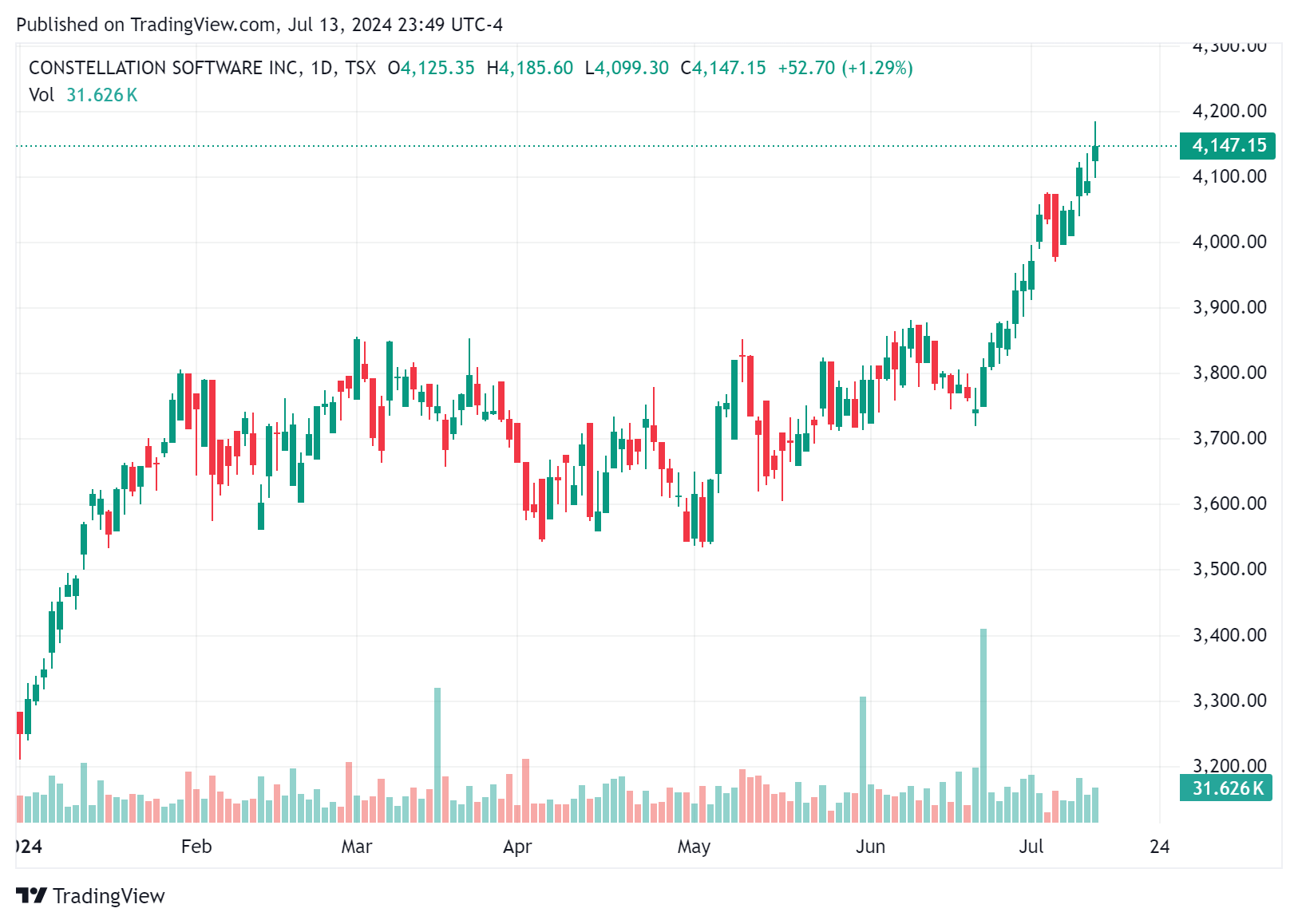
Constellation Software ($CSU)

TradingView chart

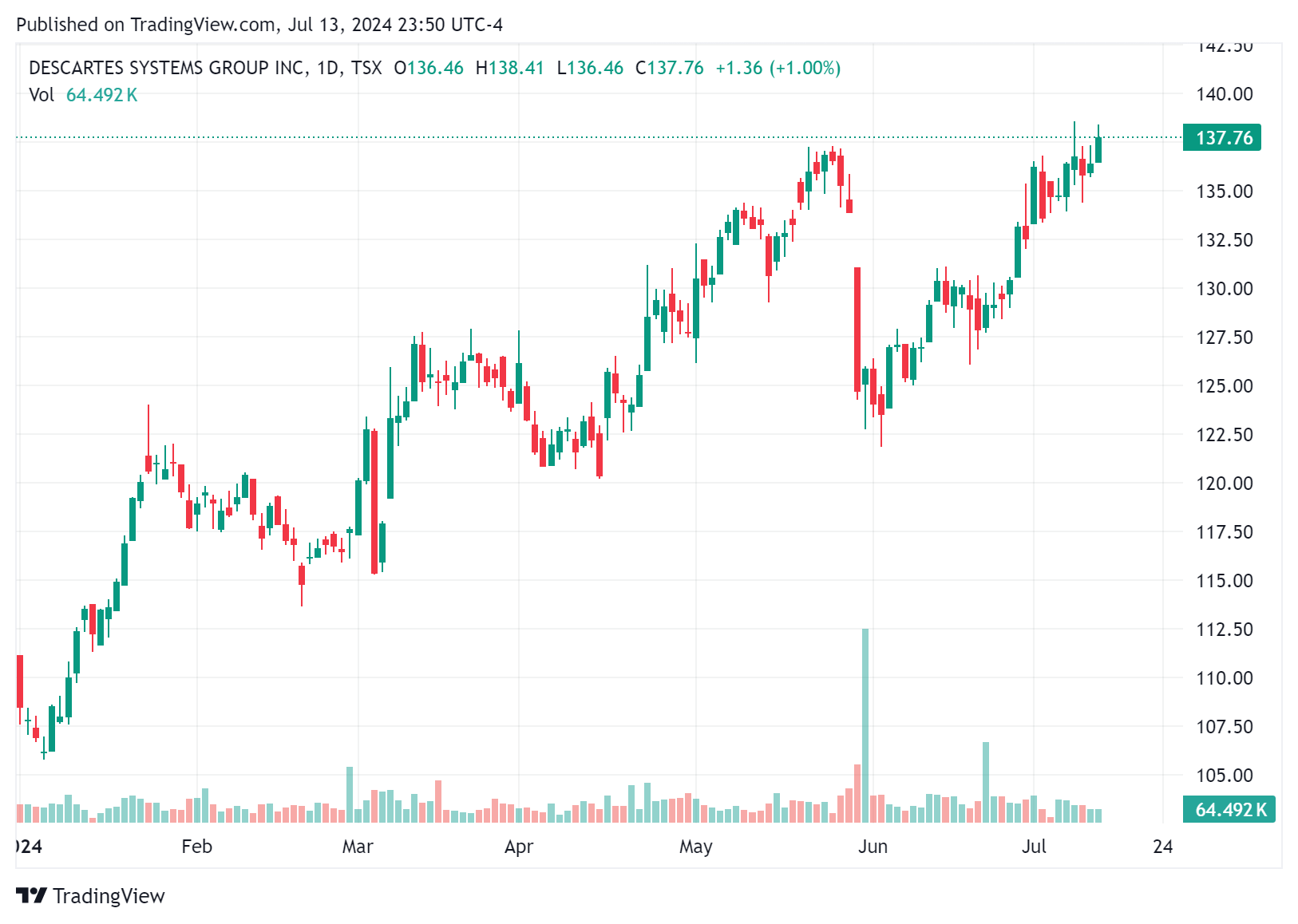
Descartes Systems Group ($DSG)

TradingView chart

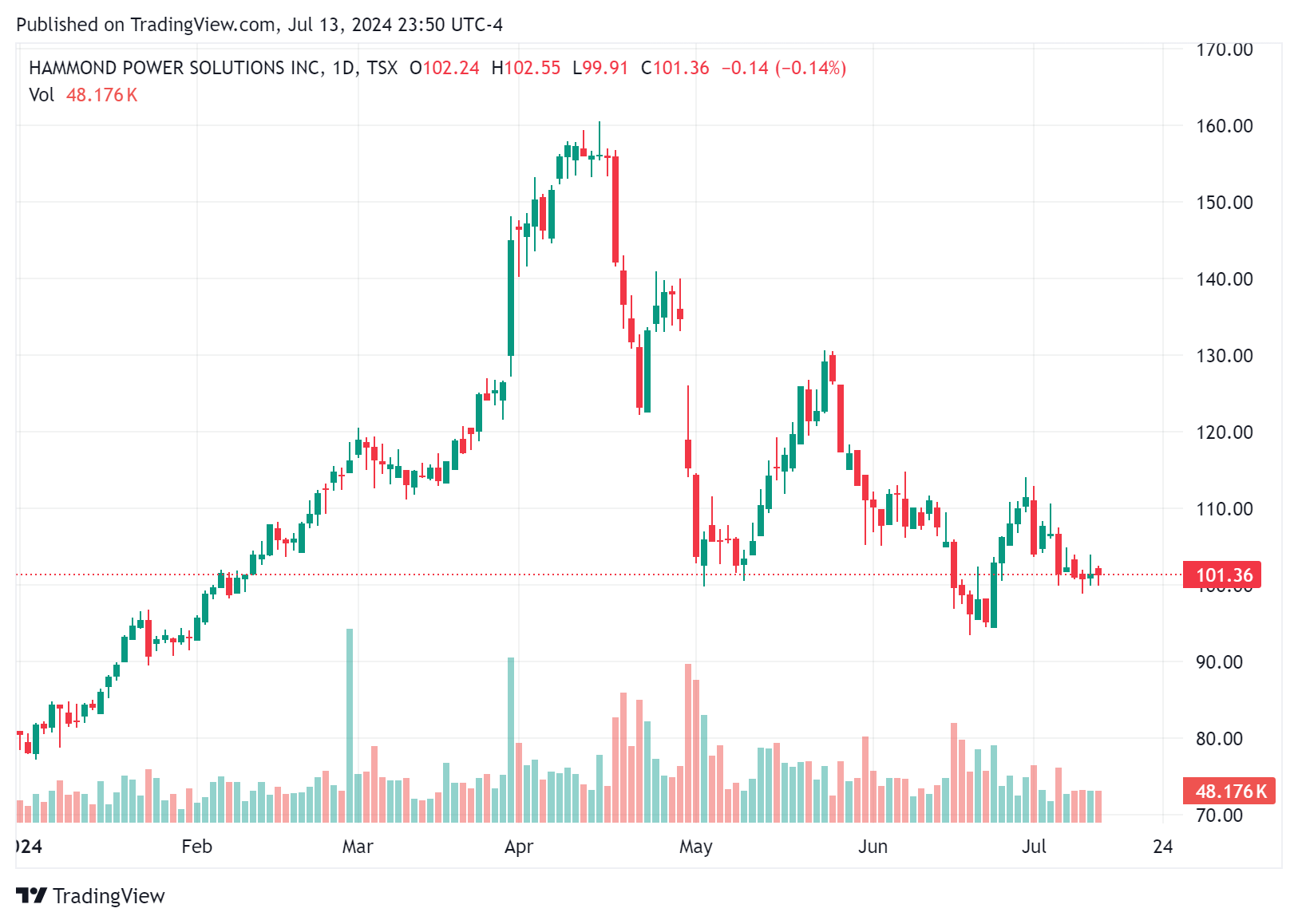
Hammond Power Solutions ($HPS.A)

TradingView chart

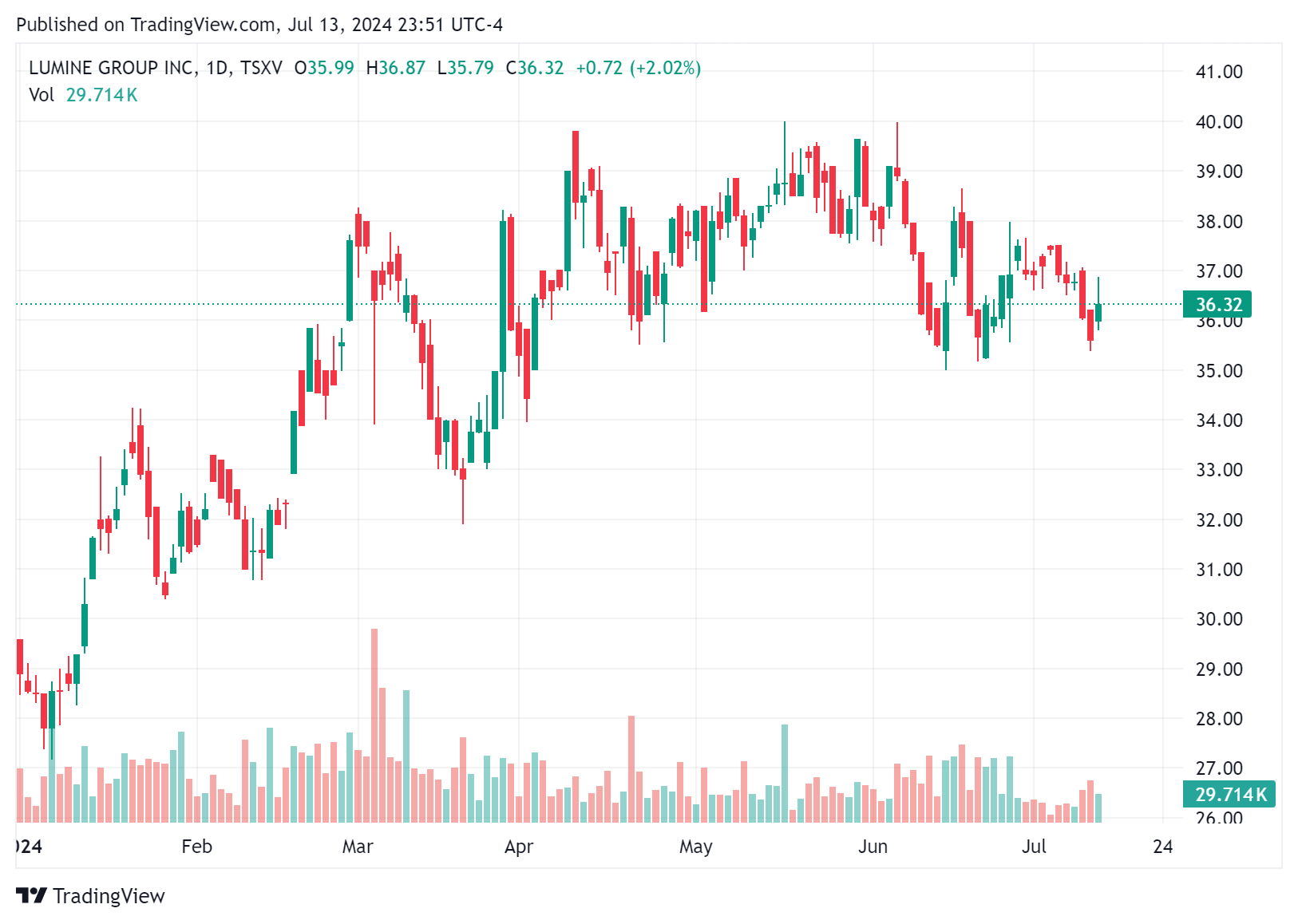
Lumine Group ($LMN.v)

TradingView chart

Subscribe Now to My FREE Newsletter (Join 5,000+ Subscribers!)

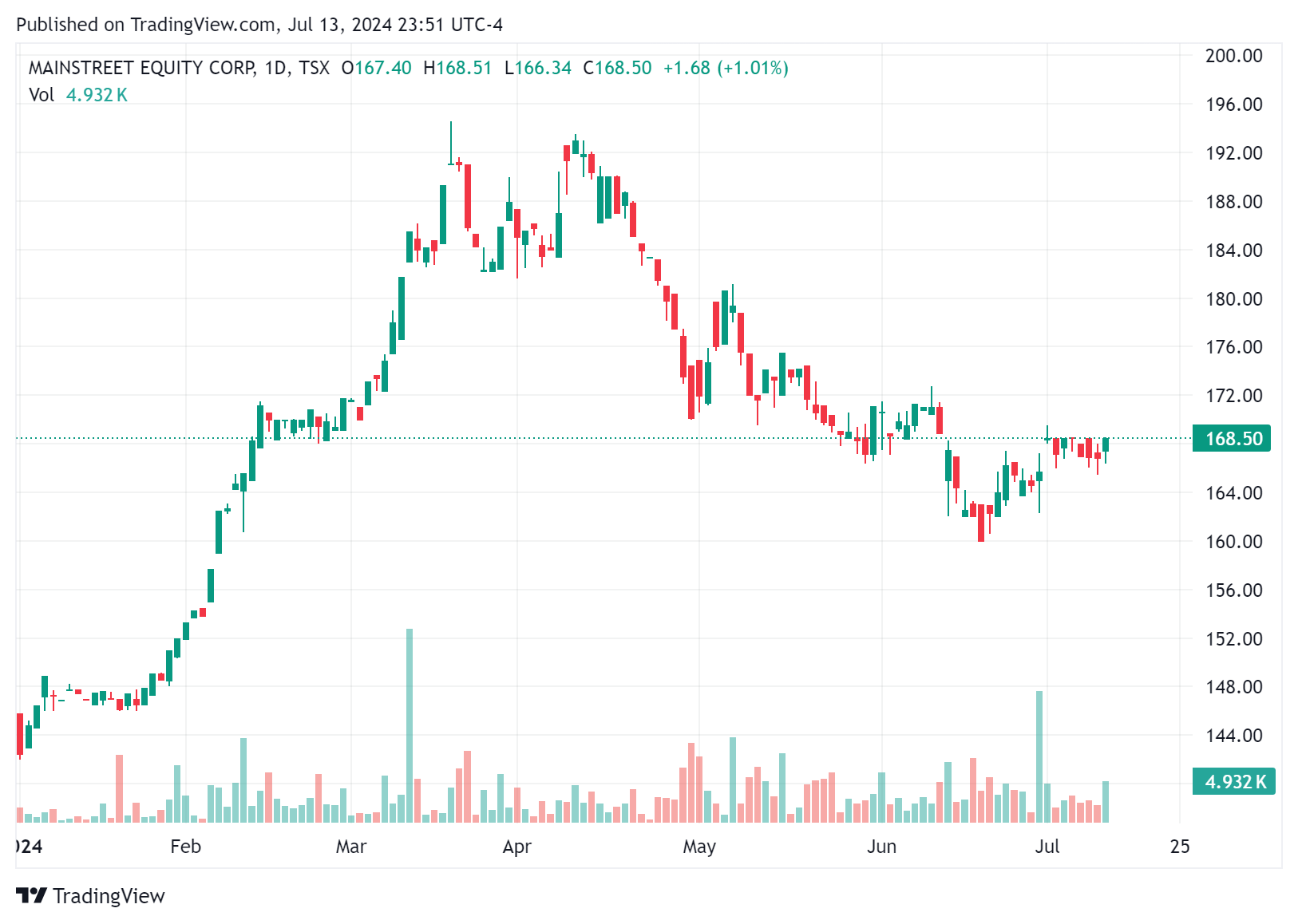
Mainstreet Equity ($MEQ)

TradingView chart

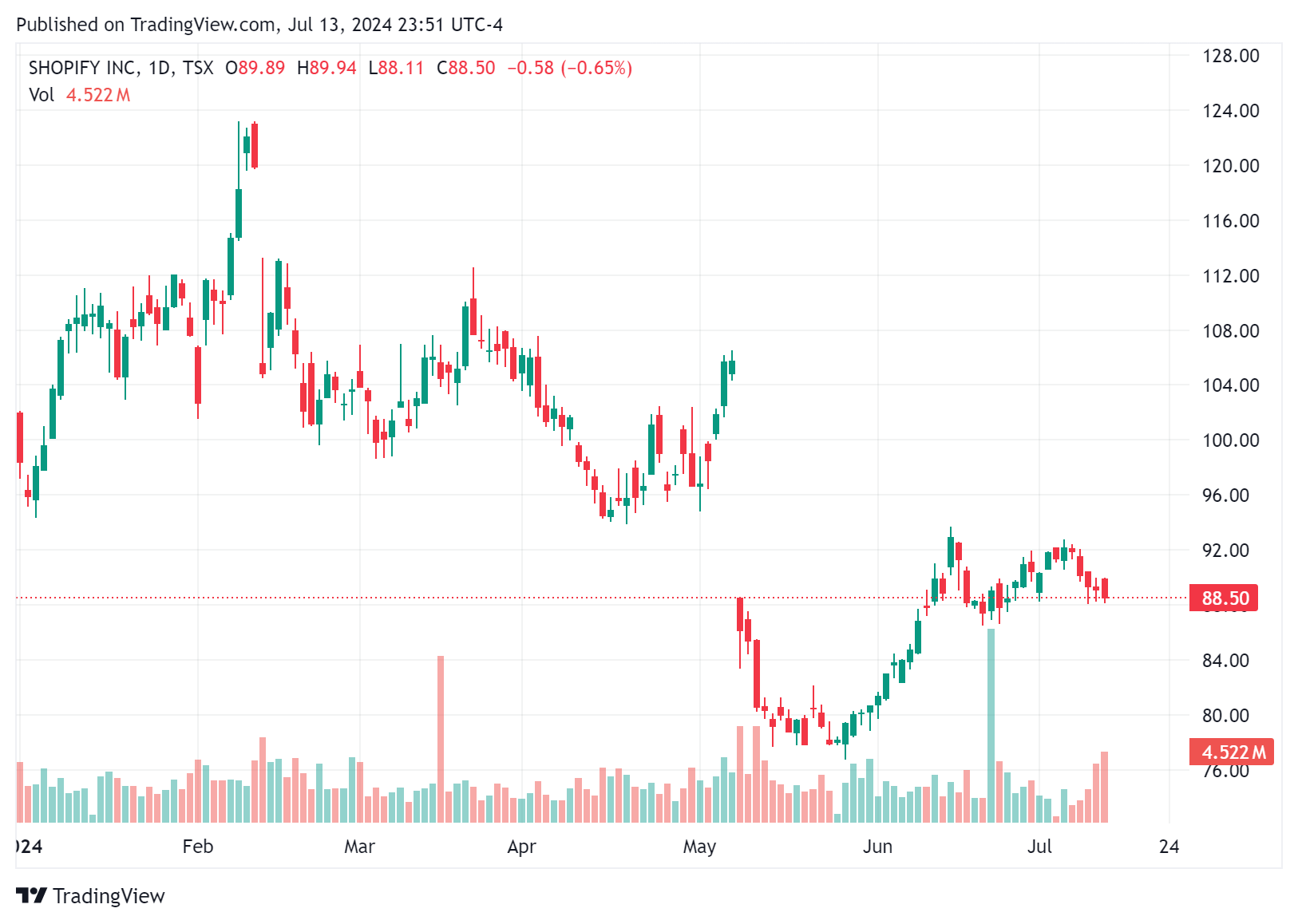
Shopify ($SHOP)

TradingView chart

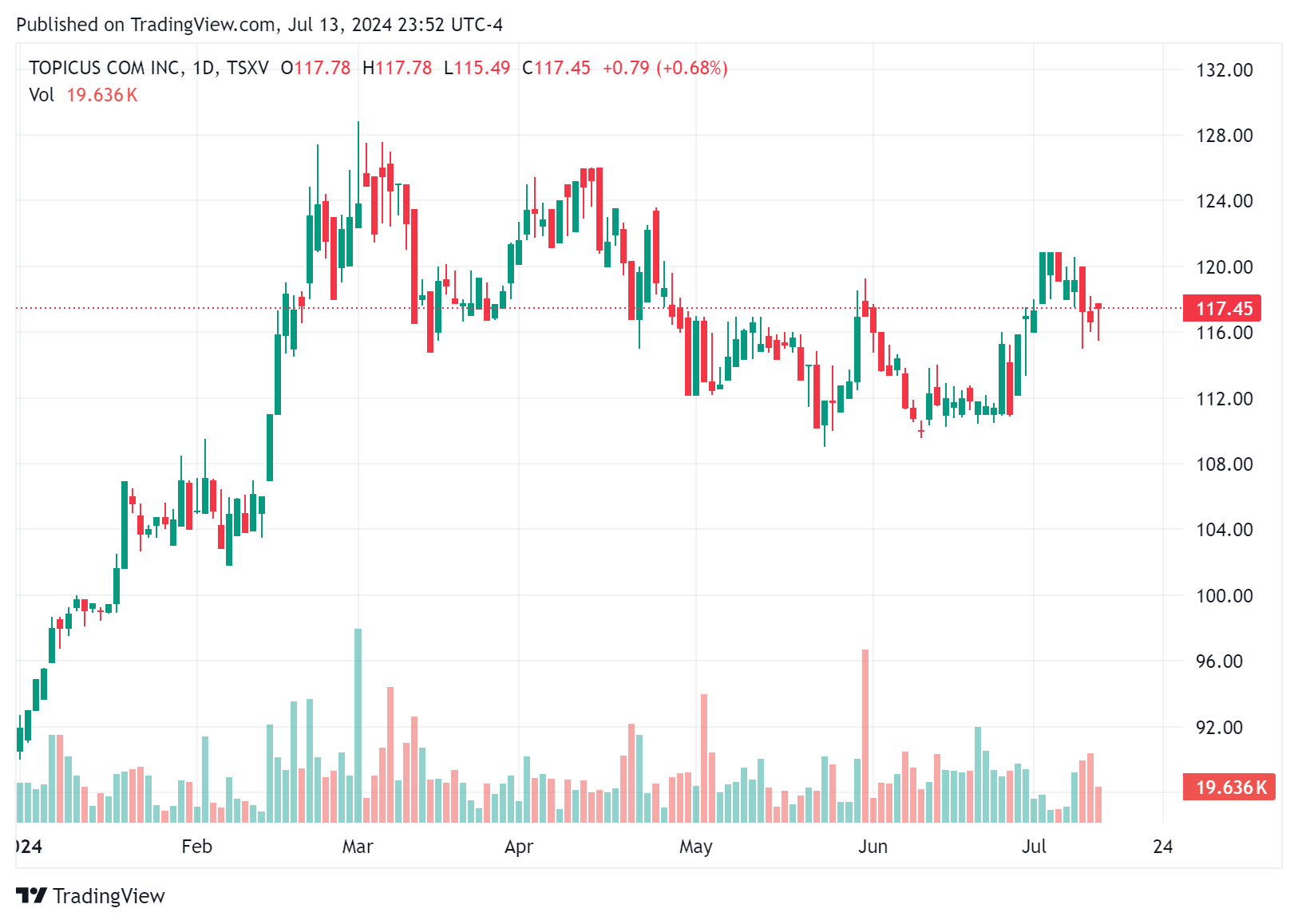
Topicus.com ($TOI.v)

TradingView chart

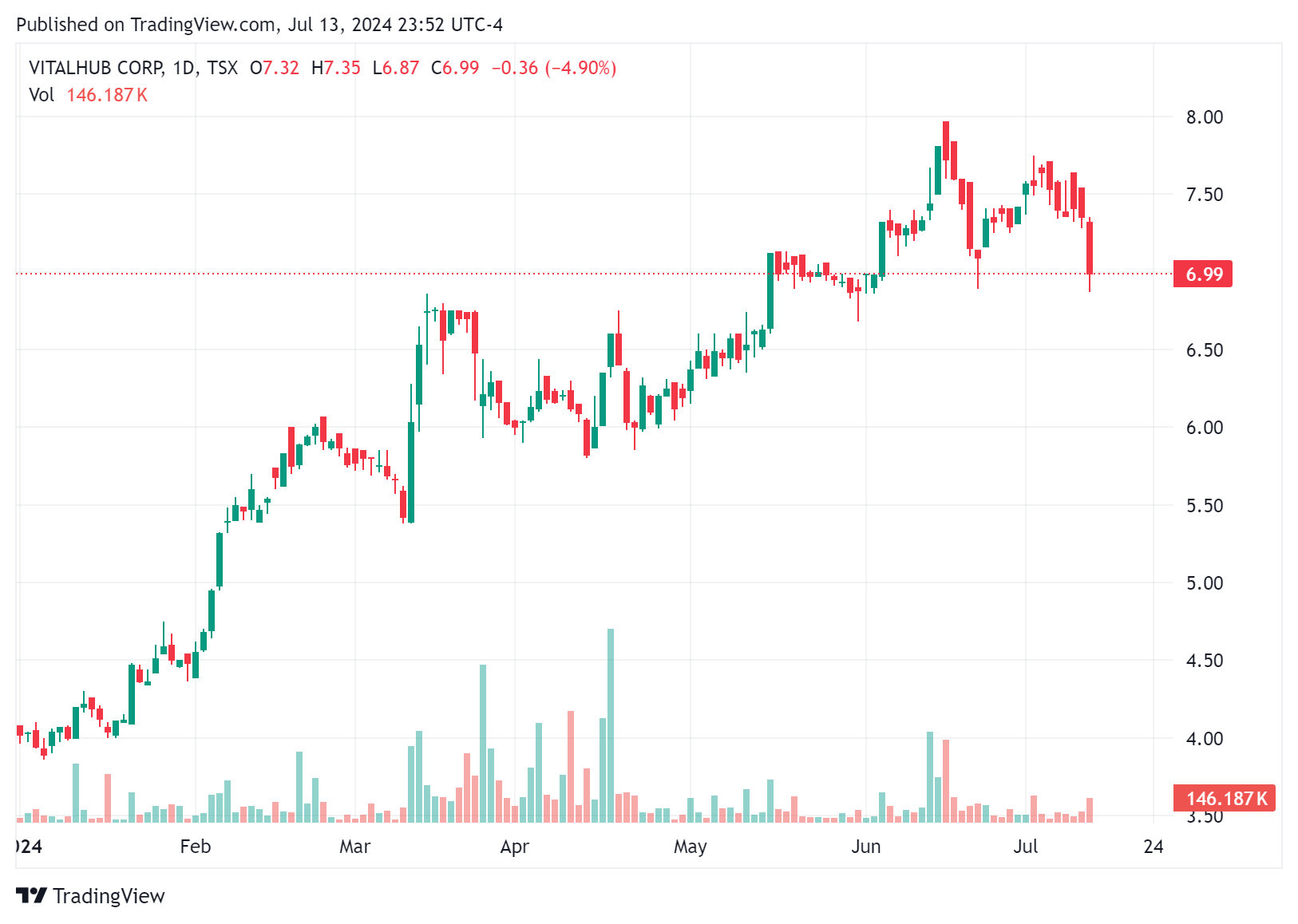
Vitalhub ($VHI)

TradingView chart

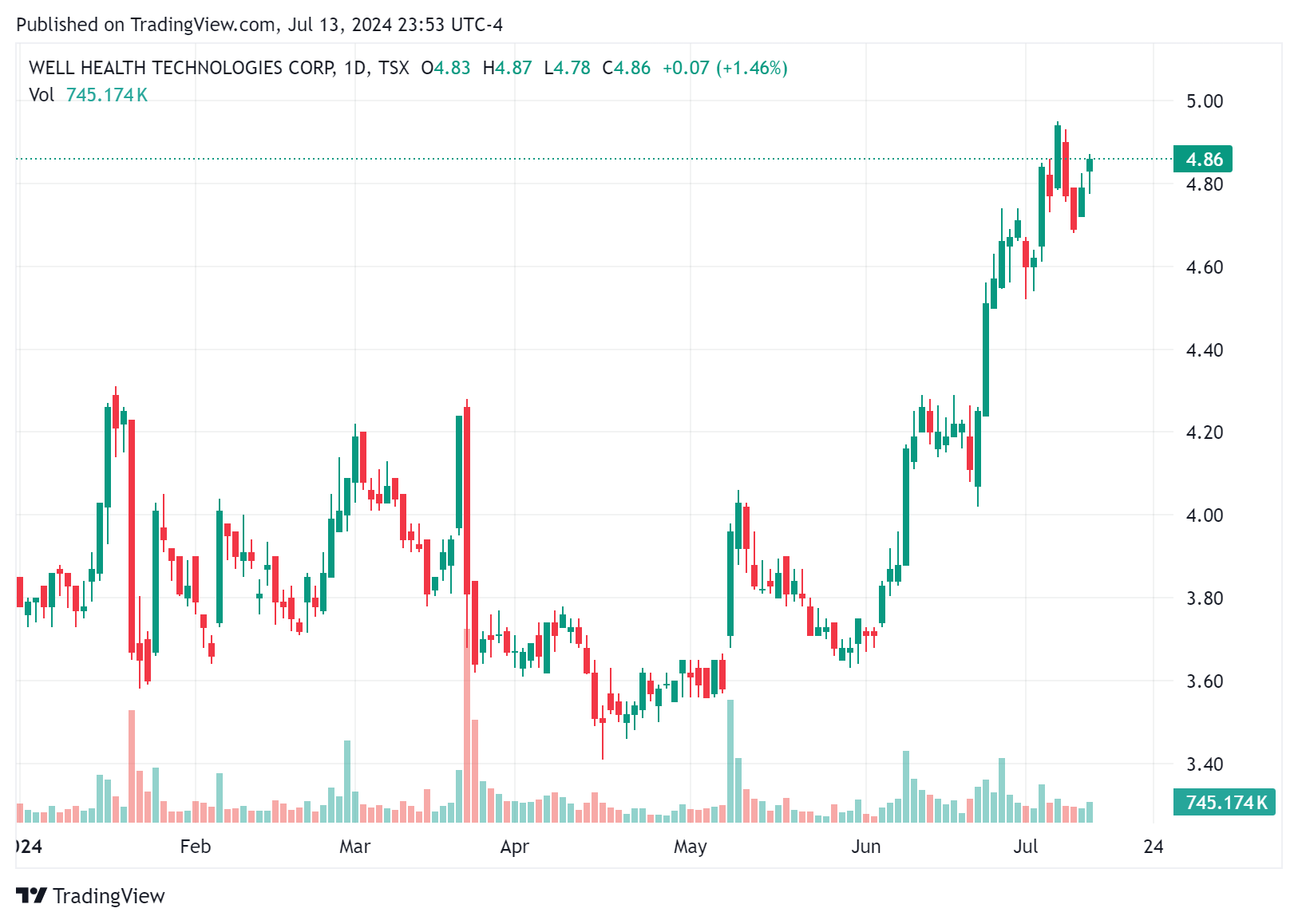
WELL Health Technologies ($WELL)

TradingView chart

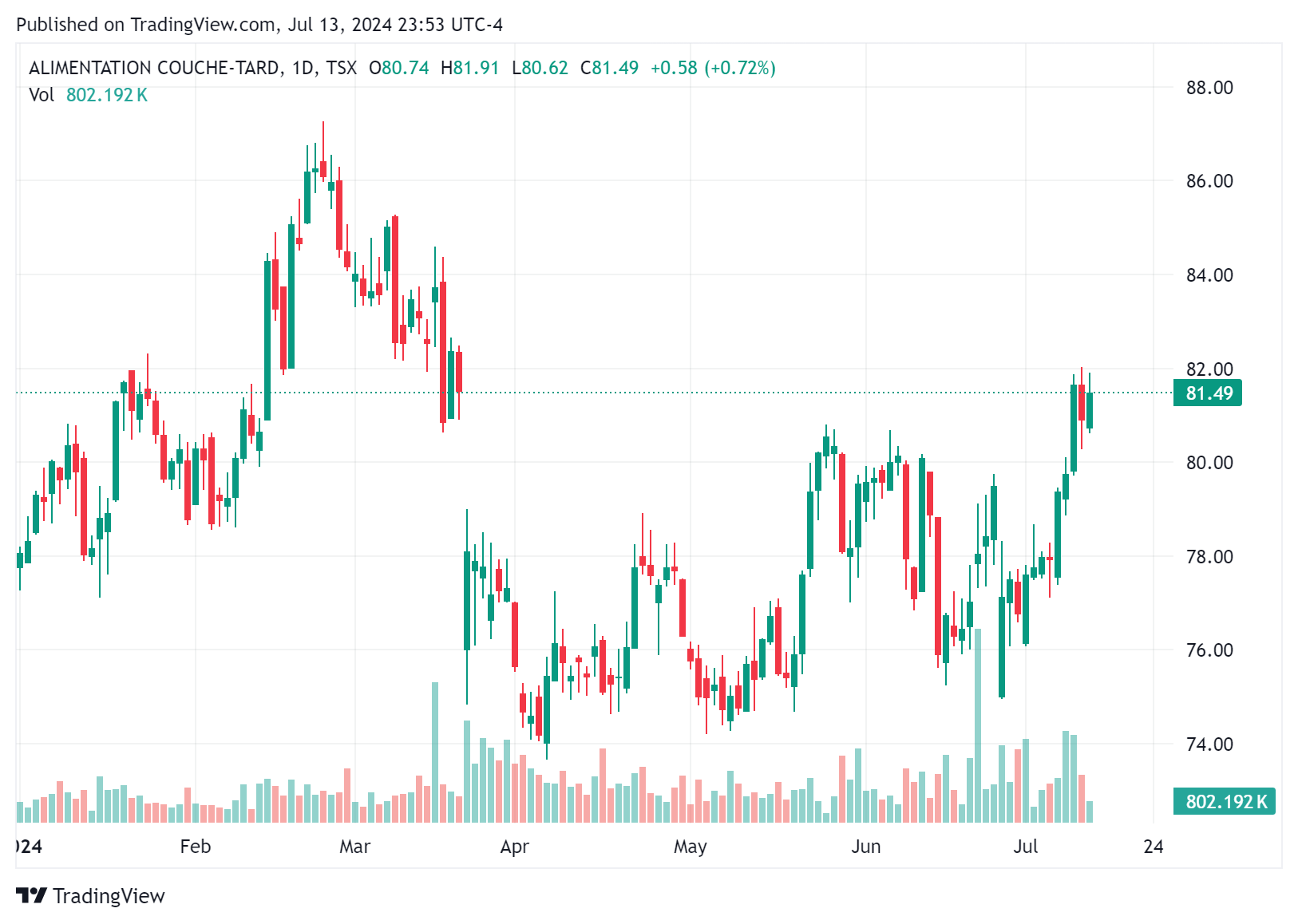
Alimentation Couche-Tard ($ATD)

TradingView chart

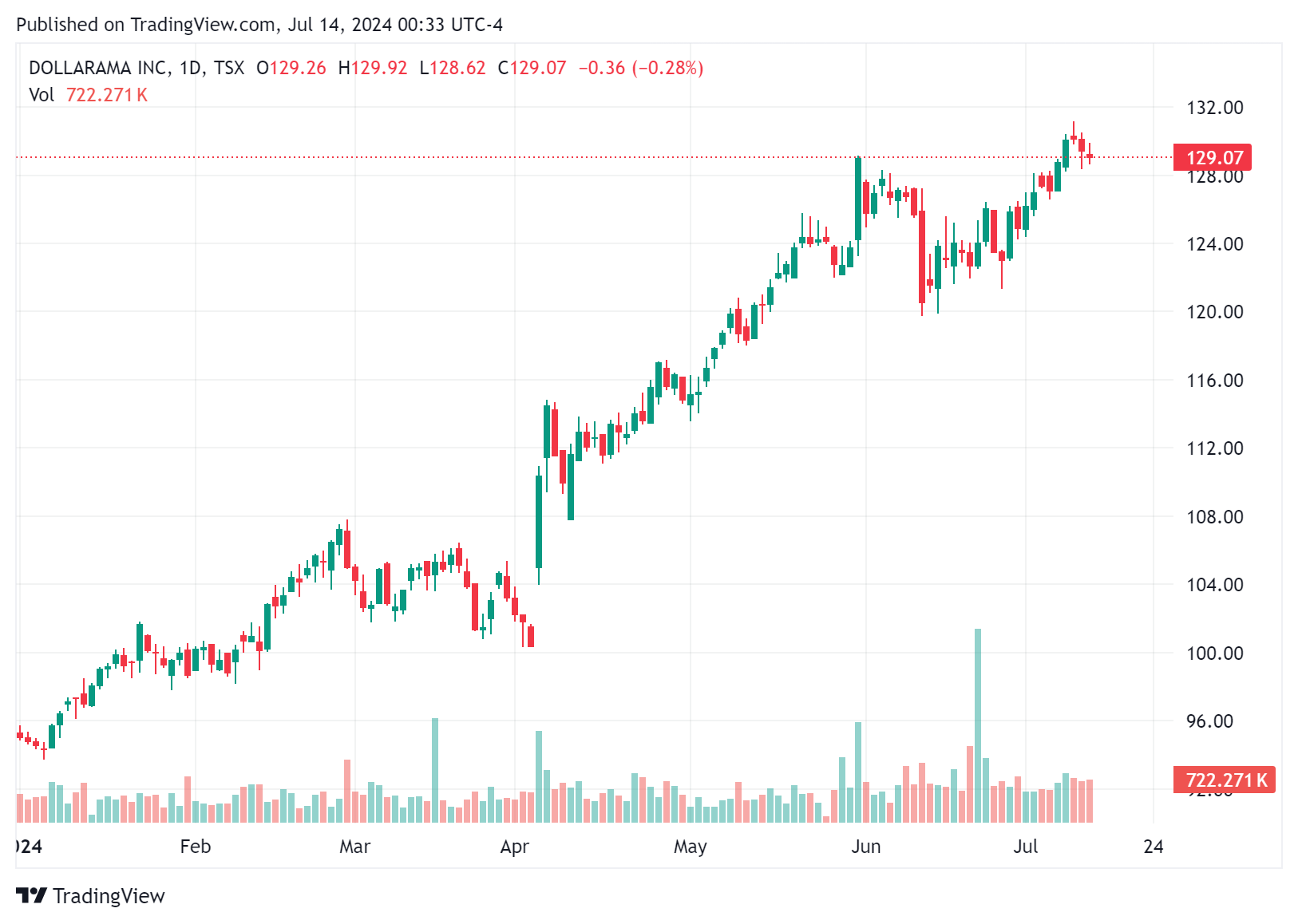
Dollarama ($DOL)

TradingView chart

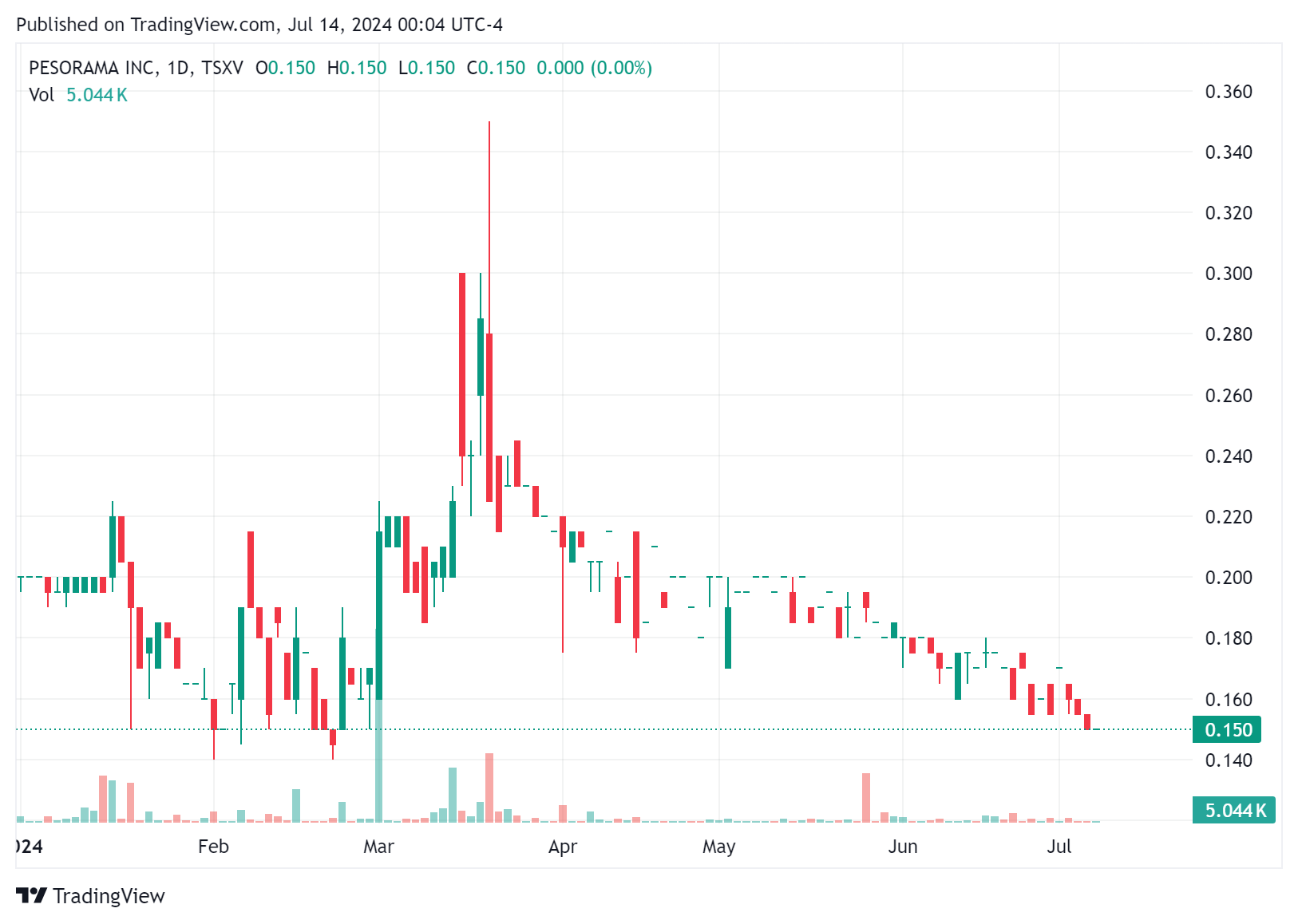
Pesorama ($PESO.v)

TradingView chart

Subscribe Now to My FREE Newsletter (Join 5,000+ Subscribers!)

What are your favourite stocks currently?

Regards,
Robin (r.speziale@gmail.com)

***

Author’s Ownership Disclosure (July 16, 2024): CSU (yes), DSG (yes), HPS.A (yes), LMN.v (yes), MEQ (yes), SHOP (yes), TOI.v (yes), VHI (yes), WELL (yes), ATD (yes), DOL (yes), PESO.v (yes)

One Stock Portfolio

Investing

Subscribe Now to My FREE Newsletter (Join 5,000+ Subscribers!)

It almost feels like a sin.

The one stock portfolio.
What about diversification?

But if you think about it, most of the world’s wealthiest people put all of their eggs into one basket – their business.

Why is investing in a stock portfolio so different?

We’re told to “diversify, diversify, and diversify some more” to protect ourselves. But is it the right thing to do?

A diverse portfolio might make you comfortable in 30 years’ time, but it won’t make you rich and it certainly won’t change your life.

After 18 years of playing this game, the thought of a more concentrated portfolio has become increasingly alluring (albeit still a bit sinful) to me. So not necessarily a one stock portfolio from the get-go, but if I play my cards right and make a bold bet – the right positioning early on and capital appreciation over time might make it a 80%-in-one-stock portfolio.

Concentration = conviction.

Buffett and Munger tell us to carry around a symbolic ‘punch card’ and that before we invest in a stock – remember that there’s only so many punches in that card available to us during our lifetimes.

It’s to help us tame our insatiable desire to constantly buy more stocks, diluting the future returns in our portfolio.

That seems to have worked out pretty well for them.

Subscribe Now to My FREE Newsletter (Join 5,000+ Subscribers!)

I recently read the book, Richer, Wiser, Happier by William Green and in it Green writes about Nick Sleep of the now closed Nomad Investment Partnership. Sleep was quite the magician because he magically turned $1 into $10. The Partnership returned 921.1% over 13 years. Here’s the kicker – those results were mostly driven by only 3 stocks – Amazon, Costco, and Berkshire Hathaway. After closing the fund in 2014, Sleep just took his portion of those three stocks with him to form his personal portfolio.

Others have concentrated too (some even unintentionally):

Philip Fisher, one of Warren Buffett’s early idols and author of one of my favourite books of all time – Common Stocks and Uncommon Profits – credited most of his investment success and personal wealth to one stock; Motorola. Fisher said: “if you are in the right companies, the potential rise can be so enormous that everything else is secondary. Every $1,000 I and my clients put into Motorola in 1957 is now worth $1,993,846 — after all the ups and downs of the stock and of the market.” Fisher smartly first bought Motorola stock in 1955 and courageously held on until his death in 2004.

Benjamin Graham, who taught Buffett at Columbia Business School ironically made most of his life-changing wealth in a growth stock, not a value stock – the latter of which he based his entire educational and professional career. That stock? Geico. Graham said: “the aggregate of profits accruing from this single investment decision [Geico] far exceeded the sum of all the others realized through 20 years of wide-ranging operations in the partners’ specialized fields, involving much investigation, endless pondering, and countless individual decisions.” In 1948, 12 years after GEICO’s founding, Graham’s firm (Graham-Newman Corp.) bought 50% of GEICO for $712,000. By 1972, the value of that investment had grown to $400 million.

Rakesh Jhunjhunwala, who recently passed away, attributed the vast amount of his wealth to the Titan Company. This Tata group business rose from around ₹3 (during the time Rakesh first built a position in 2002) to ₹3000 where it currently trades at now. Yes, you read that right; a 1,000x return. At the time of his death, the Rakesh estate held 44,850,970 Titan Company shares, around ~5% of their total public float. When asked in 2010 by a reporter from The Economic Times if he would ever sell any shares, Rakesh said: “I will sell Titan one day, but I do not know when. I have a dream. I will sell my share for a billion dollars, otherwise I would not hold on to the stock.” Amazingly Rakesh never sold out of his position in Titan even through all of the market turbulence. Today that position is worth around $1.6B USD. Now that’s vision + conviction!

Subscribe Now to My FREE Newsletter (Join 5,000+ Subscribers!)