Macro (Top-Down) Investing 101

Investing

Macro or top-down investors generally base their decisions on current or future economic events. They start their selection process by analyzing asset classes, themes, markets, sectors, and industries, before (if at all) moving on to analyzing individual companies. Macro investors may very well pick a basket of stocks that fit their top-down profile or macro prediction.

For example, if an investor predicts that water will be a scarce and profitable resource in the future, then he or she will invest in stocks that operate in that sector currently. Because of this, macro investors are generally different in their approach than bottom-up investors (value investors, growth investors, or fundamental investors).

The inherent risk in top-down investing is in the case that one’s macro prediction does not materialize (perhaps water utilities do not become a very profitable business). In that example, the associated positions that were invested in to initially capitalize on that macro prediction do not achieve the expected returns for the investor.

MarketMasters

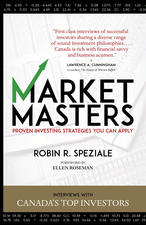
Robin Speziale is the national bestselling author of Market Masters, which is available at Chapters, Indigo, and Coles as well as Costco and Amazon.ca. He lives in Toronto, Ontario. Learn more about Market Masters.

16 Investing Lessons From Derek Foster The Idiot Millionaire

Investing

Post - CC

SubscribeSubscribe Now to My FREE Newsletter (Join 5,000+ Subscribers!)
Want to see My Best Stock Ideas for 2020?  Learn More.

My full interview with Derek Foster; The Idiot Millionaire originally appeared in my national bestselling book, Market Masters, which is available at Chapters, Indigo, and Coles as well as Costco and Amazon.ca.

***

Derek Foster is an “idiot.” He saved, then invested, and then quit the rate race at age 34. He spent his twenties backpacking across Europe, Australia, and New Zealand, and lived a number of years in Asia. Who does that? He should be broke, living paycheque to paycheque, and working a dead-end job until he’s 65. Instead, he’s independently wealthy, having amassed around a million dollars in investable assets.

While Derek has branded himself as the “Idiot Millionaire,” he’s anything but — Derek is very, very smart. He uses the “idiot” angle to inspire the average Joe or Jane Canadian to achieve their own financial independence. And he sells a lot of books in the process. Stop Working: Here’s How You Can! propelled Derek into Canadian financial folklore. I was enthralled by Derek’s path to financial freedom, and have read most of his six books. Today, he touts buying strong dividend-paying companies. But dividends alone won’t propel you to the million-dollar mark. There’s more to it, and it’s all revealed in my conversation with Derek.

The truth is that Derek Foster was a prudent saver who made some great calls in the market, from leveraging up on a cigarette company, piling into income trusts, taking advantage of the Canadian/U.S. dollar parity, and selling puts. He made these great calls by taking what the market gave. My favourite line from our interview comes when Derek describes his advantage in the market: “It’s not foresight. I’m opportunistic. The opportunity was there and I took it while I could.” One can glean Derek’s investment mantra in his words — he isn’t a value investor or a growth investor or a macro investor. Derek is a market “taker.” Derek himself would tell you that anyone can use his “simple investment strategy that any six-year-old can follow.” But as you’ll soon learn, there’s a higher learning curve to beating the market. Here’s how a sophisticated investor amassed around a million dollars in the market by 34.

Derek Foster’s 16 Investing Lessons:

1) “With the exception of tech, the market leader usually stays the market
leader for many years.”

2) “Even though the cigarette industry’s volume is going down 1 to 2% a year, it doesn’t matter because the prices increase 5 to 6% a year, so they’re actually making more money.”

3) “I was a very avid saver. I saved a high percentage of my income throughout my life. Probably about 70% of my paycheque.”

4) “You have to take what the market gives you.”

5) “I look for quality. I look for a company that I feel has a sustainable competitive
advantage . . . And then after that I look for a good price . . . Once I find that stock, ideally I want to hold that stock forever.”

6) “I don’t think my portfolio’s ever gotten above 25 stocks. Usually that’s where it tops out.”

7) “Most companies increase their dividends over time, so in actuality my standard of living increases slightly every year in perpetuity.”

8) “I have sold put options on companies I want to buy. Also, I have sold a couple of covered calls on companies that I’m thinking of dumping.”

9) “I look for a moat: a reason that the company can continue to make obscene profits for years into the future. Unfortunately, there’s not many of those companies out there. In the world, there’s probably a hundred or even less than that.”

10) “Stocks are almost like wine — they get better with age. Oftentimes, you’re looking for businesses that have been in business for decades or ideally even over a century.”

11) “It’s not foresight. I’m opportunistic. The opportunity was there [buying U.S. stocks with the CAD at parity] and I took it while I could.”

12) “The advantage that young people today do have, and I’m a huge advocate of, are the Tax-Free Savings Accounts (TFSA), which weren’t around when I was young.”

13) “Baby boomers’ kids have left the house and they’ll dig a little deeper in their pockets for higher quality.”

14) “I stick to my circle of confidence. Because I’m not that bright, my circle’s fairly small, but that’s okay as long as I stick within that circle.”

15) “That’s the secret to why the rich get richer — the second million, and then the third million, and then the fourth million all get easier and easier and easier.”

16) “Only a fool, somebody who’s really stupid, would not change when the circumstances change.”

SubscribeSubscribe Now to My FREE Newsletter (Join 5,000+ Subscribers!)

MarketMasters

Robin Speziale is the national bestselling author of Market Masters, which is available at Chapters, Indigo, and Coles as well as Costco and Amazon.ca. He lives in Toronto, Ontario. Learn more about Market Masters.

21 Investing Lessons From Peter Hodson of 5i Research

Investing

Post - CC

become_a_patron_button

SubscribeSubscribe Now to My Newsletter (Join 3,500 Subscribers!)

My full interview with Peter Hodson of 5i Research originally appeared in my national bestselling book, Market Masters, which is available at Chapters, Indigo, and Coles as well as Costco and Amazon.ca.

***

Peter Hodson finally hung up his hat in 2011 after wrangling up tremendous returns in the Sprott Growth Fund. “It was a high-risk, small-cap growth fund, like a cowboy fund,” he says. After a disagreement with Eric Sprott over the fund, followed by a 62% drop in 2008, Peter finally decided it was time to ride out into the sunset. During the resource bull run from 2002 to 2007, Sprott Asset Management was a high-flying firm. As Peter quipped, his experience at Sprott Asset Management could be a book on its own.

Today, Peter Hodson is CEO of 5i Research Inc., an independent research network that provides conflict-free advice to individual investors. The five Is stand for integrity, independence, individuals, investments, and insight. “We’re just trying to use our experience to help people,” as Peter puts it. Through 5i Research, investors can get access to many easy-tounderstand research reports, written for the average investor, with a simple rating system from F to A-plus. Additionally, the company offers over 28,000 questions that have been answered by Peter, as well as three model portfolios to follow. And it seems that Peter got trigger-happy  again, because he recently announced the introduction of the Growth Portfolio model, in addition to the Income and Balanced-Equity models. Once a cowboy, always a cowboy.

Peter’s still got a good shooting hand, judging by his ability to pick off new high-flying stocks in today’s market. For example, Peter picked Amaya Gaming before many investors even knew it existed on the exchange. It was April of 2013 when Peter said, “Three very good acquisitions have set Amaya up for excellent growth, and it is wellpositioned to benefit from legalization of online gaming. Revenue growth will be big this year, and the company is becoming profitable. It is wellmanaged, has excellent shareholder support, and is a relatively unique name in Canada.” Following that recommendation, Amaya went on to post a whopping 500% gain through 2015.

It will be interesting to follow Peter’s new growth stock picks. The Growth Portfolio holds 22 securities and is initially biased toward the technology and health care sectors, two areas that Peter expects will remain strong in the near term. As Peter explains, “these are also usually the more growth-oriented sectors.” Peter is also the owner of Canadian MoneySaver, a fully independent financial magazine, published since 1981, which is chock-full of quality investment features written by Canadian experts in the industry.

Peter and I arranged to meet for the interview at Coffee Culture in uptown Waterloo. Memories of my University of Waterloo days flooded over me as I drove down King Street. When I arrived, I ordered an iced coffee, secured a table, and waited for Peter. When he entered the coffee shop wearing a tan leather jacket, black shirt, and jeans, it felt almost like a scene from a cowboy flick, the lead walking in through the swinging saloon doors seeking either a drink or a showdown. Our conversation was as entertaining as it was insightful, although no one was thrown through a saloon window. Peter is a funny guy who has a fun and compelling way of presenting his stories on the market.

Peter Hodson’s 21 Investing Lessons:

1) “The best lesson is losing money, so I learned some really good lessons.”

2) “I saw everybody do the exact wrong things for the exact wrong reasons. I saw greedy people get killed, and I saw fearful people get killed.”

3) “That ‘do nothing’ lesson was huge for me, especially when I became a fund manager. The tendency to do something because you’re getting paid is really high.”

4) “Corporations think differently than investors. As a corporation, you don’t really care what the stock’s doing right now.”

5) “Sometimes it doesn’t even matter how good of a company you are; if you’re in the right sector, you’re automatically hot.”

6) “I’ve probably made more money from this philosophy than anything else: you have to take a stock from $2 and go to $4, and then be willing to buy more of it at $4 than you bought at $2.”

7) “There’s this really sweet section of companies that go from $50 million to $100 million in value. At $100 million, people care. At $50 million, they don’t care, but it’s exactly the same company.”

8) “You have to take that leap of faith and convince yourself that you’re right.”

9) “We had a whole portfolio of 200%, 300% potentials, and of course they’re not all going to work; some are going to flame out badly. So we needed the big giant ones to make up for the ones that went to zero.”

10) “One of my mantras is not to sell too early. You know, you’re never going to get a Google or an Apple, or any 50-bagger, if you sell too early.”

11) “I assume every stock I own could drop 50% tomorrow.”

12) “If it’s an A-rated stock, you can own it for 10 years, and not even care. The market will go up, the market will go down, the stock will go up, the stock will go down, but through it all, it’s a fundamentally secure investment that’s not priced ridiculously high and that’s not one you have to worry about.”

13) “Every time I saw one of my stocks go down I would basically ask myself, ‘Why are people selling? Are people selling because of earnings? Are they selling because they’re worried about the market? Or are they selling because it’s down?’”

14) “I think in periods of time there’s massive inefficiency. Over a longer period of time it’s more efficient though.”

15) “We barely make any changes ever, because if we’ve chosen right, we shouldn’t make any changes.”

16) “On the tech side, if you’re in early on a theme, then it works well for you. [But] it’s harder for Microsoft to grow at a fast rate, whereas it’s easier for the little guys to grow.”

17) “Put yourself into a position to ask yourself, ‘Why am I selling?’ But more so, ask yourself why the other guy’s buying it from you. Are they buying it because they think it’s going up? If yes, then maybe you should rethink your position.”

18) “Companies that grow their dividends are vastly superior to companies with high-dividend yields. Don’t get sucked into the 8% yield. Buy the 1% yield that’s going to go to 2%, 3%, 4%, 5%.”

19) “If you consistently invest then it really doesn’t matter if the market goes up or down. At the end of 10 years you’ll have a good average price.”

20) “If I had a dollar for every person who said, ‘I’ll sell when it breaks even,’ I’d be a bazillionaire. Breaking even is a bad investment strategy.”

21) “One of my best techniques to finding a great stock is to just look at new highs. When you see a new high, ask yourself, ‘Why is that a new high and what’s the deal with that?’”

MarketMasters

Robin Speziale is the national bestselling author of Market Masters, which is available at Chapters, Indigo, and Coles as well as Costco and Amazon.ca. He lives in Toronto, Ontario. Learn more about Market Masters.

21 Investing Lessons From Martin Braun of JC Clark Adaly Trust

Investing

become_a_patron_button

SubscribeSubscribe Now to My Newsletter (Join 3,500 Subscribers!)

My full interview with Martin Braun of JC Clark Adaly Trust originally appeared in my national bestselling book, Market Masters, which is available at Chapters, Indigo, and Coles as well as Costco and Amazon.ca.

***

You know that saying, “Don’t judge a book by its cover”? I was reminded of that adage when I met Martin Braun for the first time. As I walked into the colourless JC Clark offices, Martin greeted me with a somber hello, wearing jeans and a pressed shirt and sporting a beard. Martin walked me over to the room where we would hold our interview. Before we started our conversation, he opened a can of Dr Pepper and ripped open the wrapper of a granola bar. I don’t know many adults who drink Dr Pepper these days. Was this his lunch? Martin was cool as a cat, to the point that it almost seemed as though he had checked out of work. But again, don’t judge a book by its cover. Instead, judge Martin by his returns.

The JC Clark Adaly Trust, which Martin runs, has achieved 15.83% compound annual returns since inception in 2000. Clearly, he’s beat the TSX by a wide margin. Martin’s cumulative return since 2000 is 875%. If you had invested $100,000 with him in 2000, he would have made you a millionaire by 2015. In his best month, Martin achieved a 21% return. In his best year, Martin achieved a 57% return. And in 2015, a year that was
marred by market volatility, Martin was already up 17% by June. In other words, don’t underestimate Martin. It’s true that he makes investing look easy. But don’t be fooled — the market is a very complex and treacherous place, and Martin has found a method that works for him.

Early in his career, in 1988, Martin joined Gluskin Sheff + Associates, where he spent 10 years being responsible for the analysis and management of the Canadian and U.S. equity portfolios. But Martin struggled. That may seem surprising in light of his current returns, but it’s because, as Martin explains it, “I started out as a value investor.” It was only when he found himself sitting on the sidelines and not participating in the spectacular gains others generated during the bull market that Martin converted to a GARP (growth at a reasonable price) investor. After his epiphany, Martin decided to leave Gluskin Sheff + Associates and strike out on his own, co-founding the Strategic Advisors Corp.

Over the next seven years, as Strategic Advisors’ president and portfolio manager, he managed the Adaly Opportunity Fund (now rebranded the JC Clark Adaly Fund). In those early days, Martin’s core strategy was purely risk arbitrage. He explains in the interview that during the early 2000s, merger and acquisition spreads in the market were often overlooked, and so one could capture 20% spreads on a consecutive basis. Once the market became more efficient, though, and squeezed those spreads, Martin shifted to what remains his strategy today: growth at a reasonable price. Martin is a high-conviction investor, so his hedge fund is usually limited to under 20 stocks. Those stocks can be described as highgrowth, small- to mid-cap companies that are on the verge of making it
to the big leagues. Martin has a knack for finding and then investing in companies before they make rapid price advancements in the market.

Martin Braun’s 21 Investing Lessons:

1) “I’ve learned that being a value investor is very often a bad idea because a lot of value stocks are value traps; they lure you into the position because they’re ‘cheap.’ But in actual fact they’re cheap for a reason.”

2) “Growth is the key driver in the markets. [But] it’s the combination or synthesis of all three — growth, value, and catalysts — that create, for me, the investment thesis that I’m looking for.”

3) “You have to make some concessions to the fact that the market’s much bigger than you and that you need to figure out the market; the market doesn’t have to figure out you.”

4) “Every time a company announced it was being acquired it would go into that database and we’d just go trolling through the database looking for the best spreads with the least risk.”

5) “It didn’t take me very long to figure out that I didn’t just have to trade on announced deals. I could also trade rumoured deals or theoretical deals.”

6) “A good hedge fund manager is not limited by those little boxes where you need to play within a specific sandbox. You can do whatever the spirit moves you to do.”

7) “In the mid- to late nineties and then after the crash, I couldn’t just sit there and say, ‘This is what I do and I can’t do anything different.’ Something works for a while and then it doesn’t work. Then it works again, and then it doesn’t. We adapt.”

8) “I invest in a handful of businesses, not a whole bunch of them, and get to know them really well. . . . ‘Just put a few eggs in the basket but watch the basket very closely.’ I’m looking for 20 good stocks.”

9) “Once you’ve learned so much about that business don’t put just a couple bucks in — put a lot of bucks in. If one of those stocks goes off the rails then you’ll be one of the first ones to realize that it’s coming off the rails, and push it out the door before everyone else.”

10) “I want to invest in a company that most people don’t appreciate how good it is or how good it’s going to be. Sometimes it’s already achieved something special but people don’t realize how good it truly is.”

11) “It takes a certain skill to be able to execute. It’s one thing to say, ‘I’m going to do this,’ and it’s another to actually do it. The stocks that I didn’t make money on or I lost money on was because I misjudged management.”

12) “Don’t invest on the basis of a tip. Do your own research. Even if someone tells you that you should go buy some shares, don’t just go, ‘Okay!’ and buy some shares.”

13) “Try to get as close to the business as possible. Maybe it’s a consumeroriented
business and as a consumer you can check it out and see if it makes any sense to you as a consumer.”

14) “I think that, generally speaking, the research and the commentary from media is very bad. You generally don’t want to do what they tell you to do.”

15) “Reading the paper thinking you’ll find some good stock ideas is very treacherous. By the time those stocks make it to the mainstream media they’ve probably been largely exploited and there’s not much money left for you.”

16) “You might get lucky the first time or the second time, but you’ll get wiped out by the third time. It’s like a guy who goes to Vegas and gets ‘hot.’ Day One at the table he cleans up. Day Two he breaks even. Day Three he gives it all back to the house, plus some.”

17) “I always think about the risk first. If I can deal with the risk side then I find that the return side tends to take care of itself.”

18) “There’s a lot of cheap optionality embedded in stocks. In other words, you’re not paying for this happening, and you’re not paying for that happening; you’re paying maybe a little teeny bit for a third thing and maybe a little bit more for a fourth thing happening to the stock. If any of those four things were to happen you’d make good money because the market’s not really paying for them.”

19) “If the market was paying for 75 cents and the company makes 90 cents, then, ‘Oh. The market’s happy.’ and the stock goes up.”

20) “I figure my upside is at least three to one of my downside. That’s all you want to do when you put together a portfolio: make sure the ratio of the upside to the downside is in your favour.”

21) “The best money managers are quite whole-brained in their approach. They can somehow synthesize the analytics side with the intuitive side of the brain.”

MarketMasters

Robin Speziale is the national bestselling author of Market Masters, which is available at Chapters, Indigo, and Coles as well as Costco and Amazon.ca. He lives in Toronto, Ontario. Learn more about Market Masters.

Growth Investing 101

Investing

Growth investors invest in stocks that have higher-than-average return potential compared to other stocks in the market. That means growth investors use criteria such as revenue growth, earnings growth, return on equity, and return on invested capital, among other metrics, to inform their investment decisions. These criteria can be augmented by strong management that is skillful at capital allocation, such that those managers can maintain high growth rates for as long a period as possible.

The law of large numbers often means that growth stocks’ compound returns do lower over time, and so the once high-growth achieved by those growth stocks can stall. That is why growth investors tend to allocate their money into new growth stocks that should experience high multiple expansions into the future, at least until they, too, face an abatement in high growth compound returns.

The risk inherent in growth investing is that growth investors can “chase hot stocks,” effectively buying high and selling low, or simply rack up high commission fees from a higher-than average turnover in their portfolio. The risk/reward concept argues that growth investors are rewarded for their assumption of greater risk in the market. Usually, growth stocks exist in the micro-cap, small-cap, and mid-cap segments of the market, because as previously mentioned, growth stalls due to the law of large numbers (that is, compounding returns can’t be high forever). Eventually growth stocks can become large “steady” stocks.

15 Investing Lessons From Barry Schwartz of Baskin Wealth Management

Investing

become_a_patron_button

SubscribeSubscribe Now to My Newsletter (Join 3,500 Subscribers!)

My full interview with Barry Schwartz of Baskin Wealth Management originally appeared in my national bestselling book, Market Masters, which is available at Chapters, Indigo, and Coles as well as Costco and Amazon.ca.

***

Should Barry Schwartz be smiling? An 18-year compound return of 8.7% doesn’t put him at the front of the pack. Though his clients, who must invest a minimum of $1 million with Barry, sleep well at night knowing that their hard-earned money isn’t wildly gyrating year after year, but growing at a safe and steady pace, albeit above market returns. That’s why Barry is smiling. Barry Schwartz tells it like it is. He’s direct and quick to answer, in such a succinct way that you’d swear he practised his answers days before the interview. To think that Barry pretty much stumbled into the investing world is unusual. Investing wasn’t his original game plan. David Baskin invited Barry into his firm, took him under his wing, and groomed him to be a prudent investor. Barry joined Baskin Wealth Management in 2000 and became a partner in 2005. Today, Barry is completely focused on strong large-cap franchise businesses with explosive free cash flow and an enduring competitive advantage.

Throughout the interview, Barry repeats “free cash flow” over and over again to exemplify its importance. Seriously, as you read through the interview, count how many times Barry says “free cash flow.” In Barry Schwartz’s court, cash is king.

While Barry publicly describes himself as a value investor, it isn’t in the Graham and Dodd sense of the term — buying deep value stocks at below their intrinsic value. Rather, Barry invests in businesses for the long term. Businesses that will not lose their value in 10 years’ time. In fact, Barry invests based on Warren Buffett’s ideologies, ideologies that in my opinion are derived more from Philip Fisher than they are from Benjamin Graham, even though Buffett himself would say otherwise: he claims, “I’m 15% Fisher and 85% Benjamin Graham.”

Before heading up to interview Barry in his office, I grabbed a quick sandwich and drink at Starbucks on the ground floor of his building. It was only until after the interview that I realized Starbucks would fit perfectly into Barry’s ideal portfolio. Upon reaching Barry’s office floor, I was greeted by his assistant, who asked me to take a seat before seeing Barry. When he arrived, it was with a huge smile. Barry struck me as a man who was doing exactly what he wanted to be doing with his life.

Barry Schwartz’s 15 Investing Lessons:

1) “Do you know the famous story about Joseph Kennedy? When he heard the shoe-shine boy or the cabbie give him investment advice, he knew that it was time to sell or short everything.”

2) “We don’t buy Nortel for our clients because it’s not profitable. We stick to profitable companies.” (As recounted by Barry Schwartz)

3) “I only put maximum 5 or 6% in any one stock.”

4) “Stop-losses don’t make sense. For example, you can wake up the next day and find our great stock down 10% for no reason, and you’re cashed out. You’re really giving up all your control in the stock market to nervous people. Lots of stocks are volatile. Even the great ones can go up or down 50% in a year.”

5) “We don’t let the stock market drive our investment decisions. We research companies, we think about their fundamentals, and we buy them with an eye that they’ll be worth a lot more in the future.”

6) “To really make a lot of money with an investment, you need to have conviction and an egotistical attitude to say, ‘The stock market is wrong, and investors are misinformed.’”

7) “Bad things happen to good companies, but that provides you with opportunities. If they’re profitable companies, they can get through it, and sentiment may revert.”

8) “When companies generate free cash flow, and a high amount of free cash flow, good things happen. If you shoot a bazooka, you’re going to blow something up. It’s the same effect with free cash flow. I’ve never made a bad decision by buying into a company paying 8% or 9% free cash flow yield or higher.”

9) “Warren Buffett said something along the lines of, ‘If you have to have a meeting before you go out and raise your prices 10%, that’s not the type of business I want to be in.’”

10) “We’ve gotten smarter over time. When you stick your fingers in the tiger’s cage, you get bit. So you don’t do it again. You know, the cat doesn’t go sit on the hot stove. It learns its lesson and moves on.”

11) “[Great] stocks all have something in common: they’re quality businesses that raise dividends almost every year, that generate a lot of free cash flow, that are in businesses that sell products and services that people use every day, and that have potential for growth.”

12) “You can’t be dogmatic and say, ‘I only buy companies with 10-times earnings, and if I don’t find them, I don’t buy them.’ Well then, of course, if you did that you would never find anything to buy over the last four years.”

13) “Value will often be recognized in the market. That’s why you buy and diversify, because you’re never going to be right on every stock.”

14) “There are always opportunities in companies that don’t have analyst coverage or are neglected or are smaller ideas.”

15) “It is easier [for retail investors] to buy some smaller-cap companies. The billion-dollar or less stocks that a company like ours can’t get access to anymore because we have gotten too big and would own too much of the stock.”

MarketMasters

Robin Speziale is the national bestselling author of Market Masters, which is available at Chapters, Indigo, and Coles as well as Costco and Amazon.ca. He lives in Toronto, Ontario. Learn more about Market Masters.

15 Investing Lessons From Benj Gallander of Contra the Heard

Investing, Uncategorized

Post - CC

SubscribeSubscribe Now to My FREE Newsletter (Join 5,000+ Subscribers!)

My full interview with Benj Gallander of Contra the Heard originally appeared in my national bestselling book, Market Masters, which is available at Chapters, Indigo, and Coles as well as Costco and Amazon.ca.

***

At first glance, you might not classify Benj Gallander as the investor type. His demeanour is too relaxed — in fact, he’s calm, glowing, and happy. He’s got a slight surfer-dude slur, and on the day of our interview he looked a lot like a Toronto hipster, with his ruffled hair, open sandals, and unbuttoned shirt. Perhaps Benj hasn’t changed a whole lot from his university days, during which he claims to have “majored in pinball, racetrack, intramural sports, and cards.” Not, he admits, a model student.

Arguably, that freewheeling nature is what makes Benj unique and has perhaps helped him be so successful in the market. It’s his youthful way of questioning — constantly asking “Why?” — that helps Benj uncover truths and capitalize on inefficiencies in the market. Throughout the interview, you’ll notice that Benj will sometimes ask questions aloud — “Is it a sector that’s potentially dying for some reason, or is it a sector that’s a necessity and will come back?” This is his mind at work. Unlike most of us, Benj’s brain hasn’t settled into a mature, biased, deep grey-matter state. Benj continues to question not only his own beliefs and actions, but those of the market, and the participants in it.

Benj is a contrarian. Contrarians often go against the herd, or against the majority. I say “often” because contrarians who actually beat the market cannot always indiscriminately buy when others sell and sell when others buy. They’d quickly go bust. Successful contrarians such as Benj make moves in the market based on logic rather than sentiment, and are usually proven right more often than they are proven wrong. Benj describes this contrarian approach as “buying good companies that have been beaten up but have the ability to make big gains at a reasonably fast pace.” By investing through a discriminate contrarian framework, Benj can buy low and sell high, and as a result enjoy consistently high returns at Contra the Heard.

It was in 1995 that Benj Gallander co-founded the Contra the Heard investment letter with his friend Ben Stadelmann. Finally, after coasting erratically through university (Western for his BA and Dalhousie for his MBA), globetrotting freely around the world, and working odd jobs here and there, it seemed that Benj had settled into a groove. Thankfully, Benj has stuck it out at his current job as president of Contra the Heard. He’s amazing at it. And he seems to be having so much fun. Through Contra the Heard’s President Portfolio, Benj has achieved a 19% annualized return since 2000, clearly overshooting the market. Benj’s five-year annualized return since 2010 is 28.9%. If in 2000 you had invested $100,000 alongside Benj, and bought all of his stock recommendations, your capital would have grown to $1,358,952.95 over a 15-year period. It should be no surprise that today Contra the Heard investment letter counts some of the most successful business people in Canada among its most loyal readers.

I first came to know of Benj through the television show Market Call on Business News Network, BNN. This was also at the time when I still practised value investing, as derived directly from the concepts that both Benjamin Graham and David Dodd taught, and so I found parallels in Benj’s contrarian framework to that of value investing. I was so intrigued by Benj that I started to email him questions about particular stocks — RIM, Sears Canada, Manulife — to elicit his unique contrarian perspective before making my own moves in the market. Benj was approachable and responded back to me with advice that was bang-on each time.

When I emailed Benj in September of 2011 to ask if he would invest in RIM and if such an investment would fit his contrarian model, Benj replied the next day: “I wouldn’t make that bet. And not at that price, Robin. I don’t buy stocks over $25. There is a better chance for a stock to go from $2.50 to $5 than a stock to go from $25 to $50.”

Benj was so right. RIM, now BlackBerry, would soon crater to around $5. His advice, generously given, saved me money and heartache.

That back and forth on various securities lasted for years until just recently I asked Benj to be part of my book. He replied in his usual carefree way: “Sure, happy to do it. Let me know what time, Robin. Maybe I can even make us some bacon and eggs.” Regrettably, I didn’t take Benj up on his offer for breakfast, as I have no doubt that he’s as great a cook as he is an investor. And so, it was on a bitterly cold winter day inside Benj’s warm and welcoming Etobicoke home that I conducted my first interview for Market Masters.

Benj Gallander’s 15 Investing Lessons:

1) “‘Buy when there’s blood in the streets.’ If everything or virtually everything has been beaten up, you’ve then got a much better chance in the market. During tough times, people get scared, and, well, that’s the wrong time to run out of the market.”

2) “If I’m buying a stock under $5, there’s a lot of institutions and funds that won’t even buy it under $10. It’s only once it hits those higher levels that they can buy in. In simple economics of supply and demand, all of a sudden there’s more demand but supply doesn’t change; it’s constant. And that pushes the stock up further.”

3) “When we buy I set an initial sell target, which is something I don’t believe I did in the early days. That grounds me now. I pretty much only sell some of a position at or near the target.”

4) “I only average down once on any stock.”

5) “I only invest in companies that have been around for 10 years.”

6) “It’s important to say, ‘Okay, maybe I was wrong,’ and ‘I have to get out of this position, take my loss, and move on.’ If you can lose 20% instead of 50% or 100%, that’s huge.”

7) “If you’re buying 60, or 100, or 200 stocks through funds, you’re overly diversifying. If you overly diversify, you cut your returns automatically. I’ve usually held 15 to 25 stocks. I don’t want to exceed 25 stocks.”

8) “Things have changed because of technology. Everything moves more quickly and, as a result, people react more quickly in the markets. Too many people wave with the noise, and that really hurts returns.”

9) “Dividends allow me to be stupid longer. About half the stocks I own pay dividends.”

10) “I always have cash on the sidelines. It’s good to have for rainy days.”

11) “I’ve heard people say, ‘Margining would have made you way more money,’ and they’re probably right. But I want to sleep well at night.”

12) “Nothing goes up forever. There’s no stock that does that. These stocks that go up for a long time, like Apple, are a complete exception. I’m not a believer in ‘buy and hold.’”

13) “Sometimes you can catch takeovers, just because of a rumour.”

14) “There’s people who still believe in the Efficient Market Theory. But I don’t believe in it. How can a market be perfectly efficient when it drops 22.4% in a day? It’s impossible. Human psychology is a major driver of how people react. And that’s what creates so much of the pendulum effect that goes too far, which allows me to make money, both in the times of euphoria and the times of depression. People do not react in many cases rationally.”

15) “I’ve learned that debt is a killer in many situations, so if you can invest in companies that have very nominal or no debt, that helps companies survive during the hard times.”

SubscribeSubscribe Now to My FREE Newsletter (Join 5,000+ Subscribers!)

MarketMasters

Robin Speziale is the national bestselling author of Market Masters, which is available at Chapters, Indigo, and Coles as well as Costco and Amazon.ca. He lives in Toronto, Ontario. Learn more about Market Masters.

Value Investing 101

Investing

Value investors seek out and invest in undervalued stocks in the market. “Undervalued” simply means that those “value stocks” trade below their intrinsic value — the actual worth of a business. That mispricing — a stock’s price trading below its intrinsic value — can occur for a variety of reasons, namely sentiment, perception, unusual or short-term events, and broad market declines. Intrinsic value is a culmination of a company’s brands, tangibles, intangibles, future earnings, and competitive advantage, among other things. Intrinsic value is seen as a better gauge of a company’s worth than merely its book value (assets less liabilities), which doesn’t adequately account for the true worth of a company.

Value investors invest in these undervalued, or mispriced, value stocks, in the anticipation that their market prices will revert to their mean or go back to their intrinsic value. But inherent in value investing is the risk that reversion to the mean does not occur in a short time frame and the stock’s market price may continue to decline or be volatile. The biggest
risk, though, is what is referred to as a value trap, in which a value investor misjudges a stock’s intrinsic value, such that the company’s fundamentals completely deteriorate and, in effect, validate the stock’s lower price. For this reason, value investors must identify a catalyst (for example, a change in management) or a set of catalysts in each value stock to determine whether they will actually revert back to their intrinsic value.

MarketMasters

Robin Speziale is the national bestselling author of Market Masters, which is available at Chapters, Indigo, and Coles as well as Costco and Amazon.ca. He lives in Toronto, Ontario. Learn more about Market Masters.

Why I Wrote Market Masters

Investing

We in the Great White North have a lot to offer the world. And yet we usually take a back seat to our American brethren, whether in movies or politics or music. The same is true of the investment industry. While Canada is flush with experts on the markets, not much is written or said or thought about them. Why is that? Do we lack able investors? Are they
all too timid? Have the best of them moved to the U.S.? In my opinion. . . none of the above. Rather, there’s a lack of strong platforms to showcase the investment talent that exists in Canada. “Out of sight, out of mind,” as the popular saying goes. I can’t remember ever seeing a worthy made-in-Canada investment compilation on any bookshelf, whether that be in a store, house, or school. My mission in writing Market Masters: Interviews with Canada’s Top Investors is to create a strong platform (but not the platform, as that would be much too grandiose), to grow awareness of Canada’s Market Masters, and to share their timeless market wisdom with you, the reader. Some are well known; others not so much. Some are top-down, others bottom-up. Some are growth-oriented, others value focused.
Some are active, others passive. You get the point — these Market Masters differ in their approach. Although the 28 Market Masters featured in this book span different areas on the market paradigm, their objective (with exception of the passive investors) is all the same: to beat the market. All of the Market Masters seek to compound wealth over time,
which, collectively, amounts to tens of billions of dollars.

But then the question becomes, so what; why should I care? I am aware of the common perception of the Canadian stock market, specifically the Toronto Stock Exchange (TSX), as a “primitive resource-based market.” Through this book, I hope to not only debunk that misconception but also to establish why the Canadian market is essential not only to Canadian investors but to international investors, too. While some may discount the Canadian market, others capitalize on its breadth, depth, and activity to further their investment winnings. A striking example came up in my conversation with American-born Bill Ackman. “We’ve had a very favourable experience in Canada in pretty much everything we’ve done,”said Bill. In another conversation, Kiki Delaney explained, “[On the TSX], there’s a lot of world-class international companies.”

In most people’s eyes, though, the Canadian market remains “chockfull of resource stocks.” As you will learn throughout this book, and as echoed by many of the Market Masters, there are many strong multinational Canadian companies on the Toronto Stock Exchange. And the exchange, in and of itself, has a storied history, and during my research I discovered facts that surprised even me.

The Canadian market is strong, resilient, and progressive.

Strong: The TSX, which is more than 150 years old, contains roughly 1,500 listings that together make up $2.575 trillion in market capitalization, with 39.7 billion shares trading hands on an annual basis. That makes the TSX the ninth-largest exchange in the world, just behind China’s Shenzhen Exchange, but ahead of the German, Indian, Swiss, Australian, South Korean, Spanish, Taiwanese, and Brazilian stock exchanges. The TSX boasts the greatest number of listings of any exchange in North America and has the second-most listings worldwide.

Resilient: The Great Depression of 1929 did not have as significant an effect on Canadian trading activity, or on the brokerage business, as it did on the U.S. and its stock exchanges. Also, the TSX was not as hard hit after Bloody Monday (1987), posting a one-day loss that was half that of the U.S.’s New York Stock Exchange.

Progressive: In the late nineties, the TSX was the world’s first exchange to introduce decimal trading and to install a female president, Barbara G. Stymiest, and was North America’s first large exchange to move to a completely electronic trading environment. Recently, there’s been a push, most likely perpetuated by investment bankers in light of a commodities bear market, to further diversify the TSX, which may be deemed a renaissance of sorts if the trend continues. For example, many significant non-resource IPOs have sprouted on the TSX: Cara Operations, Spin Master Toys, Hydro One, Sleep Country Canada, and Shopify, to name but a few.

The Canadian stock market is essential. And there’s no better authorities to teach you how to capitalize on its treasures than the Market Masters I have interviewed for this book. Ignore this “dark horse,” the Canadian market, at your own peril. Little may still be known about the Canadian market by the world’s investors, but it will continue to succeed, whether expectedly or unexpectedly, recognized or unrecognized. Canadian stocks have exceeded the returns of international stocks (8.3%), bonds (6.2%), and T-Bills (4.6%),
from 1934 to 2014. And we’re not very far behind the U.S. market’s compound annual return of 11.1% versus Canada’s 9.8% over that same 80-year period.

The market is like a cherished childhood videogame of mine, Pokémon. At the start of Pokémon, Ash, the protagonist, is tasked by Professor Oak with choosing one of three Pokémon before starting on his epic journey: Bulbasaur or Squirtle or Charmander. For a naïve young gamer, picking just one Pokémon was quite the dilemma: which Pokémon was strong enough to actually beat the game? What I found upon playing Pokémon three separate times, once with each of the three characters, is that I could beat the game with any Pokémon. Any of the three cute characters a player chooses will achieve his or her objective, just as one can beat the market by employing any set of strategies on any part of the market paradigm. With this book at your fingertips, you can pick your favourite Market Master, or even a couple of them, to invest alongside with and beat the market. It comes down to identifying which Market Masters’ strategies appeal the most to you and which of those strategies you are most comfortable using in the market. For instance, if you’re a conservative person, the risks involved in growth investing most likely aren’t for you. Conversely, if you thrive on risk, you may very well find value investing boring. You can be certain that at least one of the Canadian Markets Masters featured in this book will be suitable for you. The only question is which one.

I finally started writing Market Masters: Interviews with Canada’s Top Investors in January of 2015. The motivation was ever present as the oil crash of 2014 continued to rattle the markets, most notably Canada’s market. At that time, market support levels were tested, and then broken, sending investors into a panic. While “a rising tide lifts all boats” such as when a broad bull run — a prolonged inclining market — pushes all stocks higher, there’s a heightened level of skill required to navigate the markets through volatility. Luckily for me, the Canadian investors I had followed since the age of 18 taught me not only how to invest through an upward period but also through an uncertain downward period. It finally seemed the right time to start on the Market Masters journey, to capture Canada’s top investors’ stories and the strategies they use to beat the market.

It was soon after that glimmer of inspiration, though, that I hit a brick wall. While I was eager to meet with and interview the chosen Market Masters for my book, only a small fraction of them actually replied to my initial letter in the mail and accepted the request for an interview. If I wanted to make this work, I thought, I would have to remain persistent. I sent another round of requests, this time via email. Only another small fraction of the Market Masters actually responded to me and agreed to the interview. For weeks to come, I would send follow-up emails, and then actually call the remaining Market Masters, to finally schedule all of the interviews. But then reality sank in once again, and my heart sank with it. I’d never interviewed anyone before.

So I researched and then practised various interview formats. I meticulously studied each and every Market Master, above and beyond what I already knew about them. I oriented the interview questions such that the actual conversations with each interviewee would be timeless, regardless of when the reader came across them, but also tailored the questions to highlight the areas that made each particular Market Master unique. I strived to elicit as many investing market strategies as I could from each of the Market Masters, to be certain that readers would actually be able to apply these strategies to make money in the markets. Also, I wanted to make sure that all of the interviews were entertaining and fun to read. I don’t want you to fall asleep, but rather to stay excitably awake in anticipation
of what you’ll learn or which Market Master you’ll hear from next. I want you to feel that you are actually there in the room with each and every Market Master, talking to him or her yourself.

Happily, all of the interviews flowed smoothly, for which I thank all of the Market Masters for being so accommodating, and my assistant, Elena Toukan, for being so thorough in transcribing. The interviews took place over a five-month period, after which point Elena transcribed and then consolidated all of the interviews into book format. Though the pile of interviews was a mess at first, the gradual finessing of the interviews and information over the next couple of months would evolve into the book you’re holding now, Market Masters.

When you embark on the journey that is Market Masters: Interviews with Canada’s Top Investors, you will be whisked away into a world and into the minds of Canada’s incredible investors. They will share with you their own unique and intriguing stories. They’ll divulge their investing philosophies, strategies, processes, successes, challenges, and outlooks. They will open your eyes to a market that you’ve never quite seen or experienced before. Your perspective will surely change and, in turn, your winnings in the markets will become more plentiful, predictable, and profitable. Whether you are a novice, intermediate, or advanced investor, I can guarantee that you will learn at least one new concept in this book that you can apply to the market to advance your portfolio. And if you’ve just started out in the market, then this book will be a treasure trove for you in that your investment journey will commence with an enviously advantageous foundation.

I hope you enjoy these exclusive conversations with Canada’s Market Masters. I certainly enjoyed meeting, interviewing, and learning from all of them. To complement the interviews I’ve provided pre-interview lessons that establish key concepts a reader should understand before they read through each conversation. This is especially important if you consider yourself a beginner investor. Also, these lessons are cumulative, so that as you progress through the book, your knowledge of these core concepts will grow, and each interview down the line will flow more easily than the one before. That is why I suggest that you read through Market Masters a second time to fully absorb all of the complex strategies  that build on the core knowledge foundation developed on the first read through. You can also consult the glossary at the end of the book if you come upon a term you’re not sure about.

Finally, make sure to read all of the bonus material that I include at the end of the book. Especially the Collection of Master Keys section, which is a compilation of the most important things that I learned from each of the Market Masters. These Master Keys can help you unlock the market and open your world to tremendous money-making opportunities.

Health, happiness, and prosperity.

Happy Investing,
Robin Speziale
August 6, 2015

MarketMasters

Robin Speziale is the national bestselling author of Market Masters, which is available at Chapters, Indigo, and Coles as well as Costco and Amazon.ca. He lives in Toronto, Ontario. Learn more about Market Masters.

My Interview with Francis Chou

Investing

Post - CC

SubscribeSubscribe Now to My FREE Newsletter (Join 5,000+ Subscribers!)

My interview with Francis Chou of Chou Associates originally appeared in my national bestselling book, Market Masters, which is available at Chapters, Indigo, and Coles as well as Costco and Amazon.ca.

***

Francis Chou is arguably the only staunch Graham-and-Dodd value investor in Canada today.  I say “staunch” because both the concept  and application of value investing have become diluted over the years since Benjamin Graham fathered the philosophy in 1949’s The Intelligent Investor. Benjamin Graham would seek out and buy a dollar’s worth of tangible assets for 50 cents. Value investing has evolved, though, because tangible assets are not as prevalent in companies today as they were in  the decades from 1890 to 1980, when industrial, transportation, chemical, steel, textile, and oil and gas companies represented the majority of the stock market.

Today, an investor cannot simply “buy a dollar’s worth of assets for 50 cents,” since most companies that make up the stock market do not consist entirely of tangible assets, but rather, to a greater extent, intangible assets. Intangible assets include — but are not limited to — trademarks, copyrights, patents, and brands. Notable examples of predominant intangible companies are Google, Apple, or Microsoft. Success as a Graham-style value investor in today’s market is limited because intangible assets do not hold the same value nor do they produce the same predictable returns as tangible assets. For example, Graham could quite easily and confidently calculate the liquidation value of a steel manufacturer’s machinery and equipment based on readily available market prices, as one key input to determine the worth of that company. From there, he would invest in that steel manufacturer if, say, its current assets exceeded its total liabilities (net current asset value). But how do you calculate Microsoft’s worth when intangible assets make up the majority of its business? Think about it, the value of intangible assets can be transitory in that they often do not stand the test of time from the effects of innovation or competition. Even Benjamin Graham, late in his career, declared, “I am no longer an advocate of elaborate techniques of security analysis in order to find superior value opportunities. This was a rewarding activity, say, 40 years ago, when our textbook Graham and Dodd was first published, but the situation has changed a great deal since then.”

Given today’s reality, Francis Chou has still been able to successfully apply the same Graham-and-Dodd value investing principle to his security selection in both tangible- and intangible-asset-based companies. Using   as an example Warren Buffett, who went from being a staunch Graham value disciple to more of a growth at a reasonable price investor, I asked Francis whether he’s ever felt the need to change, to which he replied, “As my knowledge of businesses has grown, I’ve bought good companies as well as mediocre companies. I’m all over the place — wherever I can find bargains.” While deep-value investing represents the core of Francis’s philosophy, he’s complemented his funds with other securities, ones that do not fit into a “deep value” category.

Francis was a 25-year-old repairman for Bell Canada when he pooled $51,000 from himself and six coworkers  to  start  an  investment  club.  That investment club would eventually blossom into Chou Associates Management Inc., which now has around $1 billion of assets under management. The flagship Chou Associates Fund has boasted a long-running and consistent track record since its inception in 1986. Francis sent me Bloomberg screenshots of the Chou Associates Fund’s 15- and 20-year annual com- pound returns. Fifteen-year compound annual return: 11.69% versus S&P 500’s 4.23%.  Twenty-year compound annual  return:  13.19%  versus  S&P 500’s 9.81%.

SubscribeSubscribe Now to My FREE Newsletter (Join 5,000+ Subscribers!)

Both Bloomberg screens were fascinating. The 20-year chart showed the Chou Associates Fund trailing the S&P 500 from 1995 to 2001, during the technology bubble, then vastly outpacing it from 2001 to 2015. Value investing won. Morningstar has shown that the Chou Associates Fund   has achieved the highest return of all Canadian mutual funds between 1986 and 2015. Amazingly, Francis achieved the highest returns over this long period with one of the lowest standard deviations in the industry, meaning that his fund experienced only minor volatility or ups and downs. Therefore, the Chou Associates Fund actually ranks the highest according to the Sharpe ratio of portfolio risk-adjusted returns. Using his fund as an example, Francis will often say that the Modern Portfolio Theory (MPT)  is bunk. “MPT says that to get high returns, your standard deviation has to be higher; however a positive correlation between risk and return is not found here [in my funds].”

Francis’s was the most challenging interview to secure for this book. It took a letter, multiple phone calls, and multiple emails to both him and his assistant to finally schedule our talk. Francis told me, “You can get all of this information from my annual report” or “Go use what’s been written on me online.” However, I pleaded with Francis that those resources would not suffice, as I needed to produce an in-depth, informal, and entertaining interview. Finally, I got the interview. And trust me, it  was worth it.

Francis’s office is located north of Toronto, far removed from Bay Street. It’s just him and his assistant, Stephanie, who work in the office, an office so spare that you could probably fit everything in it into one box. Francis is definitely not an accumulator of things, and he is the embodiment of a successful value investor. This tells you that all you really need to invest is a computer, account, and good ideas.

There is a tinge of sarcastic humor to some of what Francis says.  At times, you’ll need to read between the lines, and his humor may not always come through on the first read. Also, occasionally during our interview, Francis would expect me to answer some of his questions. He asked me, “What’s the most important thing to check in the bank?” to which I incorrectly answered, “ROE.” He turned me, the interviewer, into the interviewee. To find out what I should have said, and to learn from a value investing master, you will have to read the interview.

SubscribeSubscribe Now to My FREE Newsletter (Join 5,000+ Subscribers!)

Pre-Interview Lessons

Bargain: a term usually used by value investors to denote a value stock.

Business Moat: the illustration of competitive advantage, which is usually created by strong brands, unique assets, long-term    contracts,

market position, or some combination of all of these factors.

Dollar-Cost Averaging: when investors continue to put money into      a stock while its price on the market declines, either to reduce the average purchase price (and limit their loss), and/or to buy more when it’s cheaper, signifying a value stock opportunity.

Intangibles: non-physical assets, such as brand, that cannot be easily or accurately quantified by accountants and can be subject to depreciation- based changes in perception alone in some cases, or write-downs on erroneous acquisitions (i.e., “Goodwill”) from the past that did not realize an ample return.

Modern Portfolio Theory (MPT): a systematic approach to portfolio diversification based on asset class allocation (e.g., bonds, stocks, etc.), that seeks to maximize return for a given amount of risk in one’s port- folio.

Quantitative Easing (QE): when a central bank (e.g., U.S. Federal Reserve) creates new money to buy financial assets, most commonly bonds, in order to influence higher private sector spending and to meet the designated inflation target during recessions or downturns in the economy.

Valuation: the worth of a company or asset.

SubscribeSubscribe Now to My FREE Newsletter (Join 5,000+ Subscribers!)

Francis Chou Interview

How many clients are currently invested in your funds?

It’s hard to say for sure, but I assume in the area of one hundred thousand accounts.

You manage about $1 billion in assets. Is that in total, or just in the Chou Associates Fund?

That’s in total, including the Chou America Mutual Funds.

How much assets under management did you start with at your firm?

Back on July 1, 1981, I started with $51,000 when I was at Bell Canada. That’s phenomenal growth. You came to Canada for work. You were actually born and raised in India, is that correct?

Yes, in a city called Allahabad in India. But my parents moved to India from China.

Why did they move to India?

My dad got a job as a university professor, teaching history, philosophy, Chinese history, and Chinese language.

Did your parents influence you early on to invest in the market?

No, my dad died when I was seven years old.

I am sorry to hear that. When did you first become interested in the mar- kets? Was it once you moved to Canada?

I came to Canada in 1976. I became interested in the markets shortly thereafter, probably around 1979.

What was the spark that got you interested in the markets?

Buying bargains, which I was doing all my life while I was in India. After my dad died when I was seven years old I started to do most of the shopping for the family. In India the shopping is very different than it is here. If you go to Loblaws, the price of everything is marked, so you just pick whatever you want, pay at the cashier, and then off you go. In India, you have to haggle for everything. But haggling is not that simple. Before you can haggle, you first have to go to several vendors to determine the quality, and then compare the prices, so that you can buy the best quality at the cheapest price.

I can see the bridge — you buy bargains in the market, too.

That’s  correct.  So,  in  a  way,  I  was  doing  the  same  thing  in  India. Everything you buy, whether it’s milk, meat, vegetables, or whatever else there — it was my job to make sure I was paying the lowest price for the best quality.

And then you were introduced to The Intelligent Investor, and value investing, which solidified your investment strategy.

Yes, I read something, most probably in the Financial Post in    1979,

saying that the father of value investing was Benjamin Graham. So one thing led to another, and I found my niche, so to speak.

Were you personally buying stocks early on?

No, I did not buy stocks then — I had no money. I was scrambling for a living.

You got a job at Bell Canada, gained some assets, and then decided to start up that investment club, which I believe included five or six of your coworkers?

Yes, there were six.

Where are those six coworkers now?

Some have died. That was a long time ago — 1981, which was 34 years ago. While some former coworkers have died, others are alive, and worth a lot of money.

The ones who are still alive — how wealthy are they now?

One of them who is around my age gave me $80,000 to invest in 1981 and right now he’s worth $5 million. When he gets to the age of 80, if we continue to compound at that same rate, he will be worth close to $60 million. And if he lives to 90 years old, he’ll be worth $200 million, just from that original $80,000, assuming that we can maintain the compound rate we have earned in the past. But even if that original $80,000 investment grows to just $100 million, that is a lot of money for a telephone technician. There are tens of thousands of MBA students graduating every year from elite universities in North America. How many of them can boast about developing a net worth close to $10 million in their lifetimes, let alone $100 million?

He’s financially independent now.

Yes, he doesn’t need anything. There are a few guys like that.

Do you still keep in touch with all of the original investors from your Bell Canada investment club?

Some of them; not all of them.

Did any divest their shares?

Yes. Most probably.

How did you initially turn the club’s $51,000 into $1.5 million? What did you invest in?

The returns were compounding fast. Later on some new money came in and the $51,000 grew.

But do you have examples of some of the early investments that you took on?

Those were some of the best times to invest. You could buy anything and you would probably do well.

Businessweek issued a feature article just before that period. It was entitled “The Death of Equities.” I believe that it was written in 1980. 1979.

Yes, 1979. Their headliner statement was completely wrong. 1981–1982 was the start of a long-term bull market. Do you attribute your early success to that bull market?

No, not at all. Read my annual letter of 1981. My success has nothing

to do with the fact that it was a bull market.

[I did read it. The quote below is from that annual letter.]

Is this the time to invest? Yes, definitely. Stocks, in this doom and gloom environment, are cheap by every historical standard. . . . What I would propose in the future, if the market is more demoralized than what it is now, is that we should open this fund to the public. There is no better time to invest aggressively. Stocks are selling at a substantial discount from book value and even during the Great Depression, the Dow [Dow Jones Industrial Average] did not trade below book value for more than a few months. . . . Companies in the United States are selling at giveaway prices.

Interesting — your foresight was spot on.

So, you cannot say that my success is because of the bull market.

You said the opposite of what the experts said at the time — you said that the stock market was alive, not dead.

That’s right. My 2014 annual letter explains the framework of what I was thinking at that time.

I have been managing money since 1981 and one of the benefits of managing money for so long is that you get exposed to many financial and economic scenarios. When I was first thinking about the current market I couldn’t help recalling what happened over the 15-year period from 1966 to 1981. The Dow hit a high of approximately one thousand in 1966 and for the next 15 years it would approach that level only to recede back again. Inflation, which was subdued in the 1960s, started to go up in the 1970s, the result of printing money in the 1960s to finance the war in Vietnam.

By 1980, the combination of high inflation and low GDP growth was the story of the day. When Volcker was named Chairman of the Federal Reserve board in 1978, his first mandate was to tame inflation. By June 1981 the federal funds rate rose to 20%. Eventually, in June 1982, a highly important economic measure, the prime interest rate, reached 21.5%. The 30-year bond hit a high of 15.2% yield when Volcker put the brakes on money printing. The Dow tumbled, selling at a severe discount to book value.

At the time, I was wondering how much lower the market could go. This is how I looked at the scenario: the interest rate was so high that      I felt it could not remain at the level for any extended period of time without just killing the economy. Volcker’s mandate was to break the back of inflation, and when he did that, interest rates were bound to go lower. Even if they didn’t, the market was incredibly cheap: approximately six times earnings and roughly 6% dividend yield. The Dow had been earning, for a long time, on average, 13% on its equity and there was nothing to suggest that it was not going to earn the same in the   future.

If interest rates went down, the end result would be that the companies would be worth a lot more. The discount rate that used the discount future earning power is somewhat linked to the prevailing long-term interest rate. When companies borrow money, the rate they pay, depending on their credit rating, is benchmarked to the pre- vailing interest rate plus or minus a few points.

The climate for investing in 1980 was one of extreme fear. For example, pension funds, as a group, invested only 9% of net investible assets into equity. In contrast, in 1971, 122% of net funds available were purchased into equities; in other words, they sold bonds to buy more of the equities. Those who wanted to get into the investment field in the late 1970s and early 1980s were considered pariahs at the times, and were to be avoided at all social gatherings as one would avoid the plague.

At that time I was getting totally immersed in the works of Benjamin Graham. I was hunting for every scrap piece of information I could find on Benjamin Graham and Warren Buffett. Although I was new to the investment scene then, the scenario had a smell of true success for any value investor. Not just success but something that would enable you to cook up a grand career.

Okay, you clearly had the correct foresight, and took the right bet on the stock market.

Yes. It was not a speculative bet but a bet based on reason and logic.

You can see how confident I was. I knew my stuff. That’s why I can say without hesitation that my success was not because of the bull market.

So, it’s about making the right call, and then having the conviction to invest. Are you as confident in the market now? Multiples seem high.

Everything is so high. But I wrote about that too in my 2014 annual

report. In the last half I provide a framework where I contrast the cur- rent scenario to the scenario in 1981. Everyone is so bullish but I’m really negative. Look particularly at the last sentence in my 2014 annual report. By contrast, current conditions today make me feel like investors are being set up for a heartbreaking disappointment, especially for the

unwary.

Are lofty valuations in the market today the result of quantitative easing programs around the world?

Yes. A lot of people don’t understand the dangers, so they can see the

bullish side, but not the negative side.

And so, when rates eventually go up, people will cycle out of equities and go into bonds?

Yes, but we don’t know for sure. We only know that the rates can

change in the future. The same thing happened in 1981. I didn’t know the market was going to take off in six months, but I knew you couldn’t get stocks any cheaper than their prices at the time, though all the numbers were indicating that everyone was running away from the stock market. Pension funds were running away from equities and you could see that. So, basically, my success in 1981 wasn’t because I was just there; it was because I understood what was happening.

You had conviction.

I took a stand.

After running the investment club for many years, you joined GW Asset Management. And that’s where you met Prem Watsa.

That’s right. After working seven years at Bell Canada, it was time to leave. I had already delivered some great numbers by 1982. From ’81 to ’82, in a six-month period, do you know how much the TSX dropped?

No.

40%. When I was running the fund, how much do you think my fund dropped?

10%?

5%.

That’s great. I’ve heard that you were the “most talented employee” at GW Asset Management.

No. I don’t know about that.

Whether true or not, why would people say that about you?

Could be just hindsight, because I’m successful now.

How did you meet Prem Watsa at GW Asset Management?

Prem was working there. He had been working at Confederation Life, and then Gardiner Watson wanted someone to run an asset management company as a subsidiary of Gardiner Watson, so that was how Prem landed there in late 1983.

You and Prem have been close since. And if we were to compare the port- folio of Fairfax Financial Holdings to your Chou Associates Fund, there are some commonalities. For example, Resolute Forest Products.

Value funds tend to have a 5% overlap. My funds may have commonalities with the funds of a lot of other value guys.

I would understand that for a stock like Google, but not for a smaller stock like Resolute Forest Products.

Resolute has more than a $1 billion market cap.

Okay, moving on then. Do you work best alone?

Yes, I just work on my own. I’ve been doing it since I started my fund.

It’s just you investing in the funds?

Yes. Normally you need 40 to 80 people, when one has seven funds and $1 billion in assets.

What do you do for the most part on a regular day?

Just read.

What do you read?

All the newspapers, and all the publications such as Newsweek, Forbes, the Economist, as well as trade magazines, politics, scientific journals, and biographies. I read about anything and everything. Nothing is irrelevant. Investing is not done in isolation. When you read about great men and women of the past, it is like having a conversation about world affairs in your living room. It is not only educational but it builds perspective about life and business in general. I have been involved in business and investing for close to 40 years and when you have been doing this for so long you will always encounter situations similar to what these great people have faced in their lives. By reading about them, you know what kind of actions they took and how well it worked for them. You cannot ask for better guidance than that.

Do you take on positions from any of the companies that you read about in the news?

No. My first job is to check whether the company in question meets my investment criteria. It could be a good company, a bad company, or it could be a CRAP. Do you know what CRAP means?

No. Is it an acronym?

It means “cannot realize a profit.”

What do you expect from CRAP companies — that they’ll eventually turn around and generate a profit?

You examine the capital structure first. In terms of priority, you look

at the most senior bonds, down to the most junior bonds, and finally to equities. But sometimes you can buy a senior bond at 40 cents on the dollar and if it goes into bankruptcy you can get 80 cents on a dollar.

Was that why you bought into Sears, which you have a stake in? Was it because of the real estate that may be worth more on the books than what it’s trading at on the market?

Yes, the real estate is worth more than what the stock is trading at on the market.

How do you generate your best investment ideas?

I do screens, read a lot, and talk to other talented portfolio managers to see where they are seeing bargains.

So you have a sounding board.

Before you make a purchase, you should look for investors who are negative on the stock.

You want to test your logic?

Disconfirm your own thesis.

Would you consider yourself a deep-value investor?

Most probably. And that’s how most would label me. But in some ways it’s not really true, because I also buy a lot of good companies.

So, you’re a lot like Warren Buffett then. He went from just picking up cheap “cigar butts” and getting a couple more puffs to investing in quality companies for a fair price, too.

I do the same.

How have you evolved?

As my knowledge of businesses has grown, I’ve bought good companies as well as mediocre companies. I’m all over the place — wherever I can find bargains.

So what’s your portfolio allocation? You mentioned that you primarily buy into CRAP. But how many quality companies do you own?

It depends, based on the time period. In the nineties I had a lot more “good” companies than I do now. To purchase good companies right now you need to pay more than 25 times earnings. That is not cheap. So I just go wherever I can find bargains. For instance, in the years 2000 to 2002, I was basically in distressed bonds. I just go wherever I can find something undervalued.

Where are you finding value now?

There is hardly anything to buy.

So there’s a lot of cash on the sidelines?

Yes, and I think if you break even over the next five years, you will have some of the best numbers five years down the road.

Do your funds experience higher performance than your peers during bad markets?

By and large, I had better performance than other mutual funds in bad times.

How were you investing right before the financial crisis? Did you foresee the crisis?

You should read my 2006 annual report. In it, I warned investors and explained how I was already planning on going into CDSs [Credit Default Swaps]. Here is what I wrote about the stock market, potential banking crisis, and sub-prime mortgages in that report:

According to the Bank for International Settlements, con- tracts outstanding worldwide for derivatives at the end of June 30, 2006 rose to $370 trillion. We are alarmed by the exponential rise in the use of derivatives. No one knows how dangerous these instruments can be. They have not been stress-tested. However we cannot remain complacent. We believe the risk embedded in derivative instruments is pervasive and most likely not limited or localized to a particular industry. Financial institutions are most vulnerable when (not if ) surprises occur — and when they occur they are almost always negative.

As a result, we have not invested heavily in financial institutions although at times their stock prices have come down to buy levels. Some 30 years ago, when an investor looked at a bank, he or she knew what the items on the balance sheet meant. The investor understood what criteria the bankers used to loan out money, how to interpret the loss reserving history, and how to assess the quality and sustainability of revenue streams and expenses of the bank to generate reasonable earnings. In a nutshell, we were able  to appraise  how much the bank was worth based on how efficiently its bankers were utilizing the 3-6-3 rule.

The 3-6-3 rule works like this: the bank pays 3% on savings accounts, loans out money to businesses with solid financials at 6%, and then the banker leaves    the office at 3 p.m. to play golf.

That was 30 years ago and you can see how easy it was to evaluate a bank.

Now, when an investor examines a bank’s financials, he or she is subjected to reams of information and numbers but has no way of ascertaining with a high degree of certainty how solid the assets are, or whether the liabilities are all disclosed, or even  known,  much  less  properly  priced.  As the investor digs deeper into the footnotes, instead of becoming enlightened, more doubts may surface about the true riskiness of the bank’s liabilities. Those liabilities could be securitized, hidden in derivative instruments, or morphed into any number of  other instruments that barely resemble the original   loans.

We wonder whether bankers are using a rule that is as difficult to understand as their derivative instruments. We call it the 1-12-11 rule: namely, the bank pays 1% on checking accounts, loans out money to businesses with weak financials at 12%, and the banker leaves the office at 11 a.m. to play golf with hedge fund and private equity managers where they discuss how to chop and/or bundle the loan portfolios into different tranches and create, out of thin air, new derivative products that are rated triple A (from products that originally were B-rated). These products are then sold to institutions (who may be oblivious of the risk involved) that are reaching for yields.

The above example is written tongue-in-cheek and it is not meant to be entirely representative of what bankers do. It is meant to show just how creative participants have been in producing new derivative products, with little regard for a sound understanding of their leverage and true risk characteristics. We may be witnessing a “tragedy of the commons” where the search for quick individual profits is causing a system-wide increase in risk and reckless behavior.

How did the sub-prime mortgage lenders contribute to the problem?

Some of the greatest excesses of easy credit were committed by sub- prime mortgage lenders. Credit standards were so lax and liberal that homeowners didn’t even need to produce verification of income to be able to borrow up to 100% or more of the appraised value of their houses.

What was your conclusion?

My report concluded as follows:

From these examples, it appears obvious that investors are throwing caution to the wind. Risk is not priced into riskier securities at all. Whenever the majority of investors are purchasing securities at prices that implicitly assume that everything is perfect with the world, an economic dislocation or other shock always seems to appear out of the blue. And when that happens, investors learn, once again, that they ignore risk at their peril. We continue to diligently look for undervalued stocks and will buy them only when they meet our price criteria — in other words, when they are priced for imperfection.

Interesting. Can you expand on Credit Default Swaps?

This is what I wrote on Credit Default Swaps [CDSes] in 2006: In terms of investment ideas in derivatives, we believe that CDSes are selling at prices that are compelling. At recent prices, they offer the cheapest form of insurance against market disruptions. In CDSes, one party sells credit protection and the other party buys credit protection. Put another way, one party is selling insurance and the counterparty is buying insurance against the default of the third party’s debt. The Chou Funds would be interested in buying this type of insurance.

To give you some sense of perspective, in October 2002, the five-year CDS of General Electric Company was quoted at an annual price of 110 basis points. Recently, it was quoted at an annual price of less than eight basis points.

To make money in CDSes, you don’t need a default of the third party’s debt. If there is any hiccup in the economy, the CDS price will rise from these low levels. The negative aspect is that, like insurance, the premium paid for the protection erodes over time and may expire worthless.

Unfortunately I could not get the approval to purchase CDSes for my funds quickly. I was having some problems get- ting regulatory approval, getting comfortable with counter- party risks, and so on.

Let’s focus on your current investment process: do you invest bottom-up?

Yes. Initially I analyze bottom-up and then I go top-down. For example, let us look at the banks. What’s the most important thing to check in the bank?

ROE?

No. It is the loan portfolio, the book of business. You start with the loan portfolio and then you go from there. But most investors invest in terms of premium or discount to book value. That is a serious mistake. Let’s say the year was 2006. You examine the loan portfolio and see all the junk there. As a result, you wouldn’t touch a U.S. bank with a barge pole. The question about loan growth becomes irrelevant then.

So you don’t systematically scan stocks for low book value?

No. I’m a businessman. I have the benefit of having worked in operations. So I have an understanding of business, and not just book value. I bring another element to my analysis.

It’s your wisdom and experience that makes you successful. You don’t indiscriminately scan and invest in stocks.

Exactly.

How do your holdings post such strong returns?

I’m trying to buy 80 cents for 40 cents. It does not matter whether they are good companies, bad companies, or distressed companies.

Then how do you evaluate intrinsic value so that you can buy bargains?

The first thing you have to do in this business is to make sure that your valuation is accurate. That’s how it starts. If you think a stock is worth

$100, you try to buy it at $60. But if your valuation is wrong, and four years down the road it turns out it’s worth only $60, then you won’t make it in this business.

How do you ascertain that your valuation is accurate?

You’re a businessman and you look for these assets. Then you ask, “If I were to buy this company, how much would I pay?”

You also ensure that there’s a catalyst, right?

Buy and wait works most of the time, but a catalyst accelerates the process and generates higher returns.

Have you taken on a position that didn’t work out right away but worked out in the long run?

Oh, yes.

Can you share an example?

Yes, one instance happened two years ago when I bought a stock called Overstock.com that I thought was worth closer to $25. I bought it for Chou Opportunity Fund around $14 and it promptly went down to $7. I bought some more at that price. A bargain at $14 became a super bargain at $7.

Why did you think that it was worth closer to $25?

That was just my valuation. That’s what I thought it was worth based on its inventories, revenues, double-digit percentage growth in revenues, the potential of the business, the website, and a combination of factors that didn’t show up in the operating statement. Eventually, it went up a year later to $34.

Once an investment reaches your target price — in Overstock’s case, $25 — do you start to sell?

Yes, I would start selling then.

And then allocate that capital in other positions?

Yes.

With Overstock, you practiced dollar-cost averaging. It went lower, and you bought more shares.

No, it was not precisely dollar-cost averaging. You don’t automatically buy when it goes down. It all depends on your valuation. In this case, it was still worth $25 after reassessing it after the drop, so at $14, I was getting a 44% discount and at $7, I was getting a 72% discount.

Has there been a time though when you sold out of a stock because it dropped?

No, you don’t sell because of that. But if my revised valuation is $7, I would sell it. It would mean my original valuation of $25 was wrong.

I see. So, if the business deteriorates along with the stock price, then you would sell?

Yes, if I think the valuation is now not $25, then I’ve made a mistake.

A downward revision to $7 would prompt me to sell. The decision is totally based on valuation.

Normally you don’t invest in technology, correct? Overstock is close, but it’s e-commerce.

I shy  away  because  of  obsolescence  and so on. I cannot predict   the

future of  technology, and I don’t know what will happen two years from now where there could and probably would be newer technology.

But you invest in BlackBerry — why is that?

Some of my investment choices like BlackBerry are because their patents are worth so much more than their stock price. For example, I bought some BlackBerry when it was around $7 because I valued the patents at about $13.

I’m interested in your thoughts on the Indian market. You were born there.

Indian people are highly intelligent and highly creative.

I agree — they generally are highly educated.

There’s no reason why Indians shouldn’t flourish in India.

Have you taken on any positions in Indian companies?

At this time, no.

Do you plan to?

We are looking into it.

Which companies would you look at in India?

I would take the same approach as I do here.

But I imagine a lot of them would be startup companies that you’d avoid.

They need to have some history. I am someone who will look at 10-year history, even a 20-year history.

Do you look for consistent earnings?

Yes. I don’t mind even if the revenue decreases as long as management is doing the right thing. I don’t want to chase businesses where management is making decisions that don’t make economic sense.

What about increases in book value. Is that important?

I think increases in intrinsic value are more important than increases in book value.

What’s the difference?

Sustainable earning power, business moats, and competitive advantage relate more closely to intrinsic value and therefore are more important than just increases in book value.

So you also need to understand whether or not a company will have competitive advantage for the long term?

Yes, five years, ten years down the road, if you’re going to go the route of good companies.

How can you predict that?

Well,  with  firms  such  as  Sears  and  BlackBerry,  you  don’t  know. Therefore, you look for asset coverage like real estate or patents. With others, like Coca-Cola, you can predict for sure.

Which companies generally don’t have enduring competitive advantage?

Technology companies for sure. Mining and commodity companies come to mind, too.

Do you have anything else to add?

It’s important to remember that investments are most profitable when the selection process is most businesslike. Therefore, you must have the skill level to evaluate a business. As for assets, evaluate what they are worth, because the accuracy of that valuation will determine how well you perform as an investor. I enjoy doing this. It’s very hard to say but I think the best way to describe it is that I’ve found my calling, which makes it easier and more enjoyable.

Do you have a succession plan in place?

At this time, I don’t. I’m still fairly young. One of the benefits of starting young is that one can have a 30-year record, even 35 like I have, and I can still manage the funds for a while. That is one of the benefits of starting so early.

Have you groomed anybody, though?

At this time, no. Eventually, I will have to. That question will get more pressing as I get older.

Are you considering having your kids enter the business?

I’ll leave it to them to decide. This business of investing and how I do it is very psychological.

By psychological you mean that when you have a conviction you stick to it, right? You don’t sell out based on general market sentiment?

You have to go against the grain. You have to do your own independent work, your own analysis, and you stand on the merits of your own judgments. The stock market will tell you in two years, maybe four years down the road, whether you’ve been accurate or not.

Have your kids shown an interest in the business?

One is seriously interested at this time.

Value Investing Thoughts

What struck me most about Francis was his strong sense of confidence. He is very certain of himself, his performance, and his outlook.

His track record shows that his predictions have come to pass, whether they were good or bad for the markets. In the early eighties he predicted that the future would bring higher equity market prices as rates started to decrease. That’s precisely what happened. Now he warns that an imminent increase in rates would hamper equity markets. Time will tell.

Francis mentioned to me that he personally started buying Fairfax Financial (FFH) stock at $3.25 early on in his career. FFH is now around

$605 per share. You don’t have to do the math to fathom that the return on his investment in Fairfax Financial is mouth-watering. While Francis is no longer on the senior management team at Fairfax Financial, he still considers its founder and CEO, Prem Watsa, a close friend and confidant. I will close this section with Francis Chou’s investment philosophy, as he describes it on his firm’s website:

The investment process followed in selecting equity investments for the funds is a value-oriented approach to investing. This involves a detailed analysis of the strengths of individual companies, with much less emphasis on short- term market factors. Far greater importance is placed upon an assessment of a company’s balance sheet, cash flow characteristics, profitability, industry position, special strengths, future growth potential, and management ability. The level of investments in the company’s securities is generally commensurate with the current price of the company’s securities in relation to its intrinsic value as determined by the above factors. That approach is designed to provide an extra margin of safety, which in turn serves to reduce overall portfolio risk. The manager may decide to maintain a larger portion of the fund’s assets in short-term fixed-income securities during periods of high market valuations and volatility. This temporary departure from the fund’s core investment strategy may be undertaken to protect capital while awaiting more favorable market  conditions.

Says Francis, “We do nothing fancy. We are just looking for undervalued stocks.” Francis provided me with the following information about the three areas on which they focus:

  • Good companies

›    Sustainable earning power (look at owner’s earnings) for the last 10 years, generally not in mining, commodities, or IT

›  Management showing reasonable allocation skill

›   Companies that are not highly leveraged

›     Companies selling for less than 10 times earnings

  • Mediocre companies

›     Liquidation value

›    Potential turnaround situation

›    Sum of the parts valuation

  • CRAP (cannot realize a profit) companies

›   Look at bonds first

›  Start with the most senior bonds in the capital structure

›    Assume it’s going bankrupt

Finally, at a value investing conference, Francis presented this closing advice for the audience:

In conclusion, if you stay patient, buy when it’s cheap, and don’t chase the stock when it runs away from you, there’s no reason for you not to beat the market. The market is there for you to take advantage of, not to let it control you. Have the courage of your conviction, courage of your work, courage of your analysis, and courage of your judgment, and you should beat the market.

Francis Chou Investing Lessons

  • Relating shopping in India to investing: “It was my job to make sure I was paying the lowest price for the best ”
  • “I contrast the current scenario to the scenario in 1981. Everyone is so bullish.”
  • “I didn’t know the market was going to take off in six months [in 1981], but I knew you couldn’t get stocks any cheaper.”
  • “When you read about great men and women of the past, it is like having a conversation about world affairs in your living It is not only educational but it builds perspective about life and business in general.”
  • “My first job is to check whether the company in question meets my investment criteria. It could be a good company, a bad company, or it could be a CRAP [cannot realize a profit].”
  • “I do screens, read a lot, and talk to other talented portfolio managers to see where they are seeing bargains. . . . [And] before you make a purchase, you should look for investors who are negative.
  • “I just go wherever I can find For instance, in the years 2000 to 2002, I was basically in distressed bonds. I just go wherever I can find something undervalued.”
  • “Whenever the majority of investors are purchasing securities at prices that implicitly assume that everything is perfect with the world, an economic dislocation or other shock always seems to appear out of the blue. And when that happens, investors learn, once again, that they ignore risk at their own peril”
  • “We continue to diligently look for undervalued stocks and will buy them only when they meet our price criteria — in other words, when they are priced for imperfection.”
  • “Initially I analyze bottom-up and then I go top-down.”
  • “Most investors invest in terms of premium or discount to book That is a serious mistake. Let’s say the year was 2006. You examine the loan portfolio [of a bank] and see all the junk there. As a result, you wouldn’t touch a U.S. bank with a barge pole.”
  • “I’m trying to buy 80 cents for 40 cents. It does not matter whether they are good companies, bad companies, or distressed”
  • “The first thing you have to do in this business is to make sure that your valuation is accur If your valuation is wrong . . . then you won’t make it in this business.”
  • “You’re a businessman . . . you ask, ‘If I were to buy this company, how much would I pay?’”
  • “I don’t know what will happen two years from now where there could and probably would be newer technology.”
  • “I don’t want to chase businesses where management is making decisions that don’t make economic sense.”
  • “Sustainable earning power, business moats, and competitive advantage relate more closely to intrinsic value and therefore are more important than just increases in book ”
  • “Investments are most profitable when the selection process is most businesslike. Therefore, you must have the skill level to evaluate a business.”
  • “You have to go against the grain. You have to do your own independent work, your own analysis, and you stand on the merits of your own judgments.”

SubscribeSubscribe Now to My FREE Newsletter (Join 5,000+ Subscribers!)

MarketMasters

Robin Speziale is the national bestselling author of Market Masters, which is available at Chapters, Indigo, and Coles as well as Costco and Amazon.ca. He lives in Toronto, Ontario. Learn more about Market Masters.