
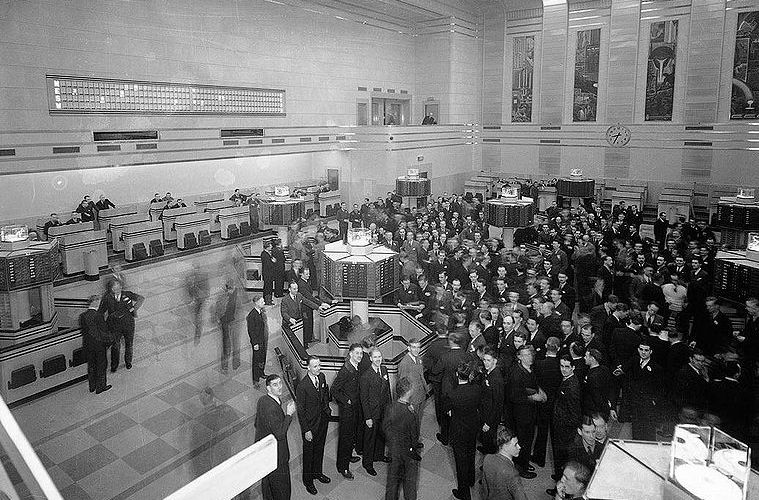
(Originally written March 2020)
Subscribe Now to My FREE Newsletter (Join 5,000+ Subscribers!)
I’m hearing some chatter from the “bears” out there (esp. on Twitter) that we’ll soon be facing more significant draw-downs in the stock market throughout 2020 due to COVID-19, and that the experience will mirror the carnage from the Great Depression.
That’s just wrong. It won’t even be close.
The Great Depression was a different beast.
From peak to trough, the Great Depression draw-down in the Dow Jones Industrial Average was -90%. Basically, everything was on the verge of going to zero.
(Get ready for my amateur charting skills…)
The Great Depression (1929 – 1932)

Some people are pointing to the first leg of the decline from the Great Depression (-50% ; see first circle in chart above), saying this is what we’re seeing now in March 2020, and that we have much further to fall after the recent “relief rally” that saw +20% gains from lows.
Those same people are also referencing this Boom/Bust Cycle chart below, saying with utmost confidence that we’re still currently at the “Return to normal” point near the top, and not near the point of greatest “Despair”. That’s plain wrong. These are very misguided people. We’re not heading into a multi-year period of slow death in the stock market.

Sure, we might fall further from here. But it won’t be a significant fall. No way.
Back to the Great Depression…
Why was it so bad from 1929 – 1932 (-90% Draw-down)?
In hindsight, it’s simple. The Federal Reserve at the time did not increase the monetary base, and by not injecting liquidity into the banking system to prevent it from crumbling, it passively watched the economy completely implode starting in 1929. Really terrible.
In the US:
– One third of all Banks shuttered (e.g. New York Bank of United States).
– There were rampant bank-runs.
– Loans were called en masse.
– GDP declined by 30%.
– Industrial production fell by nearly 47%.
– International trade fell by more than 50%.
– Unemployment rose to 23% and in some countries rose as high as 33%.
– Farming communities and rural areas suffered as crop prices fell by about 60%.
It was bad.
It was systemic.
Some historians say that the economy didn’t really recover until after WWII, from the resulting “baby-boom” and family formation throughout the Western World.
The late Economist Milton Friedman argued that the downward turn in the economy, starting with the stock market crash in 1929, would merely have been an ordinary recession if the Federal Reserve had taken aggressive action.
This view was endorsed by Federal Reserve Chairman Ben Bernanke (2006-2014), who was in office throughout the Financial Crisis of 2008, in a speech honouring Friedman:
Let me end my talk by abusing slightly my status as an official representative of the Federal Reserve. I would like to say to Milton…: Regarding the Great Depression, you’re right. We did it. We’re very sorry. But thanks to you, we won’t do it again.
— Ben S. Bernanke
Subscribe Now to My FREE Newsletter (Join 5,000+ Subscribers!)
So, when you compare today to the Great Depression, really — there is no comparison.
Today – the Federal Reserve has committed UNLIMITED Quantitative Easing (QE), combined with cutting the interest rate down to 0%. Further, the US Government recently passed $2 Trillion in stimulus. Similar efforts are being made around the world (see my earlier post for all documented stimulus packages). For those of you like me who are in Canada, the Central Bank of Canada cut its interest rate down to 0.25% (March 27, 2020), and the Canadian Government launched a $107B stimulus package.
OK – with that out of the way, I think our recovery will look more like that from 1987 (“Black Monday”) or from 2007/2008 (“Financial Crisis”). Probably a mixture of both.
Here are those charts below, along with today’s current chart (2020).
Financial Crisis (2007/2008)

The US certainly learned its lesson from the Great Depression. The first circled bottom above is when the massive $700B Troubled Asset Relief Program (TARP) was passed by Congress and signed into law by President George Bush on October 3, 2008. Around that same time, the Federal Reserve used its independent authority to spend $1.2 trillion on purchasing various financial assets and making emergency loans to address the financial crisis, above-and-beyond the $700B authorized by Congress from the federal budget. The Federal Reserve also cut its key interest rate to a range of between zero percent and 0.25%.
Yes – the market fell further up until the March 2009 nadir, after the stimulus/relief actions were launched. That’s also a possibility today. However, it didn’t fall much further from there.
Black Monday (1987)

Subscribe Now to My FREE Newsletter (Join 5,000+ Subscribers!)
The first circled bottom above is when on October 20, 1987, Fed Chairman Alan Greenspan made this statement: “The Federal Reserve, consistent with its responsibilities as the Nation’s central bank, affirmed today its readiness to serve as a source of liquidity to support the economic and financial system”. The Fed then acted to provide market liquidity and prevent the crisis from expanding into other markets. It immediately began injecting its reserves into the financial system via purchases on the open market. This rapidly pushed the federal funds rate down by 0.5%. The Fed continued its expansive open market purchases of securities for weeks.
And again, yes – the market fell after a relief rally, but retested its lows before the year was done, and then rallied into 1988. In fact, that rally turned into an incredibly long bull market.
COVID-19 Pandemic (2020)

Here we are today; March 27, 2020. Around -25% from highs, after a much-needed “relief rally”. Nobody knows exactly where the market will go from here in the short term. I especially don’t know where it’ll go tomorrow, next week, next month, or even next year (I wish!). What I do know, however, is that this is no Great Depression. Faaaaaar from it.
Wait, though. You might be thinking, “so what – COVID-19 cases are still on the rise…markets will keep falling”. That might be true… to a point. This virus is a tragic thing. I don’t want to seem insensitive here…. But the stock market will recover before COVID-19 cases peak. That’s just how the stock market works. And the spread has happened in phases; starting in Asia, then affecting Europe, and now North America.
We’ll get through this soon, saving as many people along the way.
At the end of the day – it’s impossible to time the market.
Some people dip in and out during crashes.
Or they sell-out, and just sit on the sidelines .
That’s not the smart thing to do.
Here’s why:
If you sell and are still on the sidelines during a recovery, it can be difficult to catch up. Missing even a few of the best days in the market can significantly undermine your performance.
I’ve posted below a visual (Growth of $10,000 invested on January 1, 1980) of what I’m talking about, courtesy of Fidelity.
Its shows that you lose out by missing the best days in the market, which are usually clustered around very large draw-down periods in the stock market, like the one we’re currently experiencing most recently in 2020 due to COVID-19.
Subscribe Now to My FREE Newsletter (Join 5,000+ Subscribers!)

Don’t believe me? OK – let’s go further back… to 1930
Looking at data going back to 1930, Bank of America found that if an investor missed the S&P 500′s 10 best days in each decade, total returns would be just 91%, significantly below the 14,962% return for investors who held steady through the downturns.
Bank of America noted this eye-popping stat while urging investors to “avoid panic selling,” pointing out that the “best days generally follow the worst days for stocks.”
Morale of the story: stay invested in quality stocks in the stock market; don’t miss out on (or abruptly stop) the long-term magic of compounding; and avoid panic selling unless you really need the money for an emergency.
Finally, following up on my comment about about bearish chatter (esp. on Twitter), it never really helps to listen to what’s being discussed out there. What’s important is your own independent research in the companies that you care about, and your own frame of mind.
It’s easy to sell when you see people talking about how bad it can get. There’s such thing as “Perma-Bears” out there – people who are always cautious, and sit on the sidelines throughout every bull market known to man. Don’t let these people influence you.
Have a great weekend everyone, and be well
Subscribe Now to My FREE Newsletter (Join 5,000+ Subscribers!)
 Robin R. Speziale